ASUS Ascent GX10 NVIDIA GB10 Grace Blackwell Superchip Compact Desktop AI Workstation
Regular Price:৳0.00Availability: SKU: 2.101.13.9142
Quick Overview
-
Support
Saturday – Thursday: 09 AM - 06 PM. -
Payment
Cash on Delivery | Card | Online Payment -
Shipping Cost
Inside Dhaka 100tk | Outside Dhaka 150tk -
Warranty Policy
Read More
Description
ASUS Ascent GX10 NVIDIA GB10 Grace Blackwell Superchip Compact Desktop AI Workstation Price in Bangladesh
The ASUS Ascent GX10 NVIDIA GB10 Grace Blackwell Superchip Compact Desktop AI Workstation is a powerful, ultra‑compact AI system designed for next‑generation edge inference, on‑premise AI services, and advanced data science workloads. Built around NVIDIA’s DGX platform and powered by the NVIDIA GB10 Grace Blackwell Superchip, this workstation delivers data‑center‑class AI capability in a 150 x 150 x 51 mm chassis that weighs just 1.48 kg.
At its core, the ASUS Ascent GX10 uses the NVIDIA GB10 Grace Blackwell Superchip with an ARM v9.2‑A CPU architecture. The CPU portion consists of 20 cores split into dual 10‑core clusters: 10 Cortex‑X925 performance cores and 10 Cortex‑A725 efficiency cores. This asymmetric design gives you high single‑thread performance when needed, alongside efficient multi‑threaded throughput for background tasks and services. For AI workloads in Bangladesh—such as running local LLM inference, microservices, or API endpoints—this CPU design ensures the system stays responsive even under load.
On the GPU side, the integrated NVIDIA Blackwell GPU features 6,144 CUDA cores and up to 1,000 TOPS of NVFP4 performance. Combined with the stated AI tensor performance of 1 petaFLOP (FP4, sparse), the ASUS Ascent GX10 is built to accelerate modern AI models and generative AI workloads with impressive speed. FP4 and sparsity optimizations are particularly useful for large language models, recommendation systems, and other transformer‑based architectures that can exploit low‑precision formats while maintaining accuracy.
The ASUS Ascent GX10 sits within the NVIDIA DGX platform ecosystem, running NVIDIA DGX Base OS alongside Ubuntu Linux. For Bangladesh‑based developers, this means you get a ready‑for‑AI environment straight out of the box, tuned to work with the NVIDIA software stack—CUDA, cuDNN, TensorRT, and the broader DGX tooling. If you are building or deploying AI applications in Python with PyTorch or TensorFlow, or using containerized workflows with Docker, the DGX Base OS integration simplifies driver and stack compatibility.
Memory and storage are generous for such a compact system. The ASUS Ascent GX10 provides 128GB of LPDDR5X coherent unified system memory. This unified memory architecture allows CPU and GPU to share the same high‑speed memory pool, reducing data copies and improving efficiency for many AI and data workflows. For Bangladesh AI startups, research labs, and teams working with medium‑sized models and datasets, 128GB unified memory is a major advantage over typical small‑form‑factor PCs.
Storage is handled by a 4TB NVMe M.2 SSD with self‑encryption. NVMe ensures very high sequential and random I/O, which is crucial when loading models, handling batches of data, or streaming video and sensor feeds. The self‑encryption capability helps protect sensitive data at rest, which matters for banks, healthcare providers, and regulated industries in Bangladesh that must manage data security and compliance.
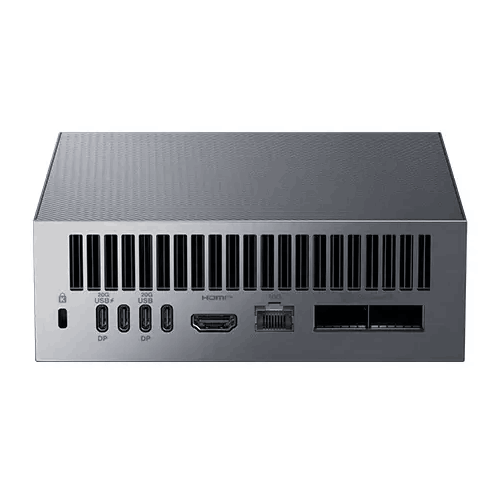
As a compact desktop AI workstation, I/O and connectivity are especially important. The ASUS Ascent GX10 is well‑equipped on this front:
- Graphics output: 1 x HDMI 2.1
- High‑speed I/O: 3 x USB 3.2 Gen 2x2 Type‑C (20 Gbps, alternate mode DisplayPort 2.1)
- Power input: 1 x USB 3.2 Gen 2x2 Type‑C with PD in (up to 240W, 48V/5A, USB‑C PD 3.1 EPR)
- Networking: 1 x NVIDIA ConnectX‑7 SmartNIC, 1 x 10G LAN
- Wireless: AW‑EM637 Wi‑Fi 7 (802.11be) triple band 2x2, Bluetooth 5.4
- Security: Onboard TPM, Kensington lock
For Bangladeshi offices, labs, and edge deployments, this combination enables extremely flexible use cases. The NVIDIA ConnectX‑7 SmartNIC and 10G Ethernet offer low‑latency, high‑throughput networking ideal for AI microservices, edge aggregation nodes, or as a compact inference server sitting close to data sources. Wi‑Fi 7 and Bluetooth 5.4 ensure cutting‑edge wireless connectivity for modern networks and peripherals.
The system is powered by up to 240W via USB‑C PD 3.1 EPR, supporting up to 48V/5A input. This is a remarkable design choice: the entire AI workstation runs from high‑power USB‑C, simplifying deployment in tight spaces and non‑traditional environments. In Bangladesh, where rack space or dedicated server power might be limited, being able to deploy a powerful AI node using standard power and compact infrastructure is a real advantage.
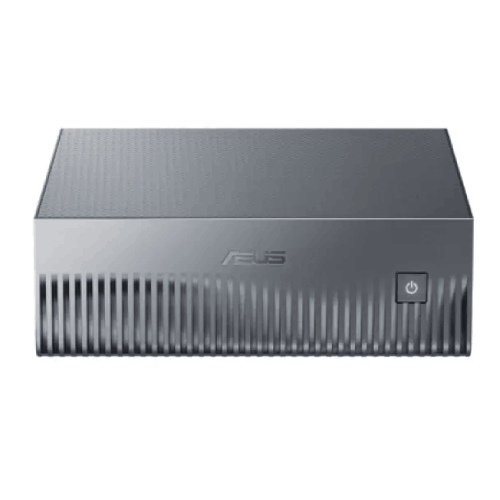
Physically, the ASUS Ascent GX10 is finished in Stellar Grey and measures just 150 x 150 x 51 mm, with a weight of 1.48 kg. This small footprint makes it ideal for crowded offices, retail environments, industrial settings, hospital IT rooms, or anywhere space is at a premium. The workstation carries wide‑ranging certifications (BSMI/CB/CE/FCC/UL/CCC/C‑Tick/WiFi/RF/VCCI), indicating compliance with international safety and RF standards—important for corporate and institutional deployments in Bangladesh.
The ASUS Ascent GX10 is positioned as a “Compact Desktop AI Workstation” rather than a generic mini PC. That means it is targeted at:
- AI inference servers for LLMs and chatbots running on‑premise.
- Compact edge AI boxes for processing sensor data, video streams, or IoT information.
- Local AI development stations for teams that need to experiment and iterate without relying on remote GPUs.
- Specialized micro data‑center nodes that extend a company’s AI infrastructure closer to the data.
Example Bangladesh‑specific scenarios include:
- A bank in Dhaka running on‑premise fraud detection or credit‑risk models near its core infrastructure.
- A hospital or diagnostic centre processing imaging data locally to preserve patient privacy while using AI to assist diagnosis.
- A retail chain using AI for real‑time video analytics (footfall, queue detection, shelf analysis) at store level with backhaul only of insights, not raw video.
- A software startup in Banani or Mohakhali developing and serving an AI‑powered SaaS, using the ASUS Ascent GX10 as a core inference node.
- A university lab in Chattogram using the compact workstation as a teaching and research platform for modern AI curricula.
Security and manageability are also addressed. With an onboard TPM and support for modern Linux (Ubuntu) plus NVIDIA’s DGX Base OS, organizations can integrate the ASUS Ascent GX10 into existing security policies, SSH‑based admin workflows, and container orchestration setups. The Kensington lock support helps deter physical theft in open lab or office spaces.
Because this is an ARM‑based Grace Blackwell Superchip, software teams in Bangladesh will mainly target Linux and CUDA‑enabled toolchains tuned for ARM v9.2‑A. Developers who are already familiar with Linux, Docker, Kubernetes, and Python‑based ML ecosystems will find this environment natural to work in. The advantage is a highly efficient, tightly integrated CPU‑GPU memory subsystem for AI.
For deployment, key considerations include:
- Proper network connectivity (10G LAN or faster where needed).
- Adequate ventilation around the small chassis, even though power draw is modest compared to rack servers.
- A reliable power environment for the USB‑C PD 3.1 EPR input, ideally backed by a UPS.
- Integration with monitoring and logging tools to observe GPU/CPU utilization and thermals.
In summary, the ASUS Ascent GX10 NVIDIA GB10 Grace Blackwell Superchip Compact Desktop AI Workstation is a highly specialized, extremely compact AI workstation that brings NVIDIA DGX‑class software integration, Grace Blackwell compute, strong networking, and large unified memory into a tiny physical footprint. It is particularly suitable for Bangladesh organizations looking for edge AI, local inference, and compact AI development nodes without the complexity of full racks or heavy servers.
✅ Key Features
- NVIDIA GB10 Grace Blackwell Superchip: ARM v9.2‑A CPU with 20 cores (10 Cortex‑X925 performance + 10 Cortex‑A725 efficiency) tightly integrated with NVIDIA Blackwell GPU.
- Integrated Blackwell GPU with 6,144 CUDA Cores: Up to 1,000 TOPS NVFP4 and 1 petaFLOP AI performance (FP4, sparse) for fast AI inference and model workloads.
- 128GB LPDDR5X Unified Memory: Coherent unified system memory shared between CPU and GPU for efficient AI and data operations.
- 4TB NVMe M.2 Self‑Encrypting Storage: High‑speed, secure local storage for models, datasets, and logs.
- NVIDIA DGX Platform & DGX Base OS: Pre‑aligned with NVIDIA’s enterprise AI stack, running Ubuntu Linux for developer‑friendly workflows.
- Advanced Networking: NVIDIA ConnectX‑7 SmartNIC and 10G Ethernet for low‑latency, high‑bandwidth data center and edge connectivity.
- Next‑Gen Connectivity: Wi‑Fi 7 (802.11be), Bluetooth 5.4, multiple USB 3.2 Gen 2x2 Type‑C ports with DisplayPort 2.1 alt mode and 240W USB‑C PD 3.1 EPR power input.
- Ultra‑Compact Design: 150 x 150 x 51 mm, 1.48 kg Stellar Grey chassis with broad international certifications.
✅ Usage / Applications
- On‑Premise LLM & Chatbot Inference: Run language models locally to power chatbots and assistants without sending data to external clouds.
- Edge AI & Video Analytics: Deploy in retail, industrial, or smart‑city scenarios for processing camera feeds and sensor data on‑site.
- AI Microservices & APIs: Host AI‑powered APIs for SaaS products, mobile apps, or enterprise systems from within your Bangladesh office or data center.
- Data Science & ML Experimentation: Use as a local training and experimentation node for researchers and data scientists.
- Healthcare & Finance AI: Process sensitive data—such as medical images or transaction records—locally with strong security and fast response.
- 3D & Visualization Support: Accelerate GPU‑enabled rendering or scientific visualization tasks that fit within the unified memory footprint.
- Education & Research Labs: Provide students and researchers with hands‑on access to modern AI hardware and DGX‑style software stacks.
- Compact AI Edge Nodes: Integrate the ASUS Ascent GX10 into distributed AI systems where space, power, and latency matter.
✅ Benefits of This Product?
- High AI Performance in a Tiny Footprint: Achieve 1 petaFLOP FP4 AI performance in a 150 x 150 x 51 mm device, ideal for tight spaces and edge deployments.
- Reduced Dependence on Cloud GPUs: Run AI inference and moderate training locally in Bangladesh, lowering cloud bills and improving latency.
- Unified Memory for Efficient Workflows: 128GB LPDDR5X unified memory simplifies development and enables larger models than typical small form factor PCs.
- Enterprise‑Grade I/O & Networking: ConnectX‑7 SmartNIC, 10G LAN, and Wi‑Fi 7 give you flexible, high‑performance networking options.
- Security‑Focused Design: Self‑encrypting storage, onboard TPM, and Kensington lock support help protect data and hardware.
- Developer‑Friendly Linux Environment: DGX Base OS with Ubuntu Linux aligns with common ML, MLOps, and DevOps tooling.
- Energy‑Efficient AI Node: Up to 240W USB‑C PD power makes it much more efficient and easier to power than full‑size AI servers.
✅ Ideal For
The ASUS Ascent GX10 NVIDIA GB10 Grace Blackwell Superchip Compact Desktop AI Workstation is ideal for forward‑thinking organizations and teams in Bangladesh who need powerful AI compute without traditional server complexity. AI‑driven startups can use it as the backbone of their inference stack or as a compact development station that fits on a desk. Banks, telecoms, and large enterprises can deploy multiple units as edge AI nodes for fraud detection, customer analytics, or operational intelligence, keeping data within their own networks.
Hospitals, diagnostic centres, and healthcare IT teams can place the ASUS Ascent GX10 close to imaging systems or hospital information systems to run AI models on sensitive patient data locally. Universities and research institutions in Dhaka, Chattogram, Sylhet, and other cities can deploy the GX10 as a shared AI platform for labs and courses, giving students access to modern, Grace Blackwell‑based hardware. For any organization that values on‑premise AI, low latency, data privacy, and compact deployment, the ASUS Ascent GX10 is a highly attractive option.
✅ Why Choose the ASUS Ascent GX10 NVIDIA GB10 Grace Blackwell Superchip Compact Desktop AI Workstation?
Choosing the ASUS Ascent GX10 means embracing a new class of compact, high‑efficiency AI workstation that merges NVIDIA’s Grace Blackwell Superchip technology with ASUS’s system design. Instead of relying solely on large, power‑hungry servers or external cloud instances, you get a device that delivers serious AI performance—1 petaFLOP FP4, up to 1,000 TOPS NVFP4, 6,144 CUDA cores—in a form factor small enough to sit on a desk or shelf.
The unified 128GB LPDDR5X memory and 4TB NVMe self‑encrypting storage enable ambitious AI projects while simplifying data management. The NVIDIA DGX Base OS and Ubuntu Linux stack mean you are working within an environment tuned for CUDA, cuDNN, TensorRT, and modern AI frameworks. For teams in Bangladesh who want to iterate quickly on models, deploy inference endpoints with low latency, or test new AI‑powered services, this acceleration and consistency are major advantages.
The ASUS Ascent GX10 is also about practicality. USB‑C PD 3.1 EPR power, Wi‑Fi 7, 10G LAN, and ConnectX‑7 SmartNIC give you versatile deployment options in offices, labs, or micro data centers. Its rich certifications and security features support enterprise standards. Overall, if you need strong AI capability packed into a sleek, compact, and efficient workstation that fits real‑world Bangladesh constraints, the ASUS Ascent GX10 is a compelling choice.
✅ Why Buy This Product from BME?
BME is a Bangladesh‑based specialist in IT and professional equipment, making it a strong partner for acquiring the ASUS Ascent GX10 NVIDIA GB10 Grace Blackwell Superchip Compact Desktop AI Workstation. When you buy from BME, you’re working with a local reseller who understands AI workstations, networking, storage, and the practical realities of deploying such systems in Bangladeshi offices, labs, and data centers.
BME can help you plan a complete solution around the ASUS Ascent GX10, including 10G switches, structured cabling, UPS units, secure racks or shelves, and appropriate displays or KVM setups. For startups, universities, and enterprises across Dhaka, Chattogram, Sylhet, Khulna, and beyond, this integrated approach simplifies rollout and ongoing operations.
Warranty and after‑sales support follow ASUS and official distributor policies in Bangladesh. BME can guide you through registration, RMA procedures, and support contacts if hardware issues arise. By sourcing the ASUS Ascent GX10 from BME rather than an unknown importer, you reduce the risk of grey‑market units and ensure a clearer path to help when it is needed. For a compact but advanced AI workstation like this, that local expertise and support are key components of the overall value.
✅ Buying Guide
- Clarify Workload Profile: Identify whether you’ll primarily run inference (LLMs, chatbots, vision models), moderate training, or mixed workloads. This shapes how you allocate access and capacity.
- Plan Network Integration: Leverage the 10G LAN and NVIDIA ConnectX‑7 SmartNIC by connecting the GX10 to a robust switch. For multi‑user or API workloads, network quality is critical.
- Consider Placement & Cooling: Despite its compact size and efficient design, ensure the ASUS Ascent GX10 has enough airflow around it and sits in a reasonably cool, dust‑free area.
- Power & UPS: Use a stable power source for the USB‑C PD 3.1 EPR input and consider a UPS to protect against voltage drops or outages common in some parts of Bangladesh.
- Integrate with Dev & MLOps Tools: Prepare your software stack—Docker, Kubernetes (if used), CI/CD, and ML frameworks—to leverage the DGX Base OS and CUDA environment.
- Access Control & Security: Use the onboard TPM and Linux user management to set up proper access policies. Secure physical placement and use the Kensington lock where applicable.
- Data Management Strategy: Plan how models and datasets are stored, backed up, and rotated on the 4TB NVMe drive, including off‑box backups for resilience.
- Multi‑User Sharing: Decide if the box will be accessed via SSH, remote desktop, JupyterHub, or job queues, and configure permissions accordingly.
- Monitoring & Logging: Implement monitoring tools (such as Prometheus, Grafana, or NVIDIA‑specific utilities) to watch utilization, temperatures, and performance over time.
- Consult BME for Ecosystem Components: Discuss with BME to ensure your network, UPS, and environment are aligned with best practices for this kind of AI node.
✅ Customers Ask About / Frequently Asked Questions
Q1: What is the ASUS Ascent GX10 mainly used for?
A1: It is designed for compact, on‑premise AI workloads—LLM and chatbot inference, computer vision, data science, edge AI, and other GPU‑accelerated tasks—using NVIDIA’s Grace Blackwell GB10 Superchip.
Q2: Can it replace a full‑size AI server in Bangladesh?
A2: For many inference and moderate training workloads, yes. It won’t match huge multi‑GPU servers, but it offers excellent AI performance in a much smaller, lower‑power form factor.
Q3: Does it run Windows?
A3: It ships with NVIDIA DGX Base OS and Ubuntu Linux. It is intended primarily for Linux‑based AI and data‑science workflows.
Q4: How many users can share the ASUS Ascent GX10?
A4: Multiple users can share it via SSH, containers, or job schedulers. The actual number depends on your workload intensity and how you manage resource allocation.
Q5: Is 128GB unified memory enough for modern AI models?
A5: Yes, for many LLMs, vision models, and data workflows, 128GB unified memory is very generous, especially in a compact workstation. Extremely large models may still require partitioning or more specialized hardware.
Q6: Can this workstation be used in a small office or retail outlet in Bangladesh?
A6: Absolutely. Its compact design and USB‑C power make it ideal for small offices, retail outlets, or branch locations where space and infrastructure are limited.
Q7: Does it support Wi‑Fi out of the box?
A7: Yes. It includes AW‑EM637 Wi‑Fi 7 (802.11be) triple‑band 2x2 and Bluetooth 5.4 for modern wireless connectivity.
Q8: How secure is data on the ASUS Ascent GX10?
A8: It features self‑encrypting NVMe storage and an onboard TPM, and you can harden the Linux environment with your own security policies, making it well‑suited for handling sensitive data locally.
Q9: Can BME help with installation and initial setup?
A9: BME can advise on basic setup, environment requirements, and complementary infrastructure. For full solution design or advanced configuration, discuss your project needs directly with them.
Q10: How do we purchase the ASUS Ascent GX10 in Bangladesh?
A10: Contact BME or visit their website, search for the ASUS Ascent GX10 NVIDIA GB10 Grace Blackwell Superchip Compact Desktop AI Workstation, review availability, and proceed with a quotation or order.
✅ Why Buy This Product
The ASUS Ascent GX10 NVIDIA GB10 Grace Blackwell Superchip Compact Desktop AI Workstation delivers serious AI capability—1 petaFLOP FP4 performance, 6,144 CUDA cores, 128GB unified LPDDR5X memory, and 4TB secure NVMe storage—in a remarkably small and efficient form factor. For businesses, startups, universities, and labs in Bangladesh, it provides a practical way to bring NVIDIA DGX‑class AI software integration and Grace Blackwell hardware into offices, branches, stores, or labs without needing a full server room.
By purchasing the ASUS Ascent GX10 from BME and integrating it with proper networking, power protection, and IT processes, you gain a compact but powerful AI node that can accelerate inference, experimentation, and small‑to‑medium training workloads while keeping your data local and secure. If you are serious about AI but need a solution that respects space, power, and operational constraints in the Bangladesh context, this workstation is a highly compelling option.
What is the price of ASUS Ascent GX10 NVIDIA GB10 Grace Blackwell Superchip Compact Desktop AI Workstation in Bangladesh?
Write a review
Question Answer
Have question about this product? Get specific details about this product from expert.