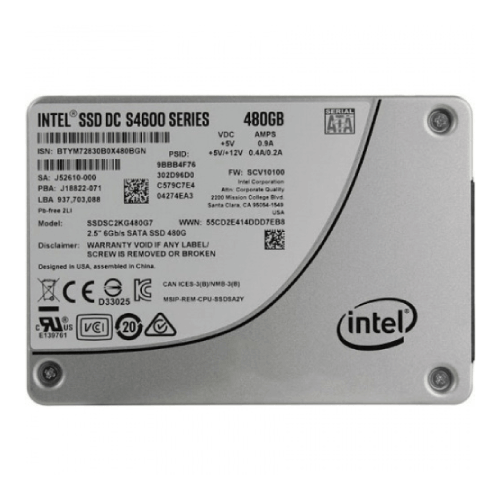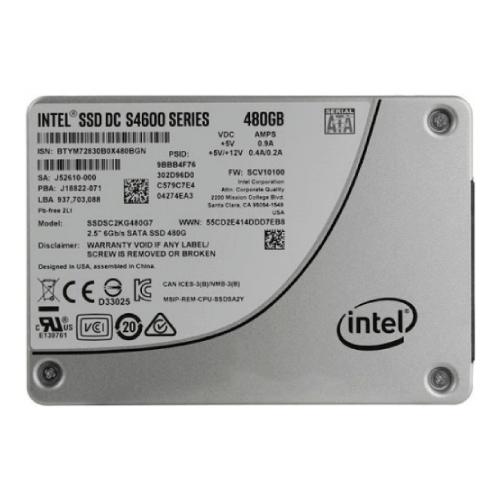
Intel S4600 480GB SATA 2.5" Server SSD
Regular Price:৳0.00Availability: SKU: 9.63.91.9401
Quick Overview
-
Support
Saturday – Thursday: 09 AM - 06 PM. -
Payment
Cash on Delivery | Card | Online Payment -
Shipping Cost
Inside Dhaka 100tk | Outside Dhaka 150tk -
Warranty Policy
Read More
Description
Intel S4600 480GB SATA 2.5" Server SSD in Bangladesh
The Intel S4600 480GB SATA 2.5" Server SSD is an enterprise-class solid-state drive designed for servers and datacentres—not for casual desktop use. It sits in Intel’s datacenter SSD line (often referred to as the Intel DC S4600 series), built to handle 24/7 workloads, higher write endurance, and consistent performance under stress.
If you’re running VMware, Hyper-V, KVM, container hosts, or critical applications on Dell, HPE, Lenovo, Supermicro or similar servers in Bangladesh, you’ve likely seen that throwing more CPU and RAM at a system doesn’t always cure slowness. Disk I/O is often the bottleneck. Swapping spinning HDDs for an Intel S4600 480GB server SSD is one of the most effective ways to bring latency down, make systems feel snappy, and reduce complaints from end users.
This drive is especially well suited for:
OS and boot volumes on your hypervisors and application servers,
Small to mid-sized databases,
Logging and caching layers,
“Hot” data sets that benefit from SSD speed while bulk archives stay on HDDs.
The Intel S4600 480GB SATA 2.5" Server SSD is about stable, predictable performance in real-world server roles, not just impressive benchmarks in a lab.
Enterprise SSD vs Consumer SSD – Why the Intel S4600 Matters
It’s easy to see “480GB SSD” and think of any SATA SSD on the market. But the Intel S4600 480GB is a datacenter/enterprise SSD:
Workload Endurance:
Designed to handle higher drive writes per day (DWPD) under continuous use,
Suited to mixed read/write workloads typical for OS + applications, small DB volumes and VM datastores.
Power-Loss Protection (PLP) (as implemented in Intel DC series – specifics from datasheet):
Enterprise SSDs usually include mechanisms to protect in-flight data during sudden power loss,
This helps avoid data corruption that consumer drives are more prone to in server environments.
Consistent Latency:
Firmware is tuned for consistent IO under heavy queue depths and simultaneous accesses,
Desktop SSDs often show variable behaviour when hammered by multiple threads and workloads.
Validation & Integration:
Enterprise drives are validated with major OEM servers and RAID controllers,
Intel S4600 series has been widely deployed in datacentres around the world.
For Bangladesh-based IT teams, using an SSD like the Intel S4600 480GB SATA 2.5" Server SSD instead of a consumer unit means:
Less risk of early drive wear-out in servers,
Better behaviour under true 24/7 conditions,
Simpler conversations with hardware vendors and support teams (they recognise Intel DC drives as appropriate in servers).
480GB Capacity – Ideal for OS, Hypervisor & Hot Data Volumes
At 480GB, the Intel S4600 provides a capacity sweet spot for many server roles:
System and Boot Volumes:
Hypervisors (ESXi, Hyper-V, Proxmox, etc.),
Linux or Windows server operating systems,
System logs, swap and temp data.
Application Volumes:
Web servers and app servers (IIS, Apache/Nginx, Tomcat, Node.js stacks),
Middleware or microservices that keep critical binaries and configs on SSD.
Databases & Key-Value Stores:
Mid-sized SQL or NoSQL datastores,
Small OLTP databases or heavy read caching layers.
In Bangladesh, common patterns include:
Using one or two Intel S4600 480GB SSDs in RAID 1 for OS and critical apps, while keeping bulk data on HDD RAID groups,
Building a compact, all-SSD virtualisation node for small offices, where a pair or quartet of these drives provide both OS and VM storage,
Hosting branch office or departmental services (AD/LDAP, file sync, line-of-business apps) on systems where 480GB is more than enough.
Instead of oversizing HDD capacity for system volumes, you strategically deploy SSD where it yields the maximum benefit.
SATA III 6Gbps – Broad Compatibility, Easy Integration
The Intel S4600 480GB uses a SATA III (6Gbps) interface in a 2.5-inch form factor:
Almost all contemporary servers include support for 2.5" SATA slots somewhere in their storage design,
Controllers and backplanes that handle SATA HDDs usually handle SATA SSDs with minimal, if any, changes,
SATA bandwidth (6Gbps) is more than adequate for most server SSD workloads at this level.
This means:
You can install Intel S4600 480GB SSDs in existing 2.5" SATA bays on your rack or tower servers,
In many cases, it’s a drop-in replacement for 2.5" server HDDs, giving an immediate benefit in boot times and IO response,
Hybrid systems (SSD + HDD) become easy to design:
SSDs (Intel S4600) for OS/boot/DB,
HDDs for logs, archives and cold data.
For Bangladeshi environments where budgets are tight and hardware refresh cycles are long, the ability to upgrade storage performance via SATA SSDs without re-architecting your platform is a major plus.
24/7 Server Workloads – Designed for Continuous Duty
The Intel S4600 480GB SATA 2.5" Server SSD is built for continuous, 24x7x365 operation typical in datacentres and serious server rooms:
Boot drives on hypervisors and application servers do not get to “rest” in the way desktop machines do,
Logging, patching, metric collection and backup agents continuously write to disk,
Under these conditions, enterprise SSDs are much less likely to degrade rapidly than consumer-grade devices.
Bangladesh adds extra layers of challenge:
Heat and humidity can be high if server rooms aren’t cooled properly,
Power may be unstable despite UPS and generator mitigation,
Servers may be kept running for many years beyond their original planned lifecycle.
A drive like the Intel S4600 480GB is meant to cope better with those realities, assuming basic best practices (cooling, power conditioning, monitoring) are followed.
How It Improves Real-World Performance in Bangladesh
Database/ERP/Accounting Backends
If your core accounting or ERP DB currently lives on a 10K SAS HDD or even 7.2K drive, moving that DB or its logs to the Intel S4600 480GB SSD can reduce latency significantly,
End users see faster screen updates, reports, and data entry responses,
Busy end-of-month processing or seasonal spikes are handled more gracefully.
Virtualisation Hosts (VMware/Hyper-V/KVM)
Install the hypervisor and its boot volume on a RAID 1 of Intel S4600 SSDs to ensure quick boot, patching and consistent host-level performance,
Use them as local datastores for critical VMs if central SAN/NAS is not available or is slower,
Reduce the risk of host performance dips caused by spinning disks struggling under VM IO.
Web and Application Servers
Use S4600 SSDs for web content, app binaries and caches to:
Speed up page serving,
Support more concurrent users,
Improve resilience under traffic spikes from Bangladesh or overseas customers.
Monitoring, Logging and SIEM
Store logs and hot indexes on SSD:
Ingest operations remain smooth even during surges (e.g., DoS attempts, unusual event storms),
Search queries over logs become faster for security teams and admins.
Reliability & Data Protection Features (General Class Behaviour)
Without listing unconfirmed stats, enterprise SSDs in Intel’s S4600 family commonly feature:
Power-loss protection components to reduce risk of data loss during sudden outages,
Advanced error correction and end-to-end data protection,
Peripheral features like thermal monitoring to manage wear and reliability.
In Bangladesh, where power outages are common (even with UPS), such features complement your existing power protection:
Minimising file system corruption during brownouts,
Reducing the chance of losing critical writes during sudden server resets or generator switchover events.
This doesn’t replace the need for backups and replication, but it lowers day-to-day operational risk.
Maintenance & Best Practices
To get the best from the Intel S4600 480GB SATA 2.5" Server SSD:
Maintain good cooling and airflow in your server racks, especially if you mix SSDs and hotter HDDs,
Use proper RAID and redundancy:
RAID 1 for OS volumes (two SSDs mirrored),
RAID 5/6/10 for SSD datastores where appropriate,
Monitor health attributes via:
RAID controller tools,
OS-level tools,
IPMI/ILO/iDRAC-style management consoles where SSD stats are surfaced,
Replace drives approaching endurance limits proactively, guided by health metrics rather than waiting for a failure,
Always keep backups and DR strategies in place—enterprise SSDs fail less often, but they can still fail.
✅ Key Features
Enterprise SATA SSD: Designed specifically for servers and datacentres, not desktop PCs.
480GB Capacity: Ideal for OS, hypervisor, application and small database volumes.
2.5" Form Factor, SATA 6Gbps: Broad compatibility with server bays and RAID/HBA controllers.
Optimised for 24/7 Use: Built to handle continuous, mixed read/write workloads.
Intel Datacenter Firmware: Focused on consistent performance, robust error handling and endurance.
Performance Boost Over HDD: Significantly improves latency and IOPS compared to spinning disks.
✅ Usage / Applications
Boot and system volumes for VMware, Hyper-V, Proxmox and other hypervisors.
Application servers (web, middleware, line-of-business apps) requiring quick storage.
Databases and transactional systems that can fit within or partially utilise a 480GB SSD tier.
Logging and caching layers, to offload hot data from slower HDD pools.
Small virtualisation clusters in branches or SMB environments.
✅ Benefits of This Product?
Speeds up server OS and applications, reducing perceived slowness for end users.
Improves stability in 24/7 workloads versus using consumer SSDs.
Easy to deploy thanks to standard 2.5" SATA form factor and broad server support.
Helps extend life of existing server investments in Bangladesh by refreshing the storage subsystem.
Supports modern workloads that demand fast random access, such as virtual machines and small databases.
✅ Ideal For
The Intel S4600 480GB SATA 2.5" Server SSD is ideal for:
Enterprises and SMEs in Bangladesh running Dell, HPE, Lenovo or whitebox servers that still boot from HDDs and suffer from slow I/O,
IT admins looking to improve system responsiveness without replacing full server platforms,
Virtualisation hosts that need reliable SSDs for boot volumes or compact datastores,
Database and application owners who’ve identified storage as the bottleneck but don’t yet need or can’t justify all-flash arrays,
Branch and remote office servers where a pair of S4600 SSDs can form a robust, low-maintenance system volume.
If your servers feel “slow” despite plenty of CPU and RAM, this is usually the level of SSD you should be evaluating.
✅ Why Choose the Intel S4600 480GB SATA 2.5" Server SSD?
You choose the Intel S4600 480GB because:
It combines enterprise reliability with SATA simplicity,
It’s part of a well-respected Intel datacenter SSD line used widely across global infrastructures,
It offers a balanced capacity (480GB) for many core server roles,
It avoids the pitfalls of pushing consumer SSDs into workloads they were never designed to handle.
Compared to hard drives:
You get dramatically lower latency,
Fewer complaints about “sluggish servers”,
Better behaviour under concurrent access.
Compared to non-enterprise SSDs:
You significantly reduce risk of early wear, inconsistent performance, and feature gaps that matter in servers (PLP, firmware behaviour, etc.).
In Bangladesh, where IT budgets are real and reliability is critical, the S4600 480GB hits a practical sweet spot.
✅ Why Buy This Product from BME?
Buying the Intel S4600 480GB SATA 2.5" Server SSD from Business Machine & Equipment (BME) gives you:
A high level of confidence in authenticity—BME focuses on genuine enterprise parts, not grey-market SSDs of unknown history,
Access to Bangladesh-aware advice: what role this drive should play in your infrastructure, and how to combine it with HDDs/SSDs in a hybrid design,
Enterprise procurement support with quotations, documentation and invoicing formatted for corporate, telco, banking and government IT processes,
A local partner that can provide product documentation and clarifications to your IT team or system integrator during implementation.
Rather than treating the Intel S4600 as just another SSD, BME helps place it correctly in the bigger puzzle of your datacentre design.
✅ Buying Guide
Before purchasing the Intel S4600 480GB SATA 2.5" Server SSD, consider:
1. Server Bay & Controller Compatibility
Ensure your servers have 2.5" SATA bays and that the RAID/HBA controllers support enterprise SATA SSDs at this capacity.
2. Role Definition
Decide whether the drive will be used for:
OS/boot only,
OS + apps,
Small database volumes,
Cache/log tiers.
3. RAID Planning
For OS volumes, plan on at least RAID 1 (two SSDs mirrored),
For data volumes, plan appropriate RAID 5/6/10 sets and ensure enough spare drives are available.
4. Performance Expectations
SSD is more expensive per GB; use it where IOPS and latency gains matter most,
For colder/archival data, keep or deploy HDD arrays instead.
5. Environment & Power
Ensure server rooms are adequately cooled,
Protect systems with UPS and, for critical sites, generator backup.
6. Backups & DR
Despite high reliability, all storage can fail. Maintain:
Regular backups,
Offsite or DR strategies,
Clear RPO/RTO objectives.
7. Lifecycle & Warranty
Confirm warranty duration with BME,
Track drive deployment dates and plan for gradual replacement.
✅ Customers Ask About / Frequently Asked Questions
Q1: Can I use the Intel S4600 480GB SSD in a desktop PC?
Technically yes (it’s SATA), but it’s overkill and more expensive than consumer SSDs for desktop usage. It is specifically optimised and priced for servers and datacentres.
Q2: Is this SSD hot-swappable?
In server hot-swap SATA bays, yes. Always follow your server and RAID controller guidelines when swapping drives to avoid data loss.
Q3: How many of these SSDs do I need for my server?
It depends on role and redundancy:
For OS only, 2 drives in RAID 1 is common,
For datastores, you may need more; capacity and IOPS requirements will guide this.
Q4: Does it support TRIM or similar optimisation in servers?
Enterprise SSDs like the Intel S4600 typically support TRIM/UNMAP at the controller/OS level when enabled. Confirm with your OS, hypervisor and RAID/HBA configuration.
Q5: Is it safe to mix S4600 SSDs and HDDs in the same RAID?
Generally, mixing SSDs and HDDs in the same RAID set is not recommended; better to use separate RAID groups or tiers.
Q6: Is there warranty coverage via BME?
Yes, in accordance with Intel’s datacenter SSD policies and BME’s arrangements. Ask BME for exact warranty duration and coverage for the S4600 480GB.
Q7: Will this SSD work in my Dell/HPE/Lenovo server?
In most cases, yes, if the server supports 2.5" SATA SSDs. However, always verify compatibility and support stance with your hardware vendor or integrator.
✅ Why Buy This Product
The Intel S4600 480GB SATA 2.5" Server SSD is a dependable way to bring enterprise-class SSD acceleration into your servers and datacentres in Bangladesh. It is:
Powerful enough to make a real difference in performance,
Mature and widely deployed in enterprise contexts,
Easy to integrate via standard 2.5" SATA bays,
Engineered for the 24/7 workload profiles that your servers see.
What is the price of Intel S4600 480GB SATA 2.5" Server SSD in Bangladesh?
Write a review
Question Answer
Have question about this product? Get specific details about this product from expert.


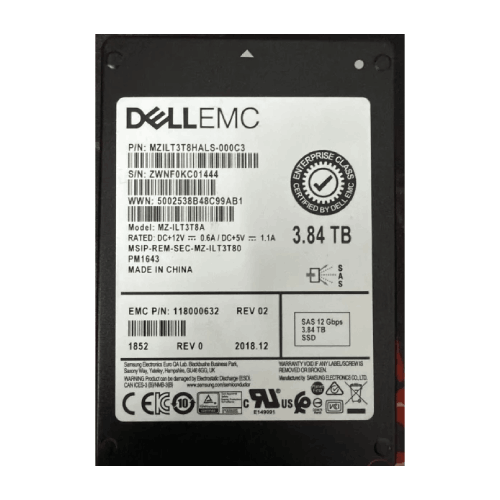
Dell EMC MZ-ILT3T8A 3.84TB 12Gbps SAS SSD