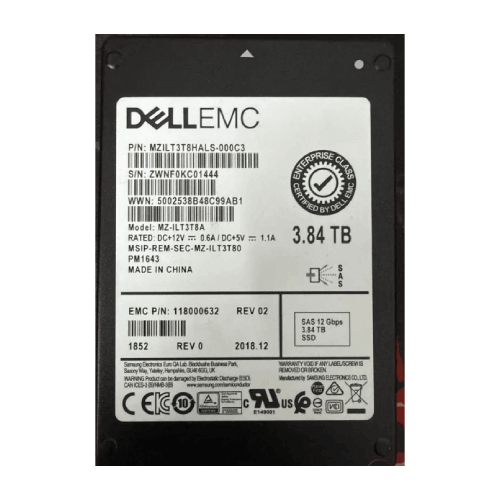
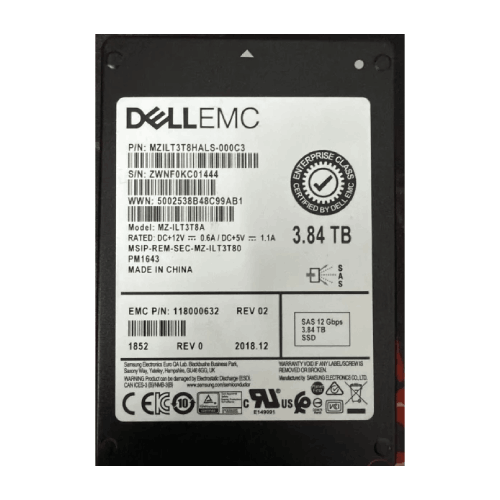
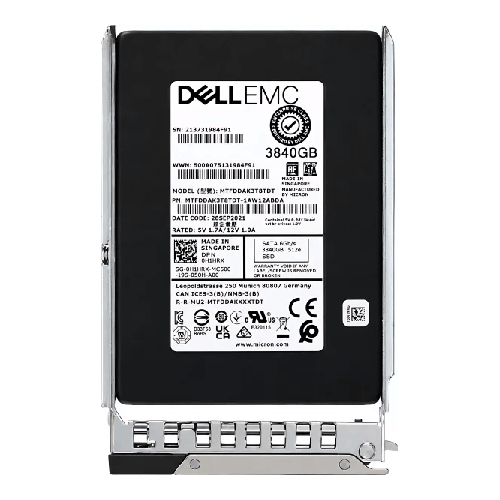
Dell EMC MZ-ILT3T8A 3.84TB 12Gbps SAS SSD
Regular Price:৳112,000.00Availability: SKU: 9.63.4.9395
Quick Overview
-
Support
Saturday – Thursday: 09 AM - 06 PM. -
Payment
Cash on Delivery | Card | Online Payment -
Shipping Cost
Inside Dhaka 100tk | Outside Dhaka 150tk -
Warranty Policy
Read More
Description
Dell EMC MZ-ILT3T8A 3.84TB 12Gbps SAS SSD in Bangladesh
The Dell EMC MZ-ILT3T8A 3.84TB 12Gbps SAS SSD is an enterprise-class solid-state drive designed for organisations in Bangladesh that need fast, reliable, and predictable storage performance in their data centre or server room. This is not a consumer SSD rebranded for servers—it is a 12Gbps SAS drive engineered for continuous, high-intensity workloads like databases, virtualization, VDI, analytics, and critical line-of-business applications.
In a typical Bangladeshi infrastructure environment—whether in a bank’s data centre in Motijheel, an ISP’s server farm in Dhaka, a manufacturing ERP backend in Narayanganj, or a cloud/hosting provider in Mohakhali—the difference between spinning disks and high-quality SAS SSDs can be measured in user satisfaction, transaction throughput, and mean time to recovery. The Dell EMC MZ-ILT3T8A sits exactly in that performance zone: enterprise-grade, hot-plug capable, SAS-interfaced and sized at 3.84TB, which means you can increase capacity and IOPS without expanding your rack footprint.
This SSD is typically used as a part of Dell EMC server/storage systems, but can also be integrated into other SAS-backplane environments that accept its form-factor and interface. It’s designed to work 24/7 under heavy load while maintaining a consistent latency profile—something that generic SSDs often struggle to do when pressed into enterprise roles.
Enterprise-Grade Storage for Real Data Centre Workloads
The first thing that sets the Dell EMC MZ-ILT3T8A 3.84TB 12Gbps SAS SSD apart from consumer products is its SAS interface and enterprise build. SAS (Serial Attached SCSI) at 12Gbps was designed for server and storage use:
Full-duplex communication and dual-port capability (on many SAS SSDs) help improve redundancy and throughput in enterprise controllers,
SAS controllers and backplanes are standard in Dell EMC PowerEdge servers and many storage arrays,
Compared to SATA, SAS offers stronger command queuing, better error detection and correction and is expected to run around the clock.
In Bangladeshi environments where servers are mission critical and cannot be easily shut down:
A Dell EMC SAS SSD is easier to justify to IT leadership than gambling on consumer SSDs,
When properly integrated, SAS disks become part of the existing management and monitoring ecosystem (including Dell’s own management tools),
You can scale I/O performance predictably across multiple drives, RAID groups, or storage pools.
The 3.84TB capacity means each drive adds a significant amount of flash storage to your server or storage node, allowing IT teams to reduce spindle count, shrink arrays, or increase VM density per host.
Why 3.84TB SAS SSD in Bangladesh? Practical Cases
Database and Transaction Systems
Banks, e-commerce companies, ERP-driven manufacturing plants, and telecoms run heavy read/write databases:
If your core OLTP database or core banking system currently runs on 10K/15K HDDs, users see delays during peak times,
Moving hot data (or the entire DB) to the Dell EMC MZ-ILT3T8A improves response time dramatically—tens of milliseconds become a few milliseconds or less,
This better latency helps support more concurrent users, more transactions per second and smoother batch operations.
Virtualization & Private Cloud
For VMware/Hyper-V/KVM environments:
Running many VMs on HDD-backed storage creates “noisy neighbour” problems—one VM’s IO can cause lag for others,
Replacing or augmenting HDDs with 3.84TB SAS SSDs lifts IOPS drastically and flattens out response times,
You can consolidate more workloads per physical server safely, potentially delaying expensive host purchases.
VDI and Remote Work
For VDI (Virtual Desktop Infrastructure) and remote work scenarios:
Boot storms (many users logging in at once) cause intense random IO, which HDDs struggle with,
SSDs like the MZ-ILT3T8A handle random and mixed IO patterns much better, making VDI sessions snappier and more reliable.
Analytics and Reporting
BI, analytics and heavy reporting jobs often hit storage hard:
Running reports off SAS SSD-backed volumes can reduce time-to-completion,
Faster report turn-around means management teams in Bangladesh can make decisions more quickly,
Resource windows for overnight jobs shrink, freeing capacity for other tasks.
12Gbps SAS Interface – Throughput and Design for Enterprise
The 12Gbps SAS interface ensures that the drive is ready for:
Integration into modern Dell EMC servers and blade enclosures that support SAS3,
Linking into backplanes and RAID adapters that can use the full 12Gb bandwidth per lane,
Use in dual-controller SAN/NAS arrays where SAS SSDs are often standard.
In practical terms, while sustained sequential throughput numbers vary depending on BIOS/controller/RAID, the interface provides:
Ample bandwidth for bursty read and write workloads,
Reduced risk of the drive becoming a bottleneck within the SAS backplane,
Full compatibility with enterprise RAID controllers that expect SAS drives for their highest-level data protection features.
For Bangladeshi IT teams, this means:
You can continue to use your existing SAS infrastructure and know the Dell EMC MZ-ILT3T8A is designed to fit that ecosystem,
It behaves predictably with your HBA/RAID cards, and respects features like TLER, error reporting, and array rebuild logic expected of enterprise gear.
Helps Reduce Rack Footprint and Power Costs
Though an SSD’s per-GB cost is higher than that of HDDs, there are important TCO angles for Bangladesh:
A few 3.84TB SAS SSDs can sometimes replace tens of HDDs in performance-sensitive tiers,
Fewer disks means:
Lower power consumption overall (SSDs are more power-efficient per IO),
Less heat output, reducing strain on cooling systems—important in our climate,
Reduced space requirements in racks, making room for future growth.
In data centres around Dhaka or at regional facilities in Chattogram or Sylhet, power and cooling are not trivial issues; they contribute significantly to operating costs and uptime challenges. By consolidating to fewer, more capable SSDs where appropriate, companies can shrink the “active hot tier” of storage.
Dell EMC Integration and Management
The Dell EMC MZ-ILT3T8A model number signals a disk that is integrated into Dell EMC’s ecosystem:
In Dell PowerEdge servers, it can be used as a system/OS drive, data drive, or part of RAID arrays through PERC controllers,
In Dell storage systems, it fits into designated SSD slots and benefits from vendor-specific firmware optimisations and monitoring hooks,
Dell management tools (e.g., OpenManage, iDRAC integration and associated storage utilities) are often able to read health data, temperature, error counts and predictive failure metrics from Dell EMC drives.
For IT departments in Bangladesh:
This means easier management, consistent firmware baselines, and support interactions that are simpler (Dell support recognises their own part numbers and firmware, reducing blame games),
Standardisation: using an accepted Dell EMC part such as the MZ-ILT3T8A helps maintain uniformity across drive pools, which improves operational discipline.
Reliability, Endurance and 24/7 Operation
While specific endurance (DWPD / total bytes written) figures and other detailed technical parameters must be taken from the official Dell EMC datasheet for your exact sub-SKU, this class of SAS SSD is generally designed for:
Continuous 24/7 duty cycle,
Stricter workload profiles than consumer drives (e.g., sustained write workloads, random mixed IO),
Long operational life within specified workloads, with internal wear-levelling and error-correction techniques.
In the Bangladesh enterprise context, where servers and storage rarely get rest time and power instability can demand rapid failover and rebuilds, having SSDs designed to survive those patterns is critical. The MZ-ILT3T8A is built for the data centre, not the living room, and this distinction shows in how it performs under stress.
Real-Life Scenarios in Bangladesh
Banking & Financial Services
A bank running core banking systems and ATM switching in Dhaka may:
Use Dell EMC SAS SSDs like the MZ-ILT3T8A for transaction logs and core data files, to keep latency low,
Rely on these SSDs for high-availability clusters where performance and reliability are essential.
ISPs and Hosting Providers
ISPs and local cloud providers can:
Use 3.84TB SAS SSDs for high-performance VM storage pools,
Offer SSD-backed VPS/VM services to their customers, differentiating against HDD-only competitors,
Achieve denser consolidation per host with more consistent IO.
Educational & Research Institutions
Universities with research workloads, simulation projects or big SQL/NoSQL datasets use SAS SSDs:
To speed up data access for analytics and big data proof-of-concepts,
To support virtualization labs, VDI for students, and internal cloud platforms.
Manufacturing & Retail
ERP, SAP or midrange ERP solutions in manufacturing and large retail:
Benefit when the underlying DB and hot tables reside on SAS SSDs,
Reporting, stock queries and order processing become faster, leading to tangible efficiency improvements.
Compatibility & Ecosystem
The Dell EMC MZ-ILT3T8A 3.84TB 12Gbps SAS SSD is intended for:
12Gbps SAS backplanes,
Dell EMC PowerEdge servers and Dell storage enclosures that support this capacity and form factor,
Other vendor environments where SAS SSDs are accepted and proper qualification is available.
Before purchase and installation in Bangladesh, your IT team should:
Check server or storage model compatibility lists and supported drive part numbers,
Confirm if hot-swap caddies or specific Dell-branded sleds are required for neat integration,
Plan RAID levels (RAID 1, 5, 6, 10, 50, etc.) and tiering strategies.
Using a Dell EMC–labeled SSD like the MZ-ILT3T8A often simplifies support paths, as OEM support teams prefer components they recognise and have tested.
Maintenance & Care
SSD maintenance in enterprise settings is more about monitoring than physical handling:
Use Dell’s or your storage OS’s tools to:
Monitor SMART / health statistics,
Track wear levels and error counters,
Proactively replace drives nearing endurance limits instead of waiting for hard failures.
Ensure:
Adequate cooling and airflow in your rack and chassis,
Stable power (including quality UPS and, ideally, generator backup in Bangladeshi environments),
Firmware is kept up to date per vendor guidance.
These best practices help extend the useful life and stability of your SSD investments.
✅ Key Features
3.84TB Enterprise Capacity: Provides a large chunk of high-performance storage for critical data sets and hot tiers.
12Gbps SAS Interface: Designed for modern enterprise servers and storage backplanes with strong bandwidth and dual-port potential.
Dell EMC Integration: Fits neatly into Dell EMC servers and storage systems, simplifying management and support.
Enterprise SSD Design: Built for 24/7 duty cycles and mixed read/write workloads in data centre environments.
Latency and IOPS Boost: Transforms the responsiveness of databases, virtualization platforms and application servers compared to HDDs.
Rack & Energy Efficiency: Allows consolidation of workloads onto fewer, more efficient drives, potentially reducing power and cooling costs.
✅ Usage / Applications
High-performance database storage for core banking, ERP, CRM and billing systems.
Virtualization hosts (VMware/Hyper-V/KVM) requiring fast shared datastores.
VDI infrastructures serving many desktop sessions from a server farm.
SSD-backed tiers in SAN/NAS systems for hot data in tiered storage designs.
Analytics and reporting workloads where fast IO shortens job completion times.
Mission-critical application servers needing consistent low-latency disk access.
✅ Benefits of This Product?
Speeds up critical applications, improving user experience and business responsiveness.
Reduces IO bottlenecks in databases and virtual environments, allowing higher consolidation.
Supports 24/7 enterprise operations, engineered for sustained workloads instead of occasional PC use.
Fits into existing Dell EMC infrastructures, easing deployment and management.
Helps reduce power and space requirements by replacing multiple HDDs with fewer high-capacity SSDs.
✅ Ideal For
The Dell EMC MZ-ILT3T8A 3.84TB 12Gbps SAS SSD is ideal for:
Banks, NBFIs and insurance companies in Bangladesh who need fast, predictable storage for transactional workloads,
Telecoms, ISPs and hosting providers offering SSD-backed VPS, cloud and VDI services,
Large enterprises and conglomerates running ERP, DW/BI and mission-critical line-of-business applications,
Growing mid-sized companies that have outgrown HDD-only storage and are moving into hybrid or full-flash environments,
Any IT team that values performance and reliability over cheapest-per-GB, and is ready to modernise their storage tier.
If your organisation has users complaining about slow systems despite CPU and RAM upgrades, storage is often the missing piece—and this is where a drive like the MZ-ILT3T8A shines.
✅ Why Choose the Dell EMC MZ-ILT3T8A 3.84TB 12Gbps SAS SSD?
You choose the Dell EMC MZ-ILT3T8A because:
You need a genuine enterprise SSD, not a desktop drive adapted for server use,
You operate or plan to operate in a Dell EMC ecosystem and want drives that integrate cleanly into that environment,
You are tired of slow storage being the bottleneck in otherwise capable servers,
You want a capacity that is significant—3.84TB—but still manageable within standard SAS designs and RAID group planning.
Compared to generic SSD offerings:
You gain the assurance of OEM qualification, firmware control and management tool support,
Performance profiles are better understood and documented in enterprise contexts,
Support interactions with Dell or partners are usually smoother when Dell EMC-labelled parts are involved.
For Bangladeshi data centres, where uptime and performance are real differentiators, investing in OEM-class storage like the MZ-ILT3T8A is a strategic decision rather than just a line-item cost.
✅ Why Buy This Product from BME?
Buying the Dell EMC MZ-ILT3T8A 3.84TB 12Gbps SAS SSD from Business Machine & Equipment (BME) gives you a number of practical advantages:
Authentic sourcing focus: BME prioritises genuine, data-centre-ready parts, helping you avoid non-qualified or counterfeit drives that can introduce hidden risks,
Bangladesh-aware guidance: You can speak to a team that understands local deployment scenarios—mixes of Dell EMC, HP, Lenovo servers, common power and cooling challenges, and typical IT project constraints,
B2B-friendly services: For banks, telcos, ISPs, corporates and system integrators, BME can provide formal quotations, vendor lists, and documentation for tenders and procurement processes,
After-sale product support orientation: While BME doesn’t replace your internal or vendor support contracts, you can count on them for product-level clarifications, compatibility checks and capacity planning discussions.
In short, BME aims to be a reliable partner for infrastructure-grade components in Bangladesh, letting your engineering teams focus on architecture and operations, not on second-guessing whether individual drives are genuine.
✅ Buying Guide
When evaluating whether the Dell EMC MZ-ILT3T8A is the right choice, consider:
1. Server/Storage Compatibility
Check your server or SAN/NAS model compatibility lists,
Confirm that 3.84TB 12Gbps SAS SSDs with this part number are supported.
2. Workload Profile
Identify whether you are dealing mostly with:
Read-intensive workloads,
Mixed read/write transactional loads,
Heavy random IO patterns (VDI, virtualization).
Map these expectations to the SSD class recommended in Dell documentation.
3. RAID & Capacity Planning
Decide how many drives you need for:
Redundancy (RAID 1/5/6/10),
Performance (stripe width),
Total usable capacity.
4. Tiering Strategy
Consider whether this SSD will:
Host hot data only,
Be part of a multi-tier system (SSD + HDD),
Replace legacy spinning-disk tiers entirely for certain workloads.
5. Power & Cooling
Assess your rack’s power budget and cooling to ensure that adding SSDs helps rather than complicates the thermals,
Plan for mixed populations (HDD + SSD) with proper airflow.
6. Lifecycle & Warranty
Understand how SSD service life expectations (TBW/DWPD) match your usage pattern,
Confirm warranty terms with BME and how they integrate with your existing Dell EMC or service provider support.
7. Data Protection & Backups
Even the best SSDs can fail; always maintain:
Robust RAID,
Backup/DR plans,
Clear procedures for drive replacement and rebuild in your environment.
✅ Customers Ask About / Frequently Asked Questions
Q1: Is the Dell EMC MZ-ILT3T8A suitable for 24/7 server workloads in Bangladesh?
Yes. It is an enterprise SAS SSD designed for continuous operation in servers and storage arrays. It should be used within vendor-specified workload and environmental limits.
Q2: Can this SSD be used in any server brand or only Dell EMC?
While it is a Dell EMC-labelled SSD, it can technically work in any 12Gbps SAS environment that supports its specification. However, for non-Dell systems, you must verify compatibility with your server/storage vendor.
Q3: Is this SSD hot-swappable?
In most Dell EMC server/storage setups with hot-swap bays, SAS SSDs like the MZ-ILT3T8A are hot-swappable, but you must follow correct procedures and array rules when inserting/removing drives.
Q4: Do I need a special RAID controller for this drive?
You need a 12Gbps SAS HBA or RAID controller that supports SAS SSDs of this capacity. Dell PERC controllers in newer servers usually meet this requirement.
Q5: How does this compare to SATA SSDs?
SAS SSDs generally offer:
Better integration with enterprise controllers,
Potential dual-port connectivity,
Stronger error handling and queuing,
compared to SATA SSDs, making them more suitable for high-availability and shared storage configurations.
Q6: Is there a warranty if I purchase from BME?
Yes. Warranty is provided in line with Dell EMC’s local policies and BME’s arrangements. Confirm warranty period, coverage, and RMA process with BME at the time of purchase.
Q7: Will this SSD fix all performance issues in my environment?
It will remove or reduce storage bottlenecks where they are the cause of slowness. However, overall performance also depends on CPU, RAM, network, and application design.
Q8: How many of these SSDs should I buy for my use-case?
It depends on:
Your total capacity needs,
Desired redundancy level (RAID type),
Performance requirements (IOPS/throughput targets).
BME can help you think through capacity and performance planning, but final sizing rests with your architectural team.
✅ Why Buy This Product
The Dell EMC MZ-ILT3T8A 3.84TB 12Gbps SAS SSD is a focused response to a very common problem in Bangladesh IT: servers with fast CPUs and lots of RAM, bottlenecked by slow or unreliable storage. Instead of patching around performance issues with more hardware and complexity, this SSD upgrades the one component that every application depends on—its data path.
For organisations ready to treat storage as a strategic part of their infrastructure rather than an afterthought, the MZ-ILT3T8A is a logical choice: OEM-qualified, SAS-based, enterprise-designed, and sized to make a meaningful difference.
What is the price of Dell EMC MZ-ILT3T8A 3.84TB 12Gbps SAS SSD in Bangladesh?
Write a review
Question Answer
Have question about this product? Get specific details about this product from expert.


Dell EMC MZ-ILT3T8A 3.84TB 12Gbps SAS SSD
Dell EMC 1.92TB SATA Server SSD
Dell EMC MZ-ILT3T8A 3.84TB 12Gbps SAS SSD




Dell 1.8TB SAS Hot Plug Server Hard Drive

Dell 2TB SAS Hot Swap Server HDD