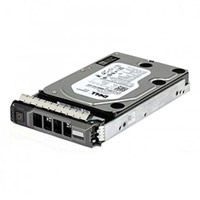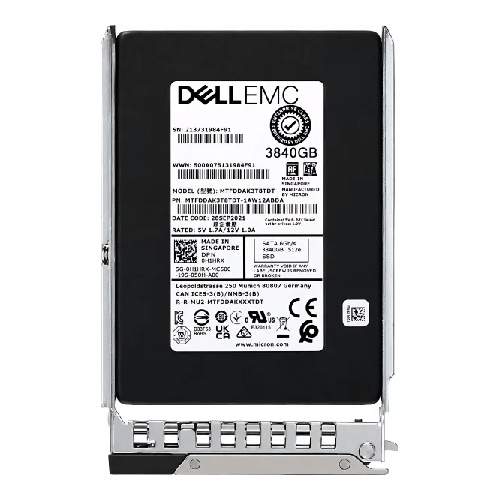
Dell EMC MZ7L33T8HBNA-00B7C 3.84TB SATA Datacenter SSD
Regular Price:৳115,000.00Availability: SKU: 9.63.4.9396
Quick Overview
-
Support
Saturday – Thursday: 09 AM - 06 PM. -
Payment
Cash on Delivery | Card | Online Payment -
Shipping Cost
Inside Dhaka 100tk | Outside Dhaka 150tk -
Warranty Policy
Read More
Description
Dell EMC MZ7L33T8HBNA-00B7C 3.84TB SATA Datacenter SSD in Bangladesh
The Dell EMC 3.84TB SATA MZ7L33T8HBNA-00B7C Datacenter SSD is a high-capacity, enterprise-class solid-state drive designed for organisations in Bangladesh that are serious about performance, uptime and predictable latency in their server and storage environments. It’s built specifically for data centre workloads—not for casual desktop use—and it brings 3.84 terabytes of flash storage into a compact 2.5-inch form factor with a SATA enterprise interface.
If your Dell PowerEdge or other enterprise server is still running mission-critical workloads on mechanical hard drives, you already know the pain points: slow queries, unpredictable performance under load, and users complaining that “the system is slow” even when your CPU and RAM look fine. The problem is often storage. The Dell EMC MZ7L33T8HBNA-00B7C Datacenter SSD gives you a path to address that bottleneck with a drive that Dell has qualified for heavy-duty, 24/7 operation.
For banks in Motijheel, telcos and ISPs in Dhaka, ERP-heavy industries in Narayanganj and Gazipur, and IT service providers in Chattogram or Sylhet, this SSD can be the difference between systems that merely “work” and systems that actually perform under pressure.
Enterprise SATA SSD vs Consumer SSD: Why it Matters
On paper, the words “SATA SSD” might not sound that different from a high-end consumer SSD, but the Dell EMC 3.84TB SATA MZ7L33T8HBNA-00B7C is geared for datacenter use:
Workload endurance and consistency: It is designed to handle sustained random and mixed read/write workloads 24/7, rather than intermittent desktop bursts.
Tighter integration with enterprise controllers: It supports the error handling, power-loss protection and firmware behaviour expected by server-class RAID/HBA controllers.
Qualification and testing: Dell EMC spends substantial engineering effort validating these drives with their servers and storage arrays.
In Bangladesh, where many companies are still tempted to drop consumer SSDs into servers to save costs, this drive offers:
A significantly lower risk profile for mission-critical workloads,
Better long-term performance consistency under continuous stress,
Clearer support paths, because you’re using an OEM-part number recognised by Dell’s ecosystem.
This isn’t about theoretical specs; it’s about how the drive behaves after years of use, not just in week one.
3.84TB Capacity – More Flash in Less Space
At 3.84TB, this Dell EMC datacenter SSD delivers considerable capacity:
Enough to host:
Several large database instances or mixed OLTP/OLAP environments,
Dense virtualisation clusters (VMware, Hyper-V, KVM) where each VM expects SSD-level performance,
Shared storage for applications like ERPs, CRMs, file services and analytics workloads.
In practical deployments across Bangladesh:
You can use a small pool of 3.84TB SSDs as a “hot tier” in a hybrid storage design:
SSDs for hot frequently-accessed data,
HDDs for colder archives.
Or you can implement a flash-only tier for certain high-value workloads, offering:
Better performance,
Smaller rack footprint,
Lower power draw per I/O than a sea of spinning disks.
Instead of filling entire racks with dozens of smaller HDDs, a handful of Dell EMC 3.84TB SSDs can provide the IO performance you need with simpler management and fewer moving parts to fail.
SATA for Datacenter: Simplicity and Compatibility
The SATA interface remains highly relevant in enterprise environments:
It is widely supported on server motherboards and RAID controllers,
It enables easier upgrades in mixed environments where SAS backplanes are not used everywhere,
It is sufficient for many datacenter workloads that are not saturating NVMe or SAS bandwidth.
For many Bangladeshi IT teams, SATA enterprise SSDs like the MZ7L33T8HBNA-00B7C are a sweet spot:
They drop into existing SATA backplanes and bays without rearchitecting the server,
They offer consistent, multi-fold performance improvements over SATA HDDs,
They serve well in roles like:
OS/boot drives,
Application volumes,
Caching layers,
Virtualisation datastores.
If you have older servers that support SATA but not NVMe or SAS, this SSD can dramatically extend their useful life as part of a performance refresh strategy.
Real-World Use Cases in Bangladesh
Core Banking & Financial Applications
Banks and NBFIs running core banking, treasury systems, and reporting on conventional drives can:
Deploy Dell EMC 3.84TB datacenter SSDs for the primary transaction logs and index-heavy databases,
Reduce response times for teller operations, ATM switching and online banking backends,
Support more concurrent users and deeper reporting without saturating disk queues.
Virtualisation and Cloud Hosting
Local cloud, hosting and VPS providers (and corporate virtual environments) can:
Use these SSDs as a fast datastore for VM images and vDisks,
Reduce “noisy neighbour” effects where one VM’s IO spikes affect others,
Achieve higher VM density per host because storage is less of a bottleneck.
Analytics, BI & Data Warehousing
Companies doing analytics and BI in Bangladesh:
Shorten ETL jobs and queries when staging and temp data resides on enterprise SATA SSD,
Reduce batch window durations so overnight processes finish before business hours,
Increase the responsiveness of data-driven dashboards for management.
ERP, CRM and Line-of-Business Systems
For manufacturing, distribution, retail and services:
When ERP/CRM databases live on SSD-backed volumes, users:
Experience faster screens,
See less waiting when generating invoices or stock reports,
Face fewer timeouts in remote branches where latency matters.
Performance and Predictability Over Time
While every environment differs, what datacenter-class SSDs like the Dell EMC MZ7L33T8HBNA-00B7C aim to deliver is consistency:
HDDs slow down significantly under random mixed loads and as they fill,
Many consumer SSDs lose performance when they run near capacity or under sustained writing due to wear-leveling and less robust firmware,
Enterprise SSDs are engineered to:
Sustain their performance envelope across a wider range of fill and write scenarios,
Provide predictable latency even under stress (e.g., during peak load or RAID rebuilds).
For IT operations in Bangladesh, predictability is as important as peak numbers:
It’s easier to capacity-plan,
Easier to understand when and why performance changed,
Easier to grow—because you know new drives will behave in line with existing ones.
Dell EMC Qualification & Support Advantage
Using a Dell EMC-labelled part like the MZ7L33T8HBNA-00B7C:
Simplifies support conversations—Dell EMC support is more willing to engage when their labelled and qualified components are installed,
Helps you maintain best practices in your Dell PowerEdge or Dell EMC storage environment,
Ensures firmware/driver combinations have been validated by Dell for your platform, reducing risk.
In Bangladesh, where many enterprises run mixed-brand environments but rely heavily on Dell servers and storage, staying within the OEM’s recommended component guidance helps avoid:
Unexpected incompatibilities,
Unknown behaviour during firmware updates,
Potential warranty complications.
Racking, Power and Cooling Considerations
Although SSDs do consume power and produce heat, relative to HDDs:
They can provide dramatically higher IOPS per watt,
They reduce the total number of spinning disks and their mechanical inefficiencies.
In local data centres and equipment rooms:
Using enterprise SATA SSDs for performance tiers can:
Reduce the number of drives per server,
Reduce noise and vibration,
Lower overall thermal output, making life slightly easier on UPS/generator-backed cooling systems.
This matters in Bangladesh where power bills and keeping the environment under control in our climate are major operational realities.
Maintenance & Best Practices
With any SSD-based storage tier:
Monitor drive SMART/health metrics:
Remaining life / wear indicator,
Error counters,
Temperature,
Plan proactive replacement when drives approach recommended endurance limits, not after failure,
Make sure:
RAID/replication and backup strategies are in place—SSDs fail too, albeit differently from HDDs,
Firmware stays within vendor-recommended versions, usually updated in maintenance windows.
Combine technical maintenance with operational policies:
Document drive locations, RAID memberships and spares,
Train staff on correct hot-swap procedures when a drive is flagged for replacement,
Maintain good airflow and dust management in racks.
✅ Key Features
3.84TB Datacenter Capacity: Large-scale SSD storage for demanding enterprise workloads.
SATA Interface: 6Gbps enterprise-class SATA for broad compatibility with server platforms.
Dell EMC Qualification: Tested and certified for use in Dell EMC server and storage systems.
Enterprise SSD Design: Built for 24/7 use with sustained performance and reliability under heavy mixed workloads.
Performance Upgrade: Provides substantial latency and throughput improvements over hard disk drives.
Rack & Power Benefits: Helps consolidate storage while potentially lowering power and cooling needs.
✅ Usage / Applications
Fast storage for databases (Oracle, SQL Server, MySQL, PostgreSQL, etc.) in Bangladeshi enterprises.
Virtualisation datastores for VMware/Hyper-V/KVM environments.
VDI and remote desktop hosting, where IOPS demand is high and unpredictable.
Application and web servers requiring low-latency access to logs, cache and data.
Tiered SAN/NAS deployments where SSDs act as the high-speed tier.
Storage for analytics, BI, reporting and data warehousing workloads.
✅ Benefits of This Product?
Accelerates critical systems, resulting in happier users and faster business operations.
Reduces IO bottlenecks in virtualised and database-heavy environments.
Improves infrastructure ROI by extending the useful life of existing servers with a storage performance refresh.
Integrates cleanly into Dell EMC ecosystems, simplifying management and support.
Supports 24/7 datacentre workloads in a way consumer SSDs are not designed to.
✅ Ideal For
The Dell EMC 3.84TB SATA MZ7L33T8HBNA-00B7C Datacenter SSD is ideal for:
Banks, financial institutions and payment processors in Bangladesh who need consistently fast transaction processing and reporting,
Telecoms, ISPs and cloud hosting companies offering VPS, VM, container and VDI services,
Large and mid-sized enterprises with virtualised infrastructure and critical line-of-business applications,
Organisations modernising from HDD-only storage to hybrid or all-flash models, but still using SATA-based server backplanes,
IT teams who want enterprise-grade flash performance without jumping fully to NVMe across the board.
If “slow storage” is a recurring issue in your IT operations, this SSD is built precisely for your kind of problem.
✅ Why Choose the Dell EMC 3.84TB SATA MZ7L33T8HBNA-00B7C Datacenter SSD?
Choosing this Dell EMC datacenter SSD means choosing:
A drive with enterprise DNA, not a re-badged consumer model,
A capacity large enough to matter—3.84TB—for serious workloads and multi-TB datasets,
An interface and qualification story that aligns with Dell EMC server infrastructure,
A solution focused on predictable performance, not just impressive peak benchmarks.
Compared to consumer or unqualified SSDs:
You gain peace of mind regarding endurance, error-handling and integration behaviour,
Your support paths with Dell or your hardware partner remain clear and straightforward,
Long-term operational risk is lower, which is critical when these drives sit under your core systems.
For Bangladesh data centres and serious in-house IT operations, this is about building your storage layer on a trusted foundation.
✅ Why Buy This Product from BME?
When you buy the Dell EMC 3.84TB SATA MZ7L33T8HBNA-00B7C Datacenter SSD from Business Machine & Equipment (BME), you benefit from:
Authentic product sourcing: BME is focused on genuine enterprise hardware, helping you avoid counterfeit or non-qualified SSDs that may jeopardise uptime.
Local, context-aware advice: You can discuss your actual server models, workloads and operating environment in Bangladesh, and BME will help you evaluate whether this part is the right fit.
B2B-friendly service: For banks, telcos, government bodies, enterprises and system integrators, BME provides formal quotations, vendor documentation and structured invoicing suitable for tender and procurement processes.
Product-level after-sale support intent: BME’s team is available to clarify specifications, compatibility, and integration considerations, enhancing the effectiveness of your in-house or vendor support.
Instead of making isolated hardware purchases, you work with a supplier that understands how datacentre components should come together in the Bangladeshi context.
✅ Buying Guide
Before you purchase the Dell EMC 3.84TB SATA MZ7L33T8HBNA-00B7C Datacenter SSD, consider:
1. Platform Compatibility
Confirm that your server or storage chassis supports 2.5-inch SATA SSDs of 3.84TB capacity,
Check Dell EMC or your vendor’s HCL (Hardware Compatibility List) for this part number.
2. Workload Requirements
Understand whether your workloads are:
Read-heavy,
Write-intensive,
Mixed;
and choose appropriate RAID levels and redundancy strategies accordingly.
3. RAID & Redundancy Planning
Define:
How many drives you need for usable capacity,
Desired RAID level (1/5/6/10),
Hot spare strategy.
4. Performance Expectations
Estimate IOPS/throughput needs for key workloads,
Consider whether these SATA SSDs will be:
The primary performance tier,
A cache layer,
Or part of a broader hybrid pool.
5. Power & Cooling
Ensure your racks have adequate power budget and airflow,
Remember that SSDs run cooler than many HDDs, but mixing with existing drives changes temperature dynamics.
6. Lifecycle & Warranty
Clarify:
Expected drive life in your usage profile (TBW/DWPD from datasheet),
Warranty terms and replacement processes with BME.
7. Data Protection Strategy
Maintain:
Backups (onsite/offsite),
Disaster recovery plans,
Procedures for quick, safe drive replacement in the event of failures.
✅ Customers Ask About / Frequently Asked Questions
Q1: Can I use this Dell EMC 3.84TB SATA SSD in non-Dell servers?
Yes, technically it can work in any server that supports 2.5" SATA enterprise SSDs of this capacity, but for non-Dell platforms you must verify compatibility with your vendor to avoid support or firmware issues.
Q2: Is this SSD hot-swappable?
In most enterprise servers with hot-swap SATA bays, this drive is hot-swappable. Always follow your RAID/storage controller’s recommended procedure when swapping drives.
Q3: What kind of workloads is this SSD best for?
It is ideal for datacenter workloads such as databases, virtualisation datastores, VDI, transactional applications and analytics where consistent low latency is required.
Q4: How does it compare to NVMe SSDs?
NVMe offers higher bandwidth and lower latency on PCIe, but SATA enterprise SSDs like this still provide a major step up from HDDs and are often easier to deploy in existing servers with SATA backplanes.
Q5: Is there built-in power-loss protection?
Enterprise datacenter SSDs typically include forms of power-loss protection; see the official Dell EMC datasheet for exact details for the MZ7L33T8HBNA-00B7C variant.
Q6: Does BME provide onsite installation?
BME focuses on hardware supply and product guidance. Installation is usually handled by your internal IT team or integration partner; BME can coordinate with them as needed.
Q7: Can I mix this SSD with HDDs in the same RAID set?
It is generally not recommended to mix SSDs and HDDs in the same RAID set, as performance defaults to the slowest drives. Use SSDs and HDDs in separate tiers or arrays.
Q8: What warranty is provided in Bangladesh?
Warranty period and coverage are determined by Dell EMC’s regional policy and BME’s arrangements. Please confirm exact warranty terms at the time of purchase.
✅ Why Buy This Product
The Dell EMC 3.84TB SATA MZ7L33T8HBNA-00B7C Datacenter SSD is designed for one purpose: to bring true enterprise flash performance and reliability into your server/storage platform. It turns sluggish, I/O-bound systems into responsive, user-pleasing platforms and gives IT teams headroom for growth and consolidation.
If your business systems in Bangladesh are critical to your operation—and downtime or slowness means lost revenue, unhappy users, or regulatory pressure—storage is not where you want to cut corners. This Dell EMC datacenter SSD is a robust, OEM-validated component that helps you modernise your infrastructure confidently.
What is the price of Dell EMC MZ7L33T8HBNA-00B7C 3.84TB SATA Datacenter SSD in Bangladesh?
Write a review
Question Answer
Have question about this product? Get specific details about this product from expert.


Dell EMC 1.92TB SATA Server SSD
Dell EMC MZ-ILT3T8A 3.84TB 12Gbps SAS SSD




Dell 1.8TB SAS Hot Plug Server Hard Drive

Dell 2TB SAS Hot Swap Server HDD