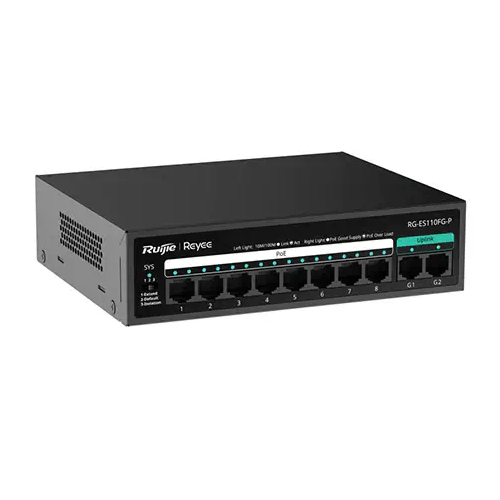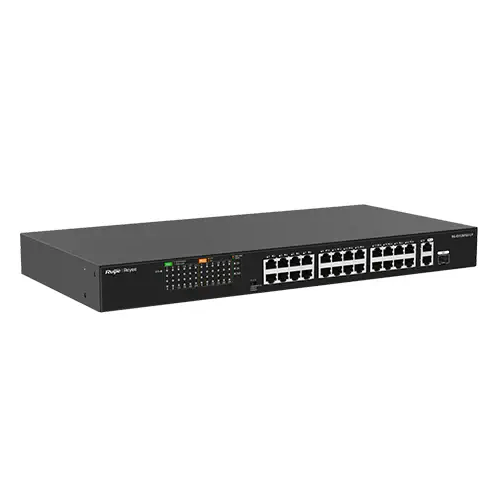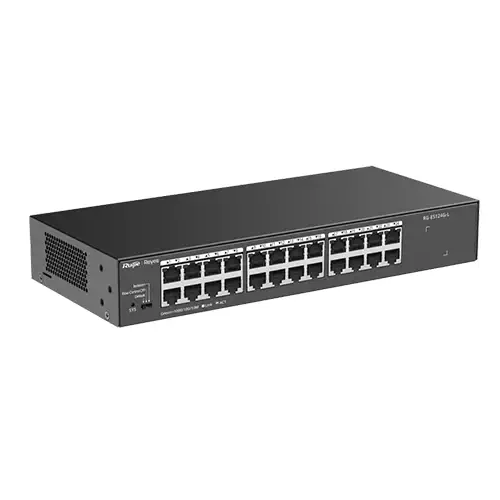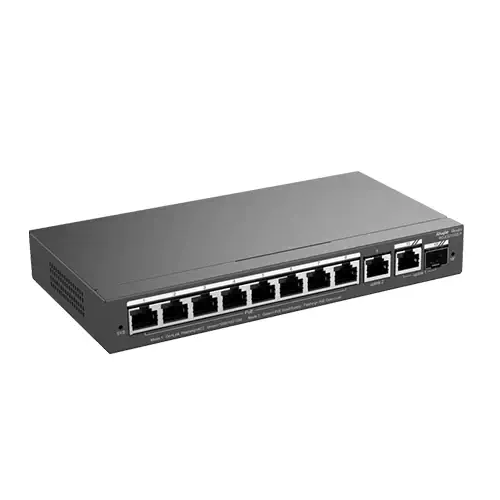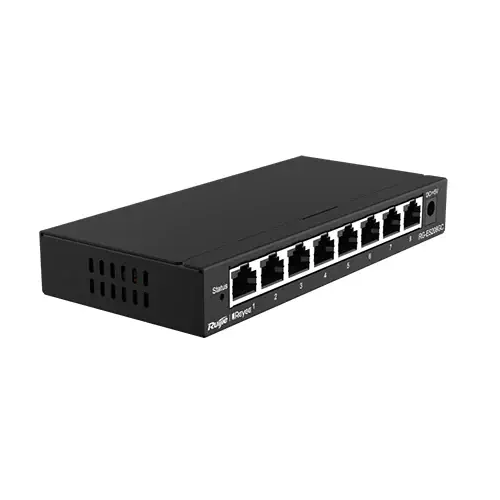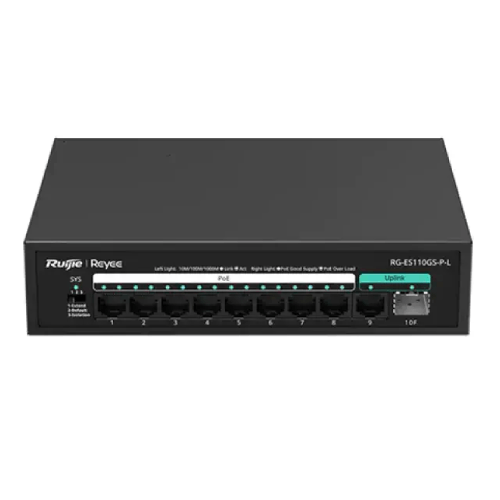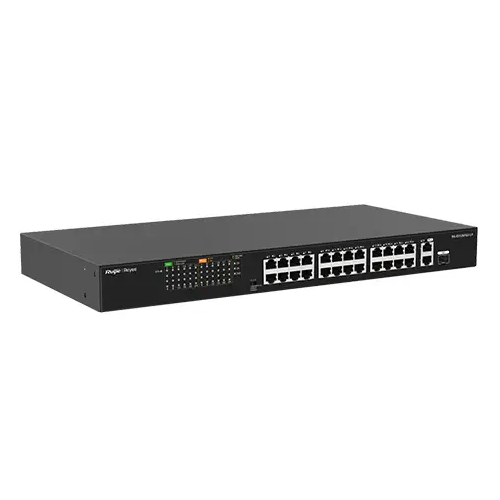
Ruijie RG-ES126FGS-LP 24-Port 10/100 Mbps with 2-Port Gigabit Unmanaged PoE Switch
Regular Price:৳0.00Availability: SKU: 6.54.312.9595
Quick Overview
-
Support
Saturday – Thursday: 09 AM - 06 PM. -
Payment
Cash on Delivery | Card | Online Payment -
Shipping Cost
Inside Dhaka 100tk | Outside Dhaka 150tk -
Warranty Policy
Read More
Description
Ruijie RG-ES126FGS-LP 24-Port 10/100 Mbps with 2-Port Gigabit Unmanaged PoE Switch in Bangladesh
As a home, office, shop, or CCTV installation adds more network devices, the Ethernet ports on a router may no longer be enough. The Ruijie RG-ES126FGS-LP provides a larger connection point for a network that needs multiple wired links and PoE support. Its listed port arrangement combines 24 ports operating at 10/100 Mbps with two Gigabit ports.
This is an unmanaged PoE switch. It is intended for straightforward network expansion, not advanced switch configuration. It can connect compatible Ethernet devices and provide PoE to supported endpoints, while a router or other upstream network equipment continues to handle functions such as internet access. The switch does not replace a router, Wi-Fi access point, or CCTV recorder.
The port mix makes this model worth considering when many connected devices do not need a Gigabit link at every access port, but the installation still benefits from two faster Gigabit connections. It is important to compare that arrangement with the actual speed requirements of your devices. If each computer or access point needs a dedicated Gigabit connection, a switch with Gigabit access ports may be a better fit.
Understanding the 24 + 2 port arrangement
The product title describes 24 ports at 10/100 Mbps alongside two Gigabit ports. In other words, it has a group of Fast Ethernet connections and a separate pair of higher-speed Ethernet connections. This distinction helps when counting ports and planning which devices will connect where.
Fast Ethernet ports support link speeds of 10 or 100 Mbps, depending on the connected equipment and the negotiated connection. The Gigabit ports support links up to 1000 Mbps when the connected equipment and cabling also support Gigabit Ethernet. A Gigabit port does not make a connected 10/100 Mbps device operate at Gigabit speed.
The exact port layout and the ports intended for PoE should be checked against the current manufacturer documentation before installation. That small verification step is useful when preparing a port map, selecting cameras or access points, and deciding where to connect the switch to the wider network.
Fast Ethernet for suitable network endpoints
A 10/100 Mbps connection can be appropriate for many network-edge devices, depending on their requirements and the amount of traffic they generate. For example, a basic camera or other endpoint may not need a Gigabit link at its individual switch port. The right choice depends on the device’s specifications, the application, and how much data is transmitted at the same time.
The 100 Mbps limit is also important. It is not the same as an all-Gigabit switch, where each access port can support a link of up to 1000 Mbps. A desktop computer moving large files across a local network, a high-performance access point, or another bandwidth-intensive device may benefit from a faster access port. Check those requirements before choosing a Fast Ethernet model.
For a mixed network, the 24-port Fast Ethernet group can connect suitable endpoints while the two Gigabit ports provide faster connection options for selected devices or the wider network, subject to the product’s port roles and your topology. Plan the links around the equipment that matters most rather than assuming every port has the same speed.
PoE support and compatible devices
Power over Ethernet can carry network data and electrical power over a compatible Ethernet connection. Where a port on the switch is designated for PoE, this can help power supported cameras, access points, or IP phones without requiring a separate power adapter beside each device. Fewer local power supplies can make some installations easier to organise.
PoE compatibility needs to be checked carefully. The connected device must support a PoE method and power level that match the switch. Before connecting equipment, confirm the switch’s PoE standard, per-port limit, and total power budget in the current product documentation. Those figures are not specified in the product title, so they should not be guessed or assumed from another Ruijie model.
PoE also does not mean that every Ethernet device can receive power from every port. A non-PoE endpoint needs its own suitable power source, while equipment that uses a different power arrangement may require a compatible solution. If an installation combines products from different brands, verify their specifications before purchase.
A useful role in CCTV installations
The Ruijie RG-ES126FGS-LP may be considered for a CCTV network where compatible IP cameras need wired network connections and PoE power. Using PoE with supported cameras can reduce the need for a separate power connection at each camera location. That can be particularly useful when cameras are mounted at entrances, corridors, shop floors, or other places where access to a nearby outlet is inconvenient.
The switch provides network connectivity; it does not record video. A network video recorder, server, or other suitable system is still needed to receive and store footage. The router and internet connection may also be required for remote viewing, depending on the wider CCTV setup.
Before selecting a Fast Ethernet switch for cameras, check each camera’s network requirements and expected data rate. Consider how many feeds may be active at once and where their traffic will go. The 10/100 Mbps access links and two Gigabit ports should be assessed against the complete camera and recorder layout rather than the camera count alone.
Connecting wireless access points and other endpoints
A compatible PoE-enabled wireless access point can receive both network data and power through an Ethernet connection, subject to the switch’s confirmed PoE specifications. This can simplify placement when the access point needs to be mounted away from a convenient power outlet. The switch does not create Wi-Fi itself; the access point provides the wireless signal.
Check the access point’s Ethernet speed requirements before connecting it to a 10/100 Mbps port. Some models may need a Gigabit link to meet their intended performance. If so, verify whether one of the two Gigabit ports is available and suitable for that connection, or consider a switch with more Gigabit access ports.
Other possible endpoints include compatible IP phones and basic network equipment. In every case, the endpoint must match the port’s speed and, if PoE is being used, its power requirements. The switch’s port count is only one part of a successful installation; compatibility and network layout matter too.
For shops, offices, and learning spaces
A small office may need wired connections for computers, printers, phones, and network equipment. A shop might connect a back-office computer, a recorder, and other Ethernet devices. A training centre or classroom may have a combination of computers, cameras, and access points. The RG-ES126FGS-LP can be considered where a site needs many 10/100 Mbps links and has a suitable use for its Gigabit ports.
For a Bangladesh business, a planned network can make everyday support less confusing. Label cables at both ends, keep a simple record of which device connects to each port, and decide in advance which connections need PoE. This makes it easier to trace a cable or identify a device if something stops working.
Do not assume that every device in a modern office will be suitable for a Fast Ethernet port. Newer computers, storage devices, and wireless access points may need more bandwidth. Check the manufacturer’s recommendations for each endpoint and reserve faster links for the devices that need them.
Unmanaged operation: straightforward, with clear limits
An unmanaged switch is designed to provide basic Ethernet connectivity without requiring detailed switch configuration. That can make it suitable for a straightforward network where the main need is to connect devices and extend the number of available wired ports. The router or other network equipment remains responsible for internet access and other routing functions.
This simpler operating style has limits. Do not assume that the switch provides VLAN configuration, advanced traffic controls, or remote management unless the official documentation confirms those functions. If an office or business needs to separate network traffic or manage switch settings centrally, check the required features before choosing an unmanaged model.
For a basic CCTV or small-office network, unmanaged operation may be sufficient if the network design is simple and all devices can work on the intended local network. For a more complex installation, discuss the topology with an IT professional and compare it with the feature set of a managed switch.
Real-world speed depends on the complete network
A switch’s port rating is only one part of network performance. The connected device, its network adapter, cable quality, port speed, router, and the path to the destination all affect the connection. To achieve a Gigabit link, both devices and the cabling must support it; a Gigabit port cannot remove a limitation elsewhere in the connection.
The same principle applies to internet speed. The switch does not increase the speed of an internet subscription. Online performance depends on the service plan, modem or router, the wider network, and other factors. A switch can provide local Ethernet connections, but it cannot compensate for a slower internet package or an overloaded upstream connection.
In a CCTV layout, for example, camera-to-recorder traffic and remote viewing traffic follow different parts of the network. In an office, file transfers between computers may use the local network, while video calls rely on the internet connection as well. Understanding these paths helps set realistic expectations for a Fast Ethernet switch.
Planning for Bangladesh conditions
Networking equipment in Bangladesh may be installed in offices, shops, homes, coaching centres, and other spaces with different levels of heat, dust, and ventilation. Choose a dry, accessible location for the switch and avoid placing it where it may be exposed to moisture, direct heat, or heavy dust. Leave space to connect and inspect cables without crowding the unit.
Load shedding can interrupt a network if the switch and other essential devices lose power. The switch does not include a guarantee of operation during an outage. If continued service is important, plan suitable backup power for the switch and the equipment that must remain online, such as the router, modem, access point, or recorder. Consider their combined power needs and the runtime required.
Do not assume the electrical input range from the model name. Check the product label or current manufacturer documentation before connecting the switch to a power source. If the installation uses a backup system, confirm that it is appropriate for the equipment and follow the relevant safety guidance.
Installation and day-to-day care
Before installation, decide where the switch will sit and measure the available shelf or cabinet space. Confirm its dimensions and any mounting details from current product information if the location is tight. Arrange cables so they are not crushed, tightly bent, or pulled from the ports.
A simple port plan can save time later. Record which cable connects to each camera, computer, access point, or upstream device. Follow the manufacturer’s guidance for connecting the switch to the network, and avoid creating an unintended cable loop between network devices.
For routine care, keep the equipment in a clean, dry, ventilated area and inspect cables if a connection becomes unreliable. Check that connected endpoint devices have power and that cables are firmly seated. If the network still has a problem, review the device and router setup as well as the switch connections; an unmanaged switch may not provide a configuration interface for deeper diagnostics.
Is this the right switch for your network?
The RG-ES126FGS-LP is worth considering when a network needs many 10/100 Mbps connections, PoE support for compatible devices, and two Gigabit ports. It may suit a CCTV-focused installation, a small office, or a shop where the connected endpoints match those speeds and power requirements.
It may not be the right choice if every computer or access point needs a Gigabit access link, if the site requires advanced managed-switch controls, or if the planned devices exceed the confirmed PoE budget. In those cases, compare the required port speed, PoE capabilities, and management features with other models before ordering.
A good purchase starts with a list of devices, their link speeds, and how they receive power. When those details match the switch’s documented capabilities, the Ruijie RG-ES126FGS-LP can provide a practical connection point for a suitably planned wired network.
✅ Key Features
- 24 Fast Ethernet Ports: Connect compatible network endpoints through 10/100 Mbps ports.
- Two Gigabit Ports: Provide two faster Ethernet connections for suitable devices or network links.
- PoE Support: Power compatible network devices through Ethernet where the port and endpoint specifications match.
- Unmanaged Design: Expand a straightforward wired network without detailed switch configuration.
- Mixed-Speed Port Layout: Combine 10/100 Mbps connections with two Gigabit ports in one switch.
- CCTV Network Use: Connect compatible IP cameras and other equipment in a suitably planned surveillance network.
- Access-Point Connectivity: Link compatible wireless access points while checking their speed and PoE requirements.
- Office and Retail Flexibility: Suit network layouts that need multiple wired connections for everyday business devices.
- Centralised Network Connections: Bring compatible endpoints together at a single switching point.
- PoE Planning Support: Check device power requirements against the manufacturer’s confirmed PoE specifications before deployment.
✅ Usage / Applications
- IP CCTV Networks: Connect compatible PoE cameras and link the network to a suitable recorder.
- Small Offices: Provide Ethernet connections for suitable computers and shared network devices.
- Retail Shops: Connect network equipment such as back-office systems and compatible cameras.
- Training Centres: Link compatible wired devices in classrooms and learning spaces.
- Access-Point Networks: Connect PoE-capable access points after verifying their power and link-speed requirements.
- IP Phone Setups: Connect compatible phones where their network and PoE requirements match.
- Home Network Expansion: Add wired ports for suitable devices when the router has limited Ethernet connections.
- Business Network Edge: Bring selected network endpoints together near an existing router or switch.
✅ Benefits of This Product?
- More Wired Connections: Provide 24 Fast Ethernet ports for suitable network endpoints.
- Simpler Compatible Device Power: Use PoE with supported equipment to reduce the need for separate power at the device location.
- Two Faster Network Links: Use the Gigabit ports for connections that need higher link speed, subject to the network plan.
- Straightforward Setup: Unmanaged operation suits basic network expansion without advanced switch configuration.
- Clear Port Planning: Separate Fast Ethernet endpoint needs from connections that require Gigabit speeds.
- Useful for CCTV: Bring compatible cameras and other surveillance equipment onto a wired network.
- Flexible Site Use: Consider the switch for suitable small offices, shops, homes, and education spaces.
- Better-Informed Purchasing: Confirming port speed and PoE requirements before installation helps avoid compatibility issues.
✅ Ideal For
The Ruijie RG-ES126FGS-LP is intended for Bangladesh-based users who need many wired connections and can work within a 10/100 Mbps access-port layout. It may suit small-business owners, CCTV installers, office administrators, and IT teams connecting compatible cameras or other network endpoints. A shop, coaching centre, or home user can also consider it when the existing router does not provide enough Ethernet ports.
It is a better match for networks where not every endpoint requires a Gigabit access link and where the unmanaged design meets the project’s needs. Buyers should check which devices need PoE, confirm the switch’s PoE standards and power budget from current documentation, and plan the two Gigabit connections around the network layout. If the installation requires Gigabit connectivity at every port, advanced switch management, or a particular PoE budget, compare those requirements with other models before purchasing.
✅ Why Choose the Ruijie RG-ES126FGS-LP?
The Ruijie RG-ES126FGS-LP combines a large group of 10/100 Mbps ports with two Gigabit ports and PoE support. That mix can be useful when many network endpoints do not need a Gigabit access link, while a smaller number of connections need a faster path into the wider network. It gives buyers a clearly defined arrangement to assess against their device list, rather than choosing a switch based only on its total number of ports.
PoE is another practical reason to consider this model. With compatible endpoints and a suitable power budget, PoE can simplify camera or access-point installations by carrying data and power over an Ethernet connection. Before relying on this benefit, verify the model’s documented PoE standard, per-port limit, and total budget. These details are essential when several devices will draw power at the same time.
The unmanaged format can suit a basic network that needs connectivity more than advanced configuration. However, its Fast Ethernet access ports are not a substitute for an all-Gigabit switch. If high data rates are important for each connected workstation or access point, another port-speed configuration may be a better long-term fit.
Ruijie is the brand identified for this network switch, but the best reason to choose this model is whether its actual port speeds, PoE capability, and operating style match your use case. When they do, it can serve as a straightforward network-edge switch. When they do not, selecting another model is the more practical choice.
✅ Why Buy This Product from BME?
Business Machine & Equipment (BME) serves customers in Bangladesh looking for business and technology products. If you are considering the Ruijie RG-ES126FGS-LP, contact BME with a short description of your network, including the number of devices, which ones need PoE, and whether any require Gigabit access links. That context can help you ask focused questions about suitability before placing an order.
Before purchasing, confirm the exact model, current availability, price, included items, applicable warranty terms, and delivery arrangements with BME. These details may depend on the specific listing or order, so check them rather than assuming that terms for another product apply. If sourcing or product documentation is important for your organisation, ask BME what information is available for the unit being supplied.
Business buyers can also ask about quotation and procurement requirements. If you need installation or configuration, confirm whether those services are available and what they include before ordering. This helps keep product selection, network planning, and purchase expectations aligned without relying on unconfirmed service or warranty claims.
✅ Buying Guide
1. Count the devices: List every camera, access point, phone, computer, recorder, and other Ethernet device. Compare the number with the 24 Fast Ethernet ports and two Gigabit ports.
2. Match each device to a port speed: Check whether each endpoint needs 10/100 Mbps or Gigabit Ethernet. This switch does not provide Gigabit speeds at all 24 Fast Ethernet ports.
3. Confirm PoE requirements: Identify which devices need power over Ethernet. Check the switch’s current documentation for the supported PoE standard, per-port limit, and total budget, then compare those details with each endpoint’s requirements.
4. Plan the two Gigabit connections: Decide which devices or network links would benefit from the faster ports. Confirm their intended role and the correct topology from the product documentation; do not assume unsupported functions such as link aggregation.
5. Check the unmanaged feature set: Choose an unmanaged switch for basic network expansion when detailed switch controls are not required. If your network needs VLANs, traffic policies, or remote management, verify those needs before buying.
6. Plan PoE device locations: Check where cameras, access points, or phones will be installed and whether the Ethernet route is practical. PoE may simplify power arrangements for compatible devices, but it does not replace checking standards and power limits.
7. Review power continuity: Check the product’s electrical requirements from its label or current documentation. If the network must continue during load shedding, plan suitable backup power for the switch and other essential equipment.
8. Check space and cabling: Confirm the switch will fit the intended shelf or cabinet. Plan neat cable routes, allow access to the ports, and avoid placing the equipment where it may be exposed to moisture, heat, or heavy dust.
9. Confirm order details: Before ordering from BME, verify the exact model, current availability, supplied items, applicable warranty terms, and delivery arrangements for your area.
✅ Customers Ask About / Frequently Asked Questions
Q: What is the Ruijie RG-ES126FGS-LP used for?
A: It is an unmanaged PoE network switch for connecting compatible Ethernet devices. Its listed layout includes 24 ports at 10/100 Mbps and two Gigabit ports.
Q: How many Ethernet ports does it have?
A: The product title specifies 24 Fast Ethernet ports plus two Gigabit ports. Check the current product documentation for the port layout and intended port roles.
Q: Are all its ports Gigabit?
A: No. The listed arrangement is 24 ports at 10/100 Mbps and two Gigabit ports.
Q: Can I use it with IP cameras?
A: It may be used with compatible IP cameras. Confirm the cameras’ link-speed and PoE requirements, and remember that a recorder or another suitable system is needed to store video.
Q: What is the PoE power budget?
A: The product title does not specify the PoE standard or power budget. Check the current manufacturer documentation or ask BME before selecting devices for the switch.
Q: Will it power any PoE access point?
A: Only if the access point’s PoE requirements match the switch’s documented capabilities. Also check whether the access point requires a Gigabit link.
Q: Is it managed or unmanaged?
A: It is described as an unmanaged switch. If your network requires advanced configuration or monitoring features, verify whether another model would be more suitable.
Q: Will it increase my internet speed?
A: No. It adds wired network connections, but internet speed depends on your service plan, router, devices, cabling, and the wider network.
Q: Is it suitable for Bangladesh’s power supply?
A: Check the product label or current documentation for its electrical input requirements before connecting it. Do not assume a voltage range from the model name alone.
Q: Can it keep the network running during load shedding?
A: Only if the switch and other essential equipment receive suitable backup power. Plan for the combined load of the switch, router, and any recorder or access points that must stay online.
Q: What are the warranty and delivery arrangements?
A: They depend on the current listing and order terms. Confirm the applicable warranty and delivery details with BME before purchasing.
Q: How should I care for the switch?
A: Keep it in a dry, ventilated location, protect it from excessive dust and moisture, and avoid pulling or sharply bending Ethernet cables. Follow the product documentation for model-specific guidance.
✅ Why Buy This Product
The Ruijie RG-ES126FGS-LP is worth considering when your network needs multiple 10/100 Mbps connections, PoE support for compatible devices, and two Gigabit ports. It may suit a CCTV installation, small office, shop, or other network where those port speeds and the unmanaged design meet the requirements.
Before you order, check which devices need PoE, confirm their power and link-speed specifications, and plan the two Gigabit connections. If every endpoint needs Gigabit Ethernet or the network requires managed features, compare the switch with alternatives that provide those capabilities.
Contact Business Machine & Equipment (BME) to confirm the current product details and purchase terms. When the documented specifications match your project, order the Ruijie RG-ES126FGS-LP for a practical way to expand a compatible wired network.
What is the price of Ruijie RG-ES126FGS-LP 24-Port 10/100 Mbps with 2-Port Gigabit Unmanaged PoE Switch in Bangladesh?
Write a review
Question Answer
Have question about this product? Get specific details about this product from expert.