Audac SMQ350 Wave Dynamics Quad Channel Power Amplifier
Regular Price:৳0.00Availability: SKU: 6.87.617.9642
Quick Overview
-
Support
Saturday – Thursday: 09 AM - 06 PM. -
Payment
Cash on Delivery | Card | Online Payment -
Shipping Cost
Inside Dhaka 100tk | Outside Dhaka 150tk -
Warranty Policy
Read More
Description
Audac SMQ350 Wave Dynamics Quad Channel Power Amplifier in Bangladesh
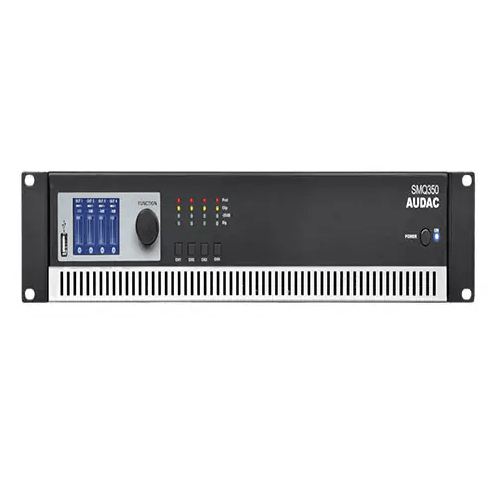
The Audac SMQ350 is a black, four-channel Class-D power amplifier described as a WaveDynamics model. Its supplied specifications list output ratings of 4 × 350 W at 4 Ω in stereo mode, 4 × 220 W at 8 Ω in stereo mode, and 2 × 700 W at 8 Ω in bridged mode. It is designed for rack mounting in a 19-inch format and has a listed height of 2 HE. These details make it a model to assess for installations that need several amplifier channels in a rack-based system.
The amplifier’s output figures are specified for different load and operating configurations. They are not interchangeable ratings: the 4 Ω stereo, 8 Ω stereo and 8 Ω bridged figures apply to different setups. Check the speaker impedance, wiring plan and amplifier configuration before connecting equipment. Do not select an operating mode based only on the largest wattage figure; follow the amplifier and speaker documentation for the intended arrangement.
The supplied stereo ratings are 4 × 350 W at 4 Ω and 4 × 220 W at 8 Ω. The bridged rating is 2 × 700 W at 8 Ω. These figures can help with initial system planning, but the specifications supplied here do not describe every allowable wiring configuration or provide a recommended speaker arrangement. If you are planning several speakers, compare their impedance and power requirements with the intended amplifier mode, and have the complete load checked against the product documentation.
Bridged operation changes how amplifier channels are configured. The listing provides a rating for two bridged outputs at 8 Ω, but does not specify the bridging procedure, terminal assignments or any restrictions beyond that rating. Use the amplifier’s instructions to confirm which connections and settings are required. Do not assume that the terminals used in stereo mode are connected the same way in bridge mode, or that every speaker load is suitable for bridging.
The SMQ350 uses Class-D amplification and a switching-mode power supply, according to the supplied specifications. These are useful technical details when comparing amplifier designs and planning a rack system. The information provided does not state total power consumption, energy efficiency, heat output or any specific operating advantage. Assess those requirements separately if they matter to your installation rather than inferring them from the Class-D designation alone.
The listed frequency response is 20 Hz to 20 kHz within ±3 dB. This gives a reference for evaluating the amplifier’s specified frequency range. The result heard through a complete system will also depend on the speakers, source material, connections, settings and room. If a project has specific signal or frequency requirements, compare them with the amplifier’s supplied specifications and check the rest of the signal chain as well.
The signal-to-noise specification is greater than 95 dB. Total harmonic distortion plus noise is listed as less than 0.05% at 1 kHz and half rated power. The measurement condition matters: the THD+N figure is specifically associated with that frequency and operating level. Use these figures for comparison on a like-for-like basis, and avoid treating them as a guarantee of identical performance at every load, frequency or output level.
Crosstalk is listed as greater than 70 dB at 1 kHz, and common-mode rejection ratio is specified as 70 dB. Damping factor is listed as greater than 200. These values can assist technical buyers comparing amplifier specifications, but the supplied details do not explain all test conditions or measurement references. If any one of them is critical to a system design, check the manufacturer’s documentation for the applicable conditions and how the figure should be interpreted.
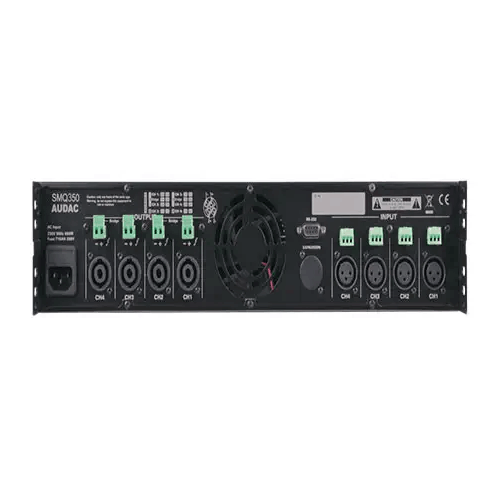
Balanced input impedance is specified as 10 kΩ. The listed input connectors are XLR and a 3-pin Euro terminal block with 3.81 mm spacing. These connection options are relevant when matching the amplifier to source equipment, signal cabling and an installation’s wiring plan. Confirm which input type suits your equipment and how the terminals are assigned. The supplied details do not identify how many of each connector are provided or specify a particular input-routing arrangement.
Input sensitivity is entered in the supplied specifications as “−19.5 dB ~ 27 dB.” The reference and exact interpretation of this notation are not explained. Before relying on the figure for gain structure, check the product documentation or ask BME to clarify what the stated range represents. Do not assume that the values are in dBu, that they describe a particular gain-control range or that they use a specific reference level unless confirmed.
The output connections are described as Speakon-compatible connectors and 2-pin Euro terminal blocks with 5.08 mm spacing. The listing does not state the number or assignment of each output connector. Check the rear-panel labels and product instructions to determine which terminals correspond to the intended channels and operating mode. Also confirm that the speaker cable and connectors you plan to use match the amplifier’s actual outputs. Do not assume that cables or speaker connectors are included.
Protection features listed for the SMQ350 include amplifier DC, short-circuit, overheating and overload protection, along with signal limiting and a loudspeaker power limiter. These are relevant points to review when choosing equipment for a fixed installation. The supplied information does not explain each protection threshold, response or operating condition, so do not treat the list as a guarantee against every fault or incorrect connection. Follow the manual’s setup, ventilation and load requirements to support safe operation.
Access is described as having User and Administrator levels, with password and USB-key protection. The supplied details do not explain the available settings, how the USB key works or whether access is local or remote. Confirm those details if access control is important to your installation. The feature listing does not establish network management, remote monitoring or a particular software platform, so do not assume those capabilities from the access-level description.
Cooling is specified as a temperature-controlled fan. The listing does not provide fan-noise figures or describe how the fan behaves under different operating conditions. When planning a rack location, consider ventilation and the manufacturer’s clearance instructions. Do not obstruct the amplifier’s ventilation paths or place it in an enclosure without checking the required airflow. If the amplifier will be installed near a quiet listening or recording area, ask for any available information about fan operation and noise.
The operating temperature is listed as 0 °C to 40 °C at 95% humidity. The supplied information does not clarify the humidity measurement conditions or whether the figure assumes a non-condensing environment. Check the product documentation against the conditions at the installation site. Do not interpret the temperature and humidity entry as an ingress-protection rating or evidence that the amplifier is suitable for a damp or exposed location.
The listed AC input is 100–120 V or 220–240 V at 50/60 Hz. The information does not state whether voltage selection is automatic, manual or determined by the supplied unit’s configuration. Confirm the exact mains-input requirements and any selection procedure before connecting the amplifier to a power source. For a Bangladesh installation, ask BME to confirm that the specific unit’s power configuration matches the intended site supply; do not assume that a unit accepts both ranges automatically.
Rack planning is supported by the listed 19-inch mounting format and 2 HE unit height. The amplifier measures 482 × 88 × 420 mm (W × H × D) and weighs 8.1 kg. Use these figures to check the rack space, cabinet depth, access and support required for installation. Allow for cabling and the manufacturer’s ventilation clearances as well as the amplifier’s listed dimensions. The supplied details do not state whether rack hardware is included, so confirm the package contents if you need mounting accessories.
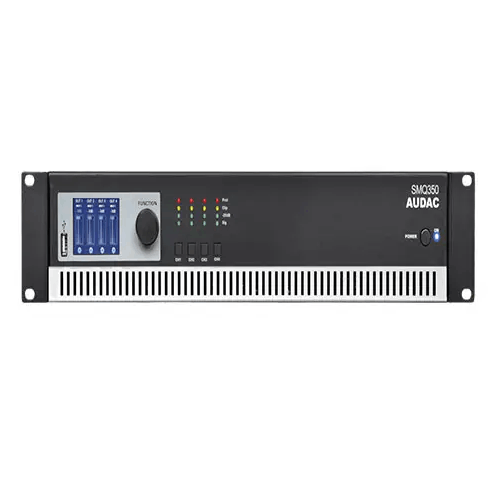
The construction is specified as steel, and the amplifier is listed in black. These details can help when matching the unit with other rack equipment or planning an installation. The product information does not state a front-panel layout, display, controls or included accessories. If those aspects matter to your operation, check the product documentation or ask BME to confirm them for the exact model.
The SMQ350 may be considered for installed sound systems that require multiple amplifier channels in a rack-based setup. Potential environments could include commercial spaces, meeting facilities, hospitality venues or other sites where a system designer has specified suitable loudspeakers and amplification. These are possible contexts for evaluation, not a guarantee that the amplifier will fit every venue. The appropriate choice depends on speaker loads, required output, signal connections, rack space, ventilation and the installation’s power requirements.
For a multi-channel system, plan how each amplifier output will be used and which speakers it will drive. Confirm whether the intended setup uses stereo or bridged operation, check the ratings that apply to that mode and verify the speaker impedance. A four-channel amplifier does not, by itself, determine the number of speakers that can safely be connected. The complete system load and wiring must be checked against the amplifier and loudspeaker documentation.
The “WaveDynamics” name appears in the product title, but the specifications supplied here do not enumerate any processing, equalisation, network or control functions beyond User and Administrator access. If you are considering the amplifier for a workflow that requires a specific digital signal-processing feature, preset, remote-control method or software integration, confirm that feature for the SMQ350 before purchasing. Do not infer specific DSP capabilities from the model name alone.
Before ordering, also check the exact input and output connections your installation requires, the input-sensitivity notation, mains-voltage configuration, rack depth and ventilation needs. Confirm that any required cables, connectors or rack hardware are available for the planned setup. The supplied details do not include a warranty period, country of manufacture or package contents, so ask BME to clarify any of these items that affect your purchasing decision.
The Audac SMQ350 is best evaluated by matching its rated output modes to the speakers and system design, then confirming the signal connections, mains input and rack requirements. Its four-channel configuration, Class-D technology, protection features, balanced input impedance and listed response measurements provide useful comparison points. Careful checking before purchase can help determine whether this amplifier suits the intended installation without assuming unlisted functions or connection arrangements.
✅ Key Features
- Four-channel amplification: Offers listed stereo ratings of 4 × 350 W at 4 Ω or 4 × 220 W at 8 Ω.
- Bridged output option: Provides a listed rating of 2 × 700 W at 8 Ω in bridged mode.
- Class-D design: Uses the amplification technology specified for this model.
- Rack format: Fits a listed 19-inch, 2 HE mounting format.
- Balanced inputs: Specifies 10 kΩ balanced impedance and XLR or 3-pin Euro terminal inputs.
- Flexible output connectors: Lists Speakon-compatible and 2-pin Euro terminal-block outputs.
- Protection features: Lists DC, short-circuit, overheating and overload protection, signal limiting and a loudspeaker power limiter.
- Temperature-controlled cooling: Uses a fan whose operation is specified as temperature-controlled.
- Access levels: Lists User and Administrator access with password and USB-key protection.
- Wide stated response: Specifies 20 Hz–20 kHz frequency response within ±3 dB.
✅ Usage / Applications
- Rack-based audio systems: Consider it where a 19-inch, 2 HE amplifier format suits the equipment rack.
- Multi-channel installations: Evaluate it for a system that needs several amplifier channels.
- Commercial audio: Check its output modes and connections against a designed commercial sound system.
- Meeting facilities: Assess it for a compatible speaker system in conference or meeting spaces.
- Hospitality venues: Compare its ratings and installation requirements with the venue’s audio plan.
- Stereo operation: Use the listed 4-channel stereo ratings when planning compatible speaker loads.
- Bridged operation: Consider the listed 2 × 700 W at 8 Ω mode only after checking the amplifier instructions and speaker load.
- Fixed installations: Plan signal, speaker, mains and ventilation connections before mounting.
✅ Benefits of This Product?
- Several output configurations: The listed 4 Ω, 8 Ω and bridged ratings provide options to assess against system needs.
- Multiple amplifier channels: Can be evaluated for installations requiring more than one amplified channel.
- Useful connection choices: XLR and Euro-block inputs, plus listed output connector types, support installation planning.
- Rack-space information: The 19-inch, 2 HE format helps buyers check equipment-rack fit.
- Protection specifications: The listed protection functions provide relevant points for system comparison.
- Performance data for evaluation: Response, signal-to-noise and distortion figures help inform technical review.
- Access-control information: User and Administrator levels are specified with password and USB-key protection.
- Clear installation checks: Mains input, dimensions and cooling details help buyers plan before purchase.
✅ Ideal For
The Audac SMQ350 may suit system integrators and organisations planning a rack-based audio installation that needs a four-channel power amplifier. Its listed ratings—4 × 350 W at 4 Ω or 4 × 220 W at 8 Ω in stereo, and 2 × 700 W at 8 Ω bridged—give buyers figures to compare with the speaker system and required operating mode. The 19-inch, 2 HE format may also be useful where rack space is part of the installation plan.
It is best considered by buyers prepared to verify speaker loads, bridge-mode wiring, input and output connections, mains configuration and ventilation requirements before use. The specifications do not detail particular DSP or network functions, so confirm those separately if required. Installers should also clarify the input-sensitivity notation and humidity conditions. The amplifier’s capabilities and safe configuration depend on the connected equipment and system design.
✅ Why Choose the Audac SMQ350 Wave Dynamics Quad Channel Power Amplifier?
The Audac SMQ350 is worth considering when an installation needs a four-channel amplifier with clearly listed output ratings across stereo and bridged configurations. The supplied specifications identify 4 × 350 W at 4 Ω and 4 × 220 W at 8 Ω for stereo operation, as well as 2 × 700 W at 8 Ω bridged. These figures give system planners a concrete starting point for matching the amplifier to compatible speakers and the required operating mode.
The model also offers practical details for rack and connection planning. It is specified in a 19-inch, 2 HE format, with balanced 10 kΩ input impedance and XLR or 3-pin Euro terminal-block inputs. Output connectors are listed as Speakon-compatible and 2-pin Euro terminal blocks. Confirm connector assignments and wiring against the amplifier’s documentation, especially if the system uses bridged mode.
Its listed protection features include DC, short circuit, overheating and overload protection, signal limiting and a loudspeaker power limiter. Performance specifications include a 20 Hz–20 kHz response within ±3 dB, signal-to-noise greater than 95 dB and THD+N below 0.05% at 1 kHz and half rated power. These figures are useful for comparison when their test conditions match your requirements.
The best choice depends on speaker impedance, signal routing, rack space, ventilation and the site’s mains supply. The input-sensitivity entry and humidity conditions need clarification, and the supplied specifications do not describe specific DSP or network features. Confirm those requirements and the exact unit configuration before ordering.
✅ Why Buy This Product from BME?
When enquiring with BME about the Audac SMQ350, provide details of your planned system and ask for the current quotation. If you already have speakers or an amplifier configuration in mind, share their impedance and the intended stereo or bridged operating mode so you can check whether the listed ratings are relevant to your setup.
The supplied information does not clarify whether the two mains-input ranges are automatically selected, what the input-sensitivity notation means, or how the stated humidity condition should be interpreted. Ask BME to confirm these points if they affect your installation. You can also check the exact connector arrangement, rack hardware, package contents and applicable written warranty terms for the unit being offered.
If delivery, installation or another service is important to your purchase, ask whether it is available for your location and what terms apply. Do not assume that a service or warranty is included unless BME confirms it. Checking the model, system match and purchase terms before ordering helps you make an informed decision about the amplifier.
✅ Buying Guide
- Define the system requirement: Identify how many amplifier channels the installation needs and what each will drive.
- Match the load: Compare speaker impedance with the ratings listed for the SMQ350.
- Select the operating mode: Confirm whether stereo or bridged mode is required and follow the amplifier instructions.
- Use the correct rating: The listed 4 Ω, 8 Ω and bridged outputs apply to different configurations.
- Check signal inputs: Confirm whether your source equipment uses XLR or 3-pin Euro terminal-block connections.
- Verify output connections: Check the connector type, channel assignments and cable requirements before wiring.
- Plan rack fit: Allow for the listed 482 × 88 × 420 mm dimensions, 2 HE height, cabling and ventilation.
- Confirm mains configuration: Ask whether the specific unit requires voltage selection; do not assume the two listed ranges switch automatically.
- Review cooling and environment: Provide ventilation for the temperature-controlled fan and verify the operating conditions.
- Clarify specification questions: Confirm the input-sensitivity notation and the listed 95% humidity condition if relevant.
- Avoid common mistakes: Do not treat the bridged rating as a stereo rating or infer DSP, network or remote-control features from the WaveDynamics name.
- Confirm purchase terms: Ask BME about the exact unit, package contents, warranty and any services you need.
✅ Customers Ask About / Frequently Asked Questions
-
Q: What is the Audac SMQ350 price in Bangladesh?
A: Contact BME for the current quotation. -
Q: How many amplifier channels does the SMQ350 have?
A: It is specified as a quad-channel power amplifier. -
Q: What are its stereo output ratings?
A: The supplied ratings are 4 × 350 W at 4 Ω and 4 × 220 W at 8 Ω. -
Q: What is the bridged output rating?
A: The listed bridged rating is 2 × 700 W at 8 Ω. Confirm the required wiring and configuration in the amplifier documentation. -
Q: Is it a Class-D amplifier?
A: Yes. Class-D is the specified amplification technology. -
Q: What input and output connections are listed?
A: Inputs are XLR and 3-pin Euro terminal block; outputs are Speakon-compatible and 2-pin Euro terminal block. -
Q: Does it fit a standard equipment rack?
A: The supplied specifications list 19-inch mounting and a 2 HE unit height. Confirm rack hardware and clearance requirements. -
Q: What mains input does the amplifier support?
A: The listing gives 100–120 V or 220–240 V at 50/60 Hz. Confirm the configuration and voltage-selection method for the exact unit. -
Q: Does the SMQ350 include DSP or network control?
A: Those functions are not specified in the information provided. Confirm any required processing or network features before buying. -
Q: Where can I enquire about the SMQ350 in Bangladesh?
A: Contact BME to ask about the current quotation and exact product details.
✅ Why Buy This Product
The Audac SMQ350 is a four-channel Class-D amplifier to consider when its listed output modes match the connected speaker system. Its stereo ratings are 4 × 350 W at 4 Ω and 4 × 220 W at 8 Ω, while the bridged rating is 2 × 700 W at 8 Ω. Balanced input specifications, several listed connector types, protection features and a 19-inch, 2 HE format provide useful details for system planning.
Before choosing it, confirm the speaker loads, stereo or bridged wiring, output connector assignments, rack clearance and cooling requirements. The AC input ranges are listed, but the selection method is not specified; verify the exact unit’s power configuration. Also clarify the input-sensitivity notation and any processing features your installation requires.
If the SMQ350’s confirmed specifications fit your system, contact BME to confirm the exact unit and purchase details before placing an order.
What is the price of Audac SMQ350 Wave Dynamics Quad Channel Power Amplifier in Bangladesh?
Write a review
Question Answer
Have question about this product? Get specific details about this product from expert.