Description
Zebra FX7500 Fixed RFID Reader Price in Bangladesh
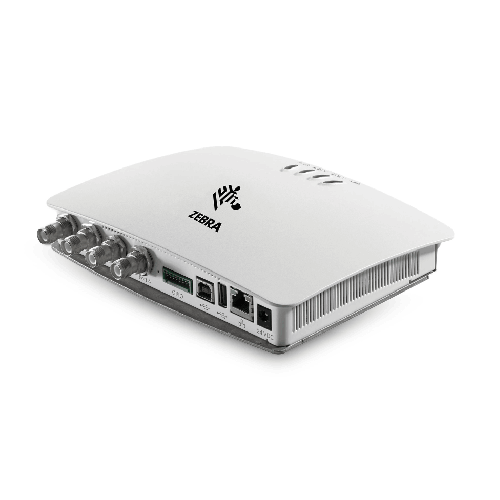
The Zebra FX7500 Fixed RFID Reader is an enterprise-grade UHF RFID reader built for high-performance tag reading in Bangladesh warehouses, factories, logistics hubs, and asset-tracking deployments. When barcode-only workflows become limiting—because items move too fast, visibility is too low, or scanning is too manual—RFID infrastructure becomes a practical upgrade. A fixed RFID reader like the FX7500 is designed to power that upgrade by enabling automated identification at dock doors, conveyor points, portals, workcells, shelves, and smart cabinets.
In Bangladesh, RFID is increasingly relevant for organizations that need faster throughput, better inventory accuracy, and improved traceability—especially across manufacturing, distribution, logistics, retail back-end operations, and high-value asset tracking. The FX7500 supports widely used RFID standards, provides flexible antenna port options, includes strong network services and security capabilities, and offers industrial-grade environmental resilience. It can be mounted using keyhole or standard VESA (75 mm × 75 mm), making installation practical for both compact sites and larger, multi-zone RFID projects.
RFID adoption is often driven by one simple reality: when operations grow, manual scanning becomes the bottleneck. In many Bangladesh warehouses and production sites, barcode scanning works well up to a point—but it requires line-of-sight, one-by-one scans, and human discipline. As volume rises, errors increase: missed scans, wrong picks, unrecorded movements, and delayed visibility. RFID addresses these issues by allowing items to be identified automatically as they move through defined read zones. The Zebra FX7500 Fixed RFID Reader is purpose-built to serve as the core hardware device in those zones.
A fixed RFID reader is different from a handheld RFID reader in the way it is used. Handheld devices are “operator-driven”—a person walks, scans, verifies. Fixed readers are “infrastructure-driven”—the facility itself becomes intelligent, automatically capturing tag reads at portals, shelves, or conveyor lines. In Bangladesh, this infrastructure approach is particularly useful for:
- Dock door inbound/outbound confirmation in distribution centers
- Work-in-process (WIP) tracking in manufacturing
- Automated inventory visibility in warehouses or large retail back-end stores
- Asset tracking for high-value tools, IT equipment, or returnable containers
- Compliance and traceability where movement history matters
The FX7500 supports the most common UHF RFID air protocols: EPCglobal UHF Class 1 Gen2 and ISO 18000-6C. These protocols are widely used across RFID tags in global supply chains, which is important for Bangladesh organizations handling imported goods, export packaging, and internationally aligned logistics processes.
Industrial physical build and installation flexibility
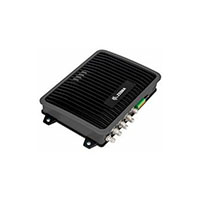
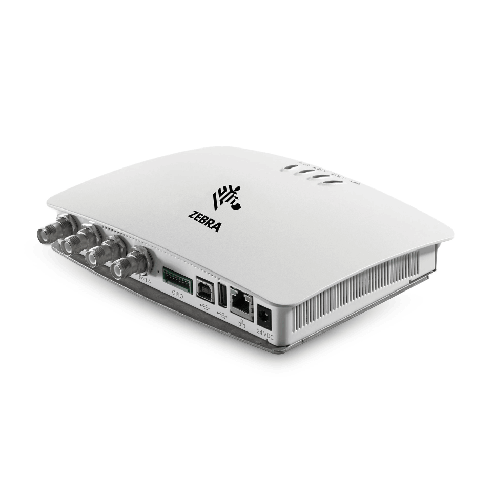
The Zebra FX7500 is compact and built for fixed mounting. Its confirmed physical characteristics are:
- Dimensions: 7.7 in. L × 5.9 in. W × 1.7 in. D (19.56 cm × 14.99 cm × 4.32 cm)
- Weight: 1.9 lbs ± 0.1 lbs (0.86 kg ± 0.05 kg)
- Housing material: Die-cast aluminum, sheet metal and plastic
- Mounting: Keyhole and standard VESA (75mm × 75mm)
This helps in real deployments because the reader can be mounted neatly on walls, inside cabinets, on equipment frames, or near portals. VESA mounting is especially convenient where standardized brackets are already used.
The unit provides multicolor LED indicators for Power, Activity, Status, and Applications—useful for field troubleshooting. In Bangladesh deployments, on-site teams often need simple “at-a-glance” confirmation that the reader is powered and active, without plugging into a laptop every time.
Environmental resilience for warehouse and factory conditions
Bangladesh environments can vary significantly: warehouses near ports may face humidity and temperature variation; factory floors may have vibration; logistics hubs may have dust and constant movement. The FX7500 includes confirmed environmental ratings:
- Operating temperature: -20°C to +55°C
- Storage temperature: -40°C to +70°C
- Humidity: 5–95% non-condensing
- Shock/Vibration: MIL-STD-810G
This type of tolerance is important for real-world uptime in industrial sites.
Connectivity: LAN + PoE and practical I/O for industrial integration
RFID projects succeed when integration is clean. The FX7500 supports multiple connection methods and power options:
- Communications: 10/100 BaseT Ethernet (RJ45) with PoE support; USB Client (USB Type B); USB Host Port (Type A)
- General purpose I/O: 2 inputs, 3 outputs, optically isolated (Terminal Block)
- Power supply: PoE, PoE+ or +24V DC (UL Approved); 12V–48V DC operation can be supported
In Bangladesh, PoE-based deployment is often preferred in warehouses because it simplifies cabling—one Ethernet cable can deliver both network and power. Where PoE is not available, DC supply options can be used.
The I/O is important for industrial workflow triggers and signals. While the exact usage depends on your system design, common examples include connecting sensors, stack lights, relays, or gate/portal triggers. Optically isolated I/O is helpful for reducing interference and improving reliability.
Antenna ports: 2-port and 4-port models
RFID coverage and read zone design depend heavily on antenna placement. The FX7500 comes in variants:
- FX7500-2: 2 monostatic ports (Reverse Polarity TNC)
- FX7500-4: 4 monostatic ports (Reverse Polarity TNC)
This allows projects in Bangladesh to select the right reader based on how many antennas are required for a portal, conveyor station, shelf zone, or room-level read point. Larger portals and more complex zones often benefit from more antenna ports.
Performance and RF characteristics (confirmed)
The FX7500 provides adjustable transmit power output depending on power method:
- 10 dBm to +31.5 dBm (PoE+, 12V~48V external DC, Universal 24V DC power supply)
- +10 dBm to +30.0 dBm (PoE)
It also provides a confirmed max receive sensitivity of -82 dBm.
For Bangladesh deployments, adjustable transmit power is useful for tuning read zones—strong enough for reliable reads, but controlled enough to avoid unintended reads outside the intended area (a common RFID design challenge). Receive sensitivity influences how well the reader can detect weaker tag responses, which can vary based on tag type, placement, and environment.
Processor, OS, and firmware management
RFID readers are not just radios—they are network devices that must be managed securely and updated over time. The FX7500 includes:
- Processor: Texas Instruments AM3505 (600 MHz)
- Memory: Flash 512 MB; DRAM 256 MB
- Operating system: Linux
- Firmware upgrade: Web-based and remote firmware upgrade capabilities
Remote upgrade capability is valuable for Bangladesh organizations with multiple sites or multiple readers deployed across a facility.
Network stack, services, and security (confirmed)
RFID infrastructure often connects directly to core systems—WMS/ERP, middleware, or edge applications—so secure communications matter. The FX7500 supports:
- Management protocols: RM 1.0.1 (XML over HTTP/HTTPS and SNMP binding); RDMP
- Network services: DHCP, HTTPS, FTPS, SFPT, SSH, HTTP, FTP, SNMP, NTP
- Network stack: IPv4 and IPv6
- Security: Transport Layer Security (TLS) v1.2, FIPS-140
- Host interface protocol: LLRP
- IP addressing: Static and Dynamic
For Bangladesh IT teams, these features support integration into enterprise networks, controlled access, and standard monitoring approaches.
API and development support
RFID projects typically require software integration. Zebra confirms API support:
- Host applications: .NET, C and Java EMDK
- Embedded applications: C and Java SDK
This supports a range of development teams and integration approaches common in Bangladesh—whether your software vendor uses .NET, Java, or C-based services.
Frequency bands (UHF) and Bangladesh considerations
You provided frequency information for the FX7500 variants:
- Global Reader: 902–928 MHz (maximum; supports countries that use part of this band), and 865–868 MHz
- US-only Reader: 902–928 MHz
Bangladesh buyers should select the appropriate model and ensure local regulatory compatibility for frequency use. BME can help verify the correct configuration for your deployment plan and compliance needs.
Regulatory compliance and standards
You provided multiple compliance listings including safety and RF/EMI/EMC standards (UL, IEC, EN, FCC, etc.) plus ROHS/WEEE. For industrial procurement in Bangladesh—especially for large projects—compliance references can be useful in documentation.
Recommended services (as listed)
You listed Zebra’s recommended services:
- Service from the Start Advance Exchange
- On-Site System Support
- RFID Design and Deployment Services
For Bangladesh projects, design and deployment planning is often as important as the hardware purchase. RFID read performance depends on site layout, tag selection, interference sources, and read zone tuning.
Overall, the Zebra FX7500 Fixed RFID Reader is a strong foundation device for RFID infrastructure projects in Bangladesh—providing flexible antenna port options, PoE-based deployment, industrial environmental resilience, secure networking, and standard RFID protocol support.
✅ Key Features
- UHF RFID fixed reader: Designed for infrastructure-based automated tag reading in warehouses and factories.
- Supports EPCglobal UHF Class 1 Gen2 & ISO 18000-6C: Widely used UHF RFID air protocols.
- Compact industrial design: 7.7" × 5.9" × 1.7" housing with die-cast aluminum, sheet metal and plastic.
- Flexible mounting: Keyhole and VESA 75mm × 75mm support for practical installation.
- Ethernet with PoE support: 10/100 BaseT RJ45 with PoE for simplified network + power cabling.
- Power flexibility: PoE, PoE+ or +24V DC (UL Approved); 12V–48V DC operation can be supported.
- Antenna port options: FX7500-2 (2 ports) or FX7500-4 (4 ports), reverse polarity TNC.
- Industrial I/O: 2 inputs, 3 outputs, optically isolated (terminal block).
- Secure network stack: TLS 1.2, FIPS-140; IPv4/IPv6; services including HTTPS/SSH/SNMP.
- Remote firmware management: Web-based and remote firmware upgrades for easier maintenance.
✅ Usage / Applications
- Dock door portal reading for inbound/outbound logistics
- Conveyor and sortation reading points in distribution centers
- Work-in-process (WIP) tracking in manufacturing lines
- Asset tracking for tools, returnable containers, and equipment
- Warehouse zone monitoring (staging, packing, dispatch)
- Retail backroom RFID reading points (workflow dependent)
- Smart cabinet and controlled storage tracking (workflow dependent)
- RFID projects requiring LLRP-based middleware integration
✅ Benefits of This Product?
- Enables faster identification without line-of-sight scanning
- Supports automated capture at fixed read zones, reducing manual labor
- Improves inventory accuracy through more consistent movement tracking
- Simplifies installation using PoE for power and network via one cable
- Scales across facilities using remote firmware upgrade and network management tools
- Supports flexible RFID zone design with 2-port or 4-port antenna configurations
- Helps integrate with enterprise systems using LLRP and common network services
- Improves operational continuity with industrial-grade environmental tolerance
✅ Ideal For
- Warehouses and distribution centers aiming for faster, more accurate movement visibility
- Manufacturing plants implementing WIP traceability and automated identification
- Logistics operators needing portal reads at receiving/shipping points
- Enterprises tracking assets such as tools, devices, and returnable containers
- Projects requiring secure network integration using TLS 1.2 and standard services
- Teams building RFID solutions with .NET, C, or Java integration requirements
✅ Why Choose the Zebra FX7500 Fixed RFID Reader?
Choose the Zebra FX7500 Fixed RFID Reader when you need an enterprise UHF RFID reader that can operate reliably in industrial environments while supporting secure, standards-based integration. With EPC Gen2 / ISO 18000-6C protocol support, PoE/PoE+ and DC power flexibility, 2- or 4-port antenna options, LLRP host interface protocol, and strong network/security features including TLS 1.2 and FIPS-140, the FX7500 is suitable for Bangladesh RFID deployments where scale, uptime, and system integration matter.
✅ Why Buy This Product from BME?
- Bangladesh RFID project support: We help you select FX7500-2 vs FX7500-4 based on antenna needs and site layout.
- Quotation support: Formal quotations for corporate, industrial, and institutional procurement.
- Deployment planning orientation: Guidance on reader placement, antenna planning considerations, and project documentation needs.
- Correct configuration assistance: Help confirming global vs US-only reader selection and power/interface requirements.
- Integration guidance: Support communicating specs to your software/ERP/WMS integrator for smooth deployment.
✅ Buying Guide
- Choose the right antenna port model: FX7500-2 for smaller zones; FX7500-4 for portals or more complex read coverage.
- Plan power and cabling: Prefer PoE/PoE+ where possible for simpler installation; use DC where PoE isn’t available.
- Confirm frequency requirements: Select Global reader vs US-only based on permitted band and deployment region.
- Design read zones carefully: RFID success depends on antenna placement, power tuning, and controlling stray reads.
- Plan integration method: If using middleware, LLRP is a common requirement—confirm your software supports it.
- Use secure network practices: Leverage TLS 1.2, SSH, and controlled access policies for enterprise deployments.
- Consider I/O needs: If you require sensor-triggered reads or output signaling, the 2-in/3-out optically isolated I/O can be useful.
- Plan firmware lifecycle: Use remote upgrade capability for maintaining consistent firmware across multiple readers.
✅ Customers Ask About / Frequently Asked Questions
-
Q1: Is the Zebra FX7500 a fixed RFID reader or handheld?
A: It is a fixed RFID reader designed for infrastructure-based installation. -
Q2: What RFID protocols does the FX7500 support?
A: EPCglobal UHF Class 1 Gen2 and ISO 18000-6C (confirmed). -
Q3: Does it support PoE power?
A: Yes, it supports PoE and PoE+, and also +24V DC (confirmed). -
Q4: How many antenna ports are available?
A: FX7500-2 has 2 ports, and FX7500-4 has 4 ports (reverse polarity TNC) (confirmed). -
Q5: What network interface does it use?
A: 10/100 BaseT Ethernet (RJ45) with PoE support (confirmed). -
Q6: What is the operating system of the reader?
A: Linux (confirmed). -
Q7: Can firmware be upgraded remotely?
A: Yes, it supports web-based and remote firmware upgrade capabilities (confirmed). -
Q8: What host interface protocol is supported for RFID communication?
A: LLRP (confirmed). -
Q9: What are the operating temperature and humidity limits?
A: Operating temperature -20°C to +55°C; humidity 5–95% non-condensing (confirmed). -
Q10: Is it suitable for warehouse portals and conveyors?
A: Yes, fixed RFID readers like the FX7500 are commonly used for portals and conveyor read points (deployment dependent).
✅ Why Buy This Product
If your Bangladesh organization is planning an RFID deployment to improve inventory accuracy, automate movement tracking, or reduce manual scanning workload, the Zebra FX7500 Fixed RFID Reader is a proven enterprise-grade platform with flexible antenna options and strong network/security features. Contact BME to check availability and request a quotation for your RFID project.
What is the price of Zebra FX7500 Fixed RFID Reader in Bangladesh?
Write a review
Question Answer
Have question about this product? Get specific details about this product from expert.
Deli E14952 Handheld Barcode Scanner


ZEBRA DS4208 Handheld USB Barcode Scanner