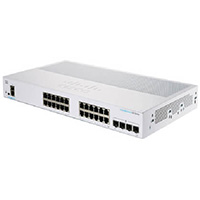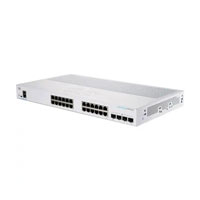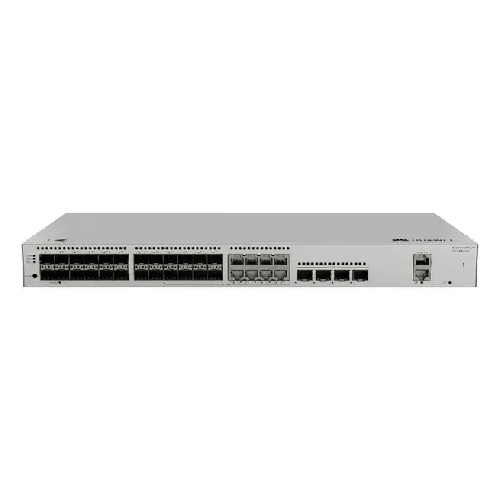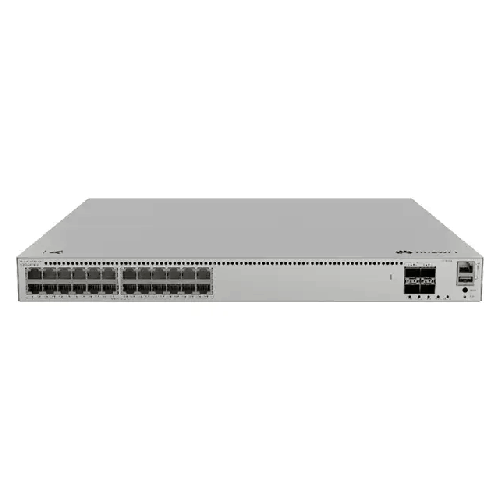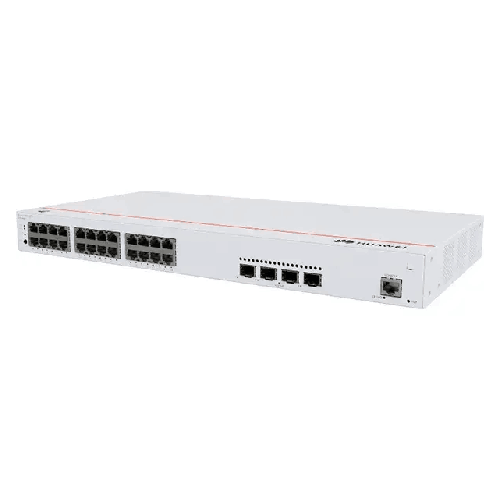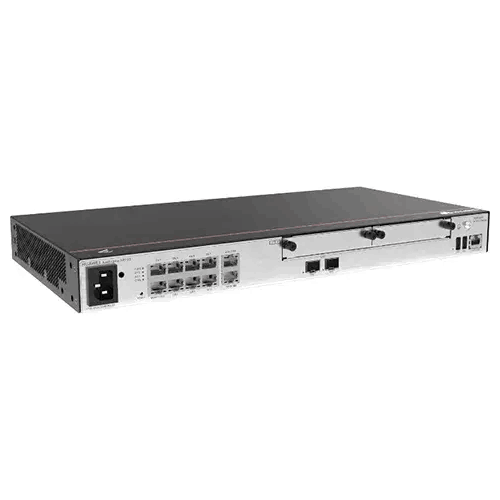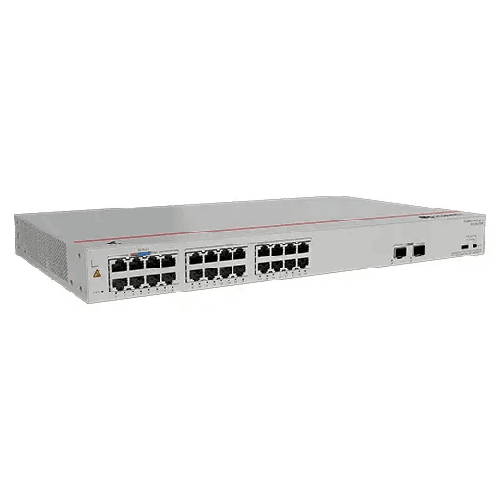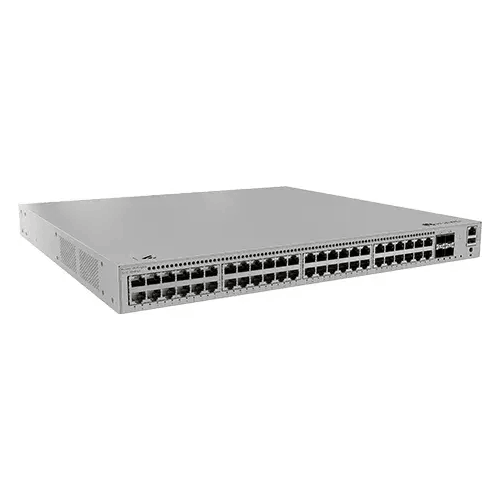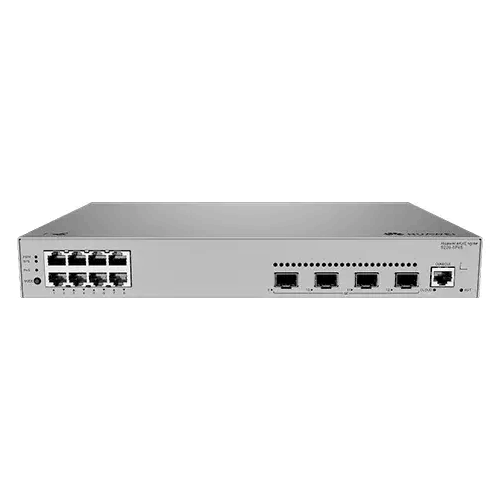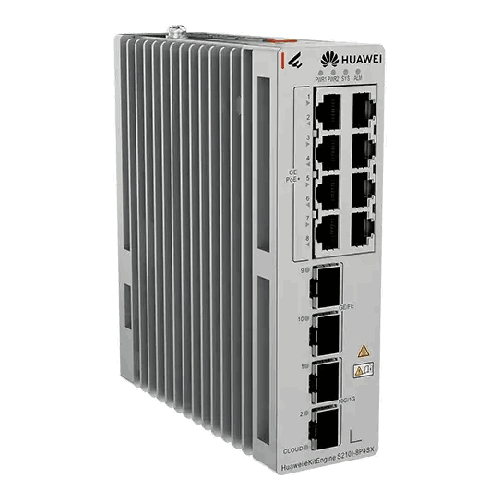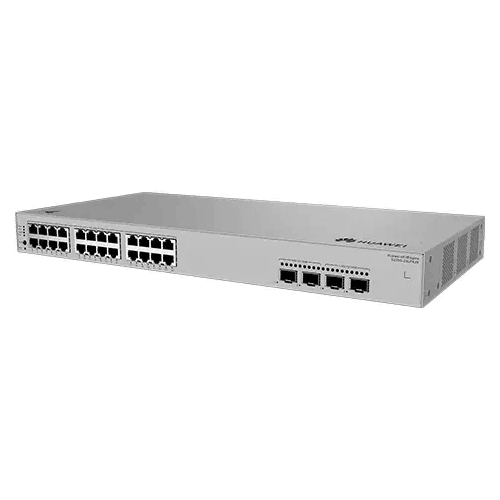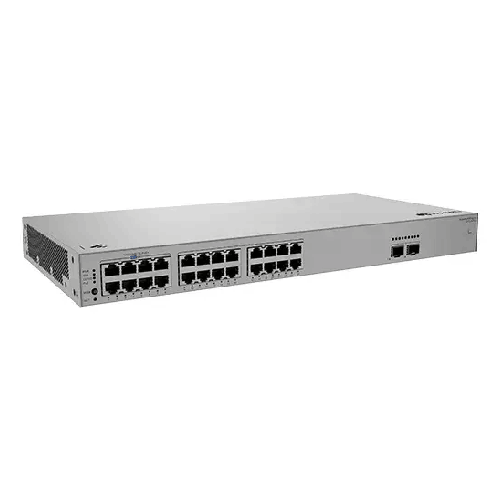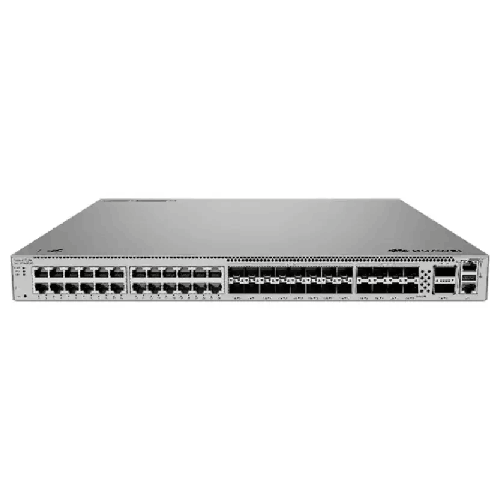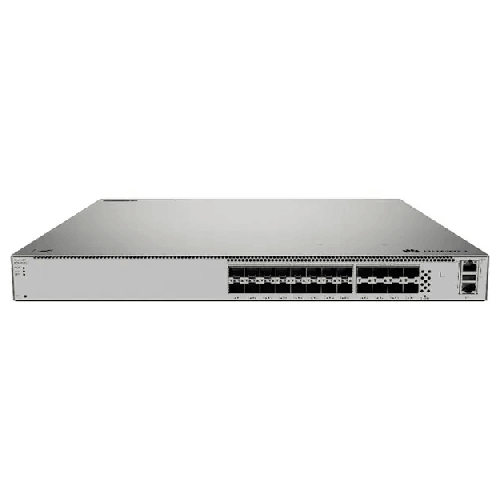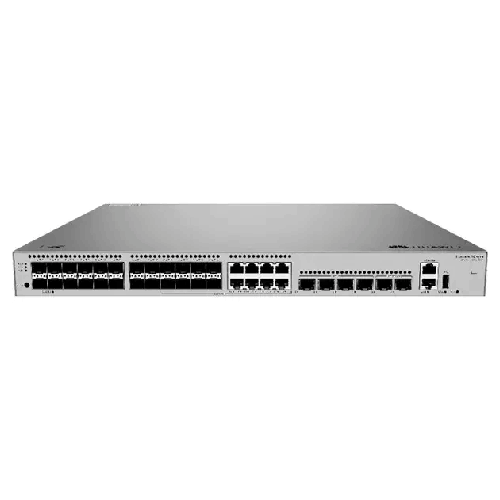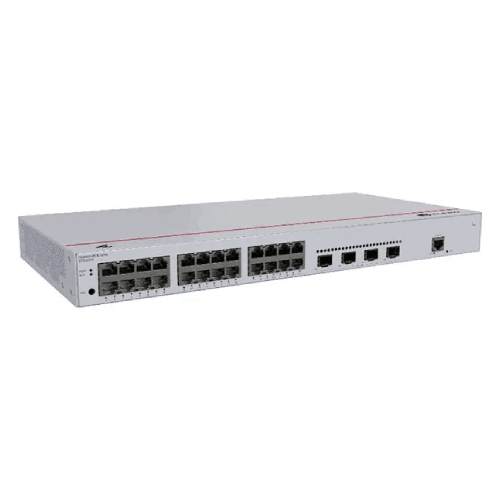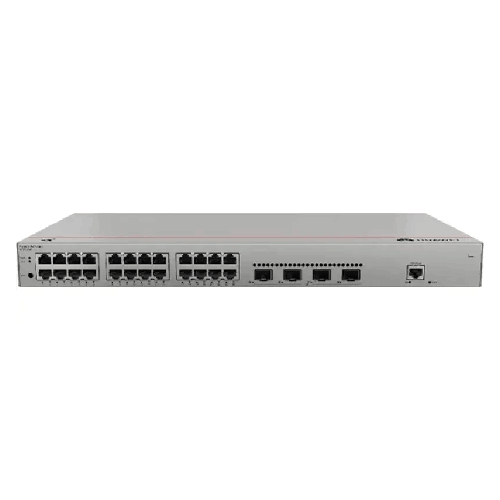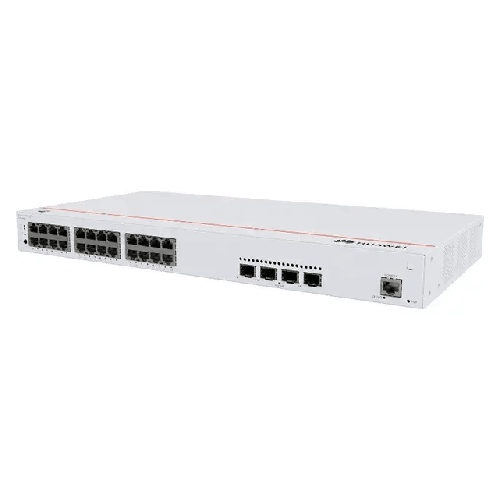
Huawei eKit S220-24P4X 24-Port 10/100/1000BASE-T & 4-Port 10GE SFP+ Managed PoE+ Switch
Regular Price:৳0.00Availability: SKU: 6.54.130.9158
Quick Overview
-
Support
Saturday – Thursday: 09 AM - 06 PM. -
Payment
Cash on Delivery | Card | Online Payment -
Shipping Cost
Inside Dhaka 100tk | Outside Dhaka 150tk -
Warranty Policy
Read More
Description
Huawei eKit S220-24P4X 24-Port 10/100/1000BASE-T & 4-Port 10GE SFP+ Managed PoE+ Switch Price in Bangladesh
The Huawei eKit S220-24P4X 24-Port 10/100/1000BASE-T & 4-Port 10GE SFP+ Managed PoE+ Switch is a business networking switch designed to combine Gigabit Ethernet connectivity, Power over Ethernet Plus, and high-speed 10 Gigabit optical uplinks in a single 1U rack-mount platform. It provides 24 × 10/100/1000BASE-T Ethernet ports with PoE+ and 4 × 10GE SFP+ ports, giving organizations a practical switching platform for modern office, surveillance, wireless, voice, and structured LAN deployments. Huawei's official S220 datasheet specifies 128 Gbps switching capacity and 95 Mpps packet-forwarding performance for the S220-24P4X.
One of the most important characteristics of this model is its 400 W PoE+ power budget. The PoE-enabled copper ports can deliver network connectivity and electrical power over Ethernet to compatible powered devices, helping reduce the need for separate power adapters and dedicated electrical cabling at each endpoint. Huawei specifies the S220-24P4X with a 400 W PoE+ capability.
The combination of 24 Gigabit copper ports and four 10GE SFP+ ports also makes the switch suitable for access-layer deployments where numerous devices operate at Gigabit Ethernet speeds but the aggregated uplink requires substantially greater bandwidth. The SFP+ interfaces can be used with compatible 10 Gigabit transceivers and fiber infrastructure according to the requirements of the network.
24 × 10/100/1000BASE-T PoE+ Ports
The S220-24P4X provides 24 × 10/100/1000BASE-T Ethernet ports, with Huawei specifying these copper ports as 400 W PoE+ capable.
These ports can connect computers, IP cameras, wireless access points, VoIP phones, printers, network appliances, and other compatible Ethernet devices. For PoE-powered endpoints, the same Ethernet connection can carry both network data and electrical power, provided the endpoint is compatible with the applicable PoE standard and the available power budget is sufficient.
This architecture can simplify installations because compatible devices do not necessarily need a separate local power adapter and electrical outlet near the network connection.
For example, a business can connect ceiling-mounted wireless access points to the switch through Ethernet cabling, allowing the switch to provide both network connectivity and PoE power. Similarly, compatible IP cameras and VoIP phones can be connected directly to PoE-enabled ports.
400 W PoE+ Power Budget
The S220-24P4X is specified with a 400 W PoE+ power budget. Huawei's official datasheet lists maximum power consumption of 44.35 W without PoE and 485.91 W with PoE, including 400 W PoE output.
The 400 W PoE+ budget should be considered at the network-design stage rather than simply assuming that all 24 ports can simultaneously deliver their maximum possible power.
The actual power available to individual endpoints depends on the power requirements of the connected devices and the total PoE budget. Therefore, a network containing high-power access points, cameras, or other powered devices should have its total endpoint power requirements calculated before installation.
This is particularly important for larger deployments where many PoE devices operate simultaneously.
Four 10GE SFP+ Ports
The S220-24P4X includes 4 × 10GE SFP+ ports. These interfaces provide high-speed uplink capability for compatible 10 Gigabit Ethernet transceivers and fiber infrastructure. Huawei confirms the four 10GE SFP+ ports in its official product documentation.
These ports can be used to connect the switch to an aggregation switch, core network, server infrastructure, or another compatible network device. The high-speed uplinks are especially useful when many Gigabit access ports are active simultaneously and the network requires greater uplink capacity.
The exact transmission distance and optical characteristics depend on the SFP+ transceiver, fiber type, wavelength, connector, and network design selected. Therefore, the SFP+ module should be selected according to the complete optical-link requirements.
128 Gbps Switching Capacity
Huawei's official English S220 datasheet specifies 128 Gbps switching capacity for the S220-24P4X.
Switching capacity is an important hardware specification because it indicates the internal switching bandwidth specified for the device. In a network with multiple active Gigabit ports and high-speed uplinks, adequate switching capacity helps provide the internal bandwidth required for traffic processing.
However, switching capacity should not be interpreted as a guaranteed application throughput figure. Actual network performance depends on traffic patterns, packet sizes, connected equipment, configured features, uplink utilization, and the architecture of the wider network.
95 Mpps Packet Forwarding Performance
The official English Huawei datasheet specifies 95 Mpps packet forwarding for the S220-24P4X.
Packet-forwarding performance describes the switch's specified packet-processing capability. Together with the switching-capacity figure, it provides useful information when evaluating the hardware for business-network deployment.
Actual application performance can vary depending on traffic characteristics and network configuration, so the 95 Mpps figure should be treated as the manufacturer's specified forwarding performance rather than a universal application-speed guarantee.
Managed Layer 2 Networking
Huawei's S220 platform is positioned as a managed Layer 2 switching platform. Huawei's SME network documentation identifies capabilities including 16K MAC entries and 4K VLANs, while the platform documentation lists Layer 2 protocols and management capabilities appropriate for structured business networks.
Managed switching provides significantly greater control than an unmanaged switch. Network administrators can configure VLANs, port behavior, topology-related features, and other network policies according to the requirements of the LAN.
For organizations with multiple departments or network services, VLAN segmentation can help logically separate traffic while retaining centralized physical switching infrastructure.
16K MAC Entries and 4K VLANs
Huawei's S220 documentation specifies 16K MAC address entries and 4K VLANs for the platform.
MAC address-table capacity is relevant when a switch is used in a network with many connected devices. VLAN capacity is equally important for organizations that need logical segmentation between different users, departments, services, or network zones.
For example, a company could design separate VLANs for employees, guests, surveillance devices, voice services, and other infrastructure components. The exact VLAN configuration should be designed together with the organization's router, firewall, wireless, server, and other switching infrastructure.
STP, RSTP, MSTP and ERPS
Huawei's S220 documentation identifies STP, RSTP, MSTP, and ERPS among the platform's Layer 2 capabilities.
These technologies can be relevant in network architectures containing redundant links or multiple interconnected switches. Spanning Tree variants help manage Layer 2 topology and prevent problematic switching loops in suitable configurations.
ERPS is relevant to Ethernet ring protection architectures. Its usefulness depends on the physical topology and the way the overall network is engineered.
Therefore, these capabilities are most valuable when the S220-24P4X forms part of a structured network rather than being deployed simply as a basic plug-and-play switch.
Cloud and On-Premise Management
Huawei states that the S220 series supports both cloud management and on-premise management modes, with the ability to switch between the two approaches according to requirements.
Huawei also documents cloud-based configuration, monitoring, and inspection through the Huawei eKit App for supported S220 switches.
This flexibility can be useful for businesses managing multiple network devices. Depending on the deployment model, administrators can use cloud-oriented management or maintain the switch through an on-premise management architecture.
The appropriate management method depends on the organization's IT policies, network architecture, administrative requirements, and available infrastructure.
PoE+ for Wireless Access Points
Modern wireless access points are frequently installed in locations where providing a separate AC power outlet can be inconvenient. A PoE+ switch can simplify such deployments by carrying power and data through the Ethernet connection to compatible devices.
The S220-24P4X's 400 W PoE+ budget makes it relevant to deployments containing multiple powered network endpoints. However, the total power demand of all connected devices should always be calculated before installation.
For a wireless network, this can be particularly useful when access points are positioned on ceilings, walls, corridors, or other locations where direct electrical infrastructure is less convenient.
PoE+ for IP Surveillance
IP cameras are another common PoE application. A compatible PoE-powered camera can receive network connectivity and electrical power through a single Ethernet cable.
The S220-24P4X can therefore be considered for surveillance networks where compatible PoE cameras are deployed throughout an office, commercial property, educational facility, or other structured environment.
The number of cameras supported from the PoE budget depends on their individual power requirements. High-power cameras with additional features can consume more power than basic camera models, so the total power calculation should be completed before deployment.
PoE+ for VoIP and Business Devices
Compatible VoIP phones can also benefit from PoE because a single Ethernet cable can provide both network access and electrical power.
A centralized PoE switch can simplify installation across office desks and meeting rooms by reducing the need for separate power adapters for compatible devices.
The S220-24P4X can therefore serve as part of a converged business network where computers, phones, wireless infrastructure, cameras, and other compatible devices share a managed Ethernet infrastructure.
10GE Uplinks for Aggregated Traffic
The four 10GE SFP+ ports provide an important architectural advantage when the switch is deployed as an access-layer device.
Twenty-four Gigabit Ethernet access connections can generate significant aggregate traffic. Using a higher-speed uplink toward an aggregation or core switch can provide a more suitable path for this combined traffic than relying only on a single Gigabit uplink.
The four SFP+ interfaces also allow network designers to consider multiple high-speed links according to the capabilities of the upstream equipment and the desired topology.
1U Rack-Mount Design
Huawei specifies 43.6 mm × 442 mm × 220 mm chassis dimensions and a 1U chassis height for the S220-24P4X.
This form factor is suitable for professional network racks and cabinets. A 1U switch can be installed alongside patch panels, routers, firewalls, servers, UPS equipment, and other rack-mounted infrastructure.
Huawei lists the full-configuration weight, including packaging materials, as 3.79 kg for the S220-24P4X.
Built-In AC Power
The S220-24P4X uses a built-in AC power module and has a rated input of 100–240 V AC, 50/60 Hz. Huawei specifies an AC input range of 90–290 V AC, 45–65 Hz for this model.
The switch's maximum power consumption is specified as 44.35 W without PoE and 485.91 W with PoE at a 400 W PoE load.
The difference is important when planning electrical infrastructure because a heavily loaded PoE switch requires substantially more input power than the same device operating without PoE load.
Cooling and Environmental Considerations
The S220 series uses active cooling with intelligent fan-speed adjustment according to Huawei's published documentation. Huawei's S220 materials also specify an operating temperature range of −5°C to +50°C, with storage temperature of −40°C to +70°C and relative humidity of 5% to 95% non-condensing.
For Bangladesh installations, adequate ventilation is particularly important in server rooms and network cabinets where multiple switches, servers, UPS systems, and other active equipment may operate simultaneously.
Because PoE operation can increase the switch's overall power consumption and heat generation, thermal planning should take the expected PoE load into account.
Designed for Modern Business Networks
The combination of Gigabit access, 400 W PoE+, 10GE SFP+ uplinks, managed Layer 2 functionality, and a 1U rack-mount form factor makes the S220-24P4X applicable to a broad range of professional networking scenarios.
It can serve as an access switch for offices, surveillance deployments, wireless networks, educational institutions, retail environments, branch offices, and other structured LAN installations.
The model is particularly relevant when the network requires both PoE+ endpoint support and high-speed 10GE uplinks in the same switching platform.
✅ Key Features
- 24 × 10/100/1000BASE-T PoE+ Ports: Provides 24 Gigabit Ethernet copper ports capable of supplying PoE+ power to compatible devices within the available power budget.
- 4 × 10GE SFP+ Ports: Provides four high-speed 10 Gigabit optical uplink interfaces for compatible SFP+ transceivers and fiber infrastructure.
- 400 W PoE+ Budget: Provides a substantial PoE+ power budget for compatible access points, IP cameras, VoIP phones, and other powered devices.
- 128 Gbps Switching Capacity: Huawei's official English datasheet specifies 128 Gbps switching capacity for the model.
- 95 Mpps Forwarding Performance: Provides Huawei's specified packet-forwarding capability for the S220-24P4X.
- 16K MAC Entries: Supports a substantial MAC address table for structured business networks.
- 4K VLANs: Supports VLAN-based network segmentation for suitable Layer 2 architectures.
- STP/RSTP/MSTP/ERPS: Provides Layer 2 topology and redundancy-related capabilities for supported network designs.
- Cloud & On-Premise Management: Supports both cloud and local management modes according to Huawei's S220 documentation.
- 1U Rack-Mount Design: Fits professional rack-based network infrastructure with a 43.6 × 442 × 220 mm chassis.
- Built-In AC Power: Uses an integrated AC power module with a 100–240 V AC, 50/60 Hz rated input.
- Intelligent Fan-Speed Adjustment: Supports active cooling with fan-speed adjustment for the operating environment.
✅ Usage / Applications
- Corporate Office Networks: Connect computers, printers, VoIP phones, access points, and other business devices.
- IP Surveillance Networks: Provide Ethernet connectivity and PoE+ power to compatible IP cameras.
- Wi-Fi Infrastructure: Power compatible wireless access points through Ethernet.
- VoIP Networks: Connect and power compatible IP phones from the switching infrastructure.
- Educational Institutions: Support computer labs, wireless access points, surveillance systems, and administrative networks.
- Retail Networks: Connect POS terminals, cameras, wireless devices, computers, and other Ethernet equipment.
- Branch Offices: Provide managed access networking with high-speed optical uplinks.
- Multi-Floor Buildings: Use 10GE SFP+ interfaces for suitable high-speed fiber connections between network layers.
- Server Room Access: Provide Gigabit endpoint connectivity with 10GE uplink options.
- Structured Enterprise LANs: Implement VLAN segmentation and managed Layer 2 networking.
✅ Benefits of This Product?
- Integrated PoE+ Connectivity: Compatible powered devices can receive data and electrical power through Ethernet.
- 400 W PoE Budget: Provides substantial centralized power capacity for a multi-device PoE deployment.
- High-Speed 10GE Uplinks: Four SFP+ interfaces provide higher-bandwidth connectivity toward aggregation or core infrastructure.
- 24 Gigabit Access Ports: Provides substantial wired endpoint density in a 1U chassis.
- Managed Network Control: Allows administrators to configure and manage the network instead of relying on basic unmanaged switching.
- VLAN Segmentation: 4K VLAN support provides flexibility for logical network separation.
- Layer 2 Redundancy Features: STP, RSTP, MSTP, and ERPS can support appropriate resilient network designs.
- Flexible Management: Cloud and on-premise management modes provide different approaches to network administration.
- Rack-Friendly Design: The 1U chassis is appropriate for structured server rooms and network cabinets.
- Centralized Power Distribution: PoE allows compatible endpoints to receive power from the network switch rather than requiring individual local power supplies.
✅ Ideal For
The Huawei eKit S220-24P4X is particularly suited to organizations that need a combination of 24 Gigabit PoE+ access ports and four 10GE SFP+ uplinks. It can be considered for corporate offices, SMEs, educational institutions, retail locations, surveillance networks, wireless deployments, branch offices, and structured enterprise LANs.
Its 400 W PoE+ budget makes it relevant where multiple compatible powered devices must receive network connectivity and electrical power through Ethernet. Typical examples include IP cameras, wireless access points, and VoIP phones.
The four 10GE SFP+ interfaces are useful when the access switch needs to connect to a higher-capacity aggregation or core layer. This is particularly relevant when many Gigabit endpoints are active at the same time and the network requires higher-speed uplinks.
The model is also appropriate for organizations that need VLAN-based segmentation, managed Layer 2 functionality, and redundancy-related protocols such as STP, RSTP, MSTP, or ERPS.
Before deployment, buyers should calculate the expected PoE load, confirm compatible endpoint requirements, select appropriate SFP+ transceivers, and verify the complete network topology.
✅ Why Choose the Huawei eKit S220-24P4X 24-Port 10/100/1000BASE-T & 4-Port 10GE SFP+ Managed PoE+ Switch?
The Huawei eKit S220-24P4X brings together three important networking requirements in one platform: Gigabit Ethernet access, PoE+ power delivery, and 10GE optical uplinks.
Its 24 × 10/100/1000BASE-T ports provide the access connectivity required by conventional Ethernet endpoints, while the 400 W PoE+ budget allows compatible powered devices to receive power through Ethernet. Huawei separately identifies the S220-24P4X as the PoE+ variant of the 24-port S220 configuration.
The four 10GE SFP+ ports provide another major advantage for network architecture. Instead of limiting the uplink to conventional Gigabit connectivity, administrators can build high-speed optical connections toward aggregation or core network equipment. This can be particularly useful when multiple Gigabit access ports are active simultaneously.
The switch also provides managed Layer 2 capabilities, including support documented for 16K MAC entries, 4K VLANs, STP, RSTP, MSTP, and ERPS.
For businesses that need PoE-powered endpoints, this model also avoids the need to select a separate non-PoE switch and external power-injection architecture, provided the connected devices and total power requirements are compatible.
Its 1U chassis, built-in AC power supply, cloud/on-premise management options, and high-speed SFP+ uplinks make it a practical component for structured professional network infrastructure.
✅ Why Buy This Product from BME?
When purchasing professional networking equipment in Bangladesh, identifying the exact Huawei model is important because closely related S220 switches can have different port types, uplink speeds, and PoE capabilities.
The Huawei eKit S220-24P4X should be specified by its complete model number when requesting a quotation or checking availability. This helps distinguish it from the S220-24T4X, which has the same basic port arrangement but does not provide the 400 W PoE+ capability. Huawei's official datasheet confirms the distinction between the two models.
For business and institutional procurement, buyers should provide the required quantity, PoE requirements, expected power consumption of connected devices, SFP+ requirements, fiber specifications, and intended deployment environment.
BME can be used as a Bangladesh sourcing channel for buyers looking for Huawei eKit networking equipment. For larger deployments, specifying the complete model number in the quotation and purchase documentation can help maintain technical clarity throughout the procurement process.
Before purchasing, it is also sensible to confirm whether compatible SFP+ modules, fiber accessories, rack hardware, and other deployment components are required for the intended installation.
✅ Buying Guide
1. Confirm the Exact Model:
Make sure the required product is S220-24P4X, rather than the non-PoE S220-24T4X.
2. Check the PoE Requirement:
The S220-24P4X provides a 400 W PoE+ budget. Calculate the combined power requirement of all planned powered devices before installation.
3. Count Your Gigabit Endpoints:
The switch provides 24 × 10/100/1000BASE-T ports. Confirm that this is sufficient for the intended wired devices.
4. Plan Your 10GE Uplinks:
The switch provides four 10GE SFP+ ports. Confirm that the upstream switch, router, server, or aggregation infrastructure supports the intended 10 Gigabit connection.
5. Select Compatible SFP+ Transceivers:
Match the transceiver to the required fiber type, wavelength, connector, transmission distance, and equipment compatibility.
6. Calculate PoE Load:
Do not simply divide 400 W by 24 ports. Calculate the actual power requirements of every PoE endpoint and maintain appropriate power headroom.
7. Plan VLANs:
If the network requires separate traffic groups for users, guests, cameras, voice, or other services, design the VLAN architecture before deployment.
8. Plan Redundant Links Carefully:
If redundant Layer 2 paths are required, determine whether STP, RSTP, MSTP, or ERPS is appropriate for the planned topology.
9. Check Rack Space:
The chassis is 1U and measures 43.6 × 442 × 220 mm. Verify available rack space and airflow clearance.
10. Check Electrical Capacity:
With PoE active, Huawei specifies maximum power consumption of 485.91 W at a 400 W PoE load. Ensure the electrical infrastructure can accommodate the expected load.
11. Consider Heat and Ventilation:
PoE operation increases the switch's power consumption. Maintain appropriate ventilation in the network cabinet or server room.
12. Match the Complete Network Architecture:
Verify compatibility with firewalls, routers, aggregation switches, access points, IP cameras, VoIP devices, servers, fiber infrastructure, and management systems.
✅ Customers Ask About / Frequently Asked Questions
Q1. Is the Huawei S220-24P4X a managed switch?
Yes. Huawei identifies the S220 family as a managed Layer 2 switching platform.
Q2. How many copper Ethernet ports does it have?
It has 24 × 10/100/1000BASE-T Ethernet ports.
Q3. How many SFP+ ports are included?
The switch has 4 × 10GE SFP+ ports.
Q4. Does the Huawei S220-24P4X support PoE+?
Yes. Huawei specifies 400 W PoE+ for the S220-24P4X.
Q5. What is the switching capacity?
Huawei's official English S220 datasheet specifies 128 Gbps switching capacity.
Q6. What is the packet-forwarding performance?
The official English datasheet specifies 95 Mpps packet forwarding.
Q7. Can it power IP cameras?
Yes, compatible PoE-powered IP cameras can receive power and network connectivity through the PoE-enabled Ethernet ports, subject to their power requirements and the switch's total 400 W PoE budget.
Q8. Can it power wireless access points?
Yes, compatible PoE/PoE+ wireless access points can be powered through the Ethernet ports, provided their power requirements are within the available PoE budget.
Q9. Does it support VLANs?
Yes. Huawei's S220 documentation specifies support for up to 4K VLANs.
Q10. Does it support STP and RSTP?
Yes. Huawei lists STP, RSTP, MSTP, and ERPS among the S220 platform capabilities.
Q11. Is the switch suitable for rack installation?
Yes. Huawei specifies a 1U chassis measuring 43.6 × 442 × 220 mm.
Q12. What is the power input?
The switch has a built-in AC power module with a rated input of 100–240 V AC, 50/60 Hz.
Q13. Does the switch support cloud management?
Yes. Huawei states that the S220 series supports both cloud and on-premise management modes.
Q14. What is the difference between S220-24P4X and S220-24T4X?
The key difference is PoE. The S220-24P4X has 400 W PoE+, while the S220-24T4X is the corresponding non-PoE configuration. Both are specified with 24 Gigabit copper ports and four 10GE SFP+ ports in Huawei's official datasheet.
✅ Why Buy This Product
The Huawei eKit S220-24P4X is a managed Gigabit Ethernet switch built for deployments that require PoE+ endpoint power and 10GE optical uplinks in the same network device. It provides 24 × 10/100/1000BASE-T PoE+ ports, four 10GE SFP+ interfaces, 400 W PoE capacity, and Huawei-specified 128 Gbps switching capacity and 95 Mpps forwarding performance.
Its managed Layer 2 capabilities, VLAN support, MAC address capacity, and topology-management features provide the configuration flexibility expected in structured business networks.
For organizations deploying IP cameras, wireless access points, VoIP phones, and other compatible PoE devices, the integrated 400 W PoE+ architecture can simplify network and power distribution. Meanwhile, the 10GE SFP+ ports provide high-speed uplink options toward aggregation or core infrastructure.
For professional networking projects in Bangladesh, use the complete model name Huawei eKit S220-24P4X when requesting availability, quotation, and technical confirmation.
What is the price of Huawei eKit S220-24P4X 24-Port 10/100/1000BASE-T & 4-Port 10GE SFP+ Managed PoE+ Switch in Bangladesh?
Write a review
Question Answer
Have question about this product? Get specific details about this product from expert.