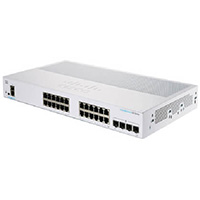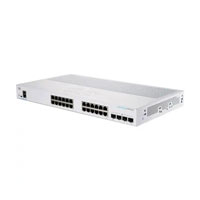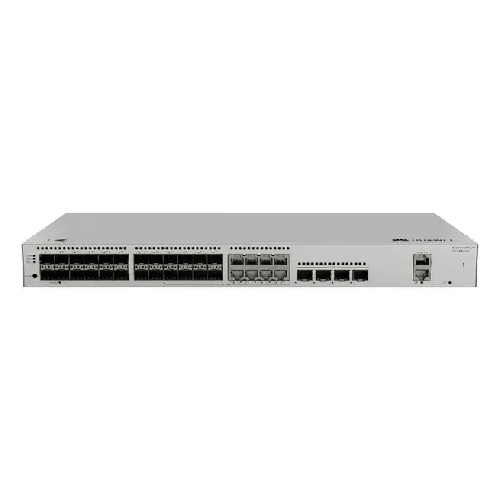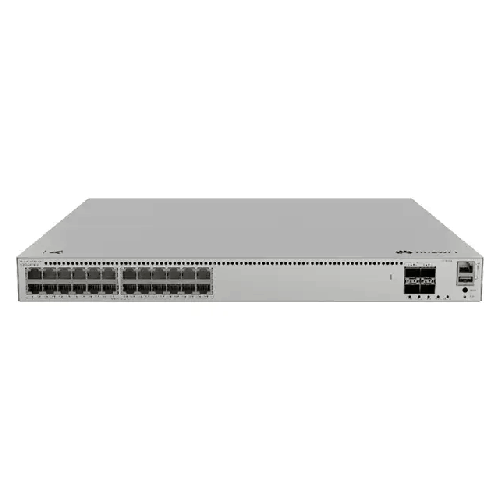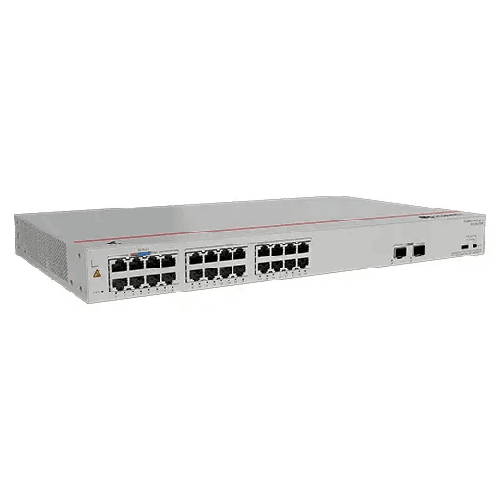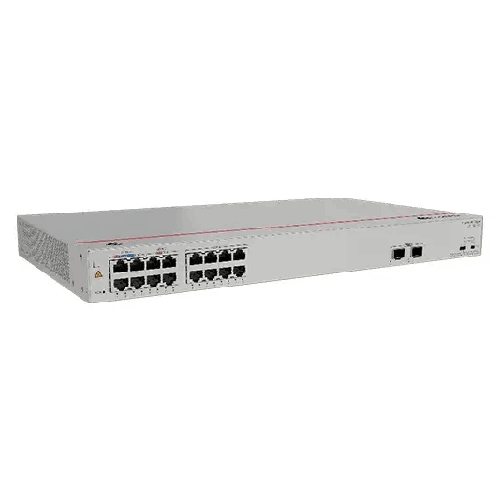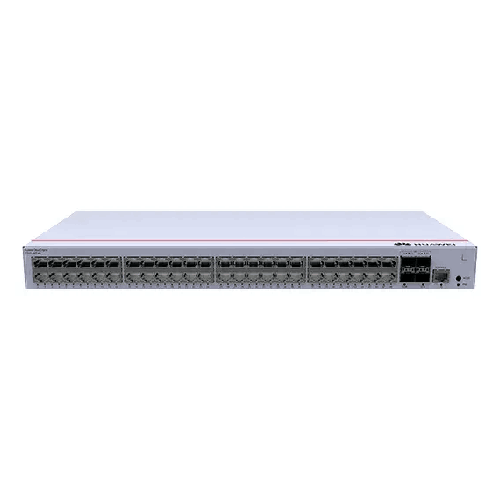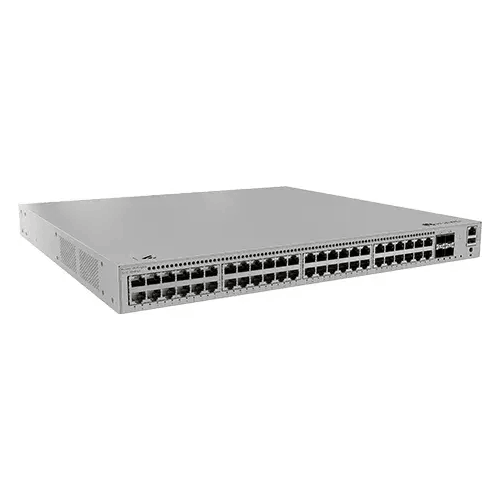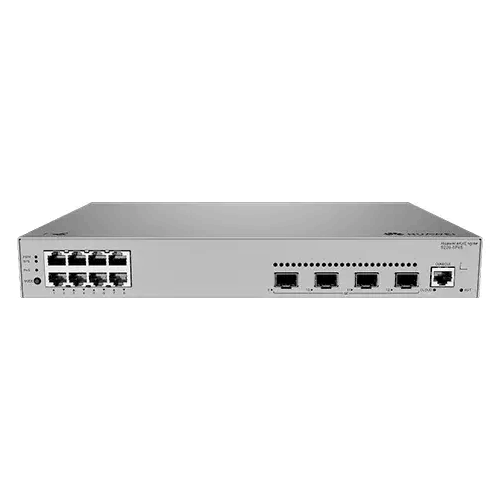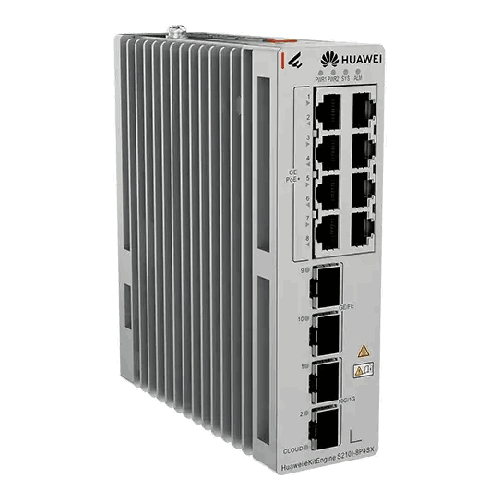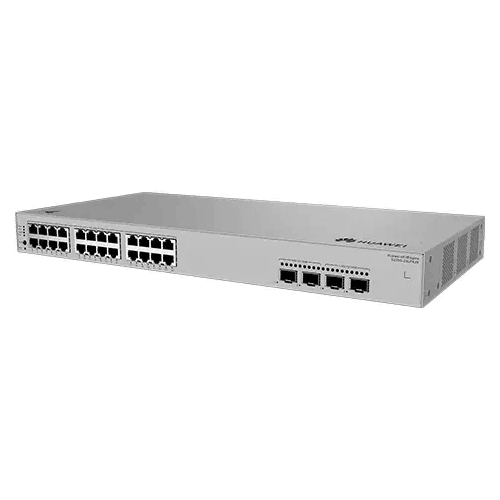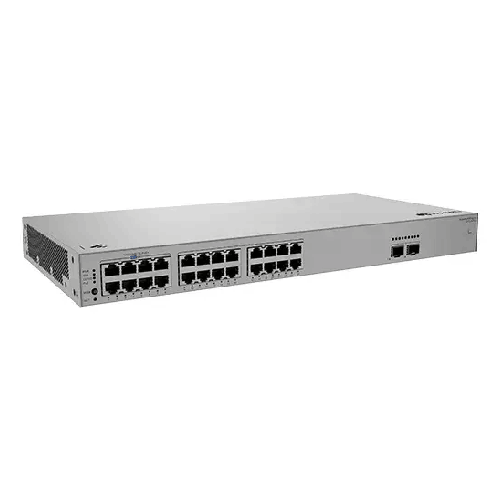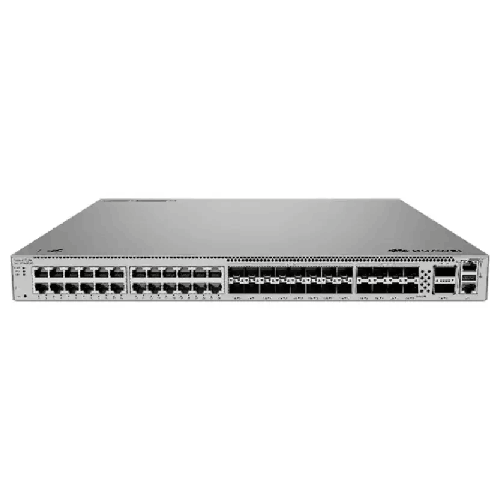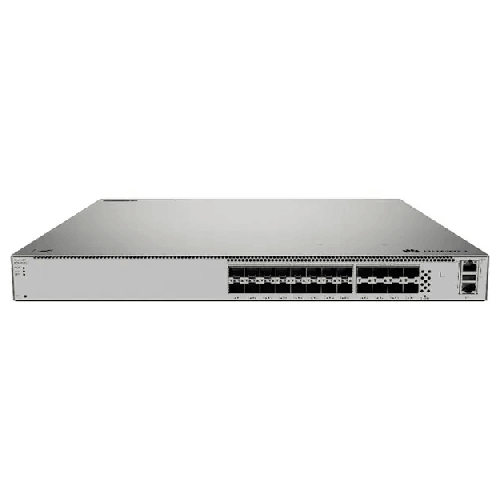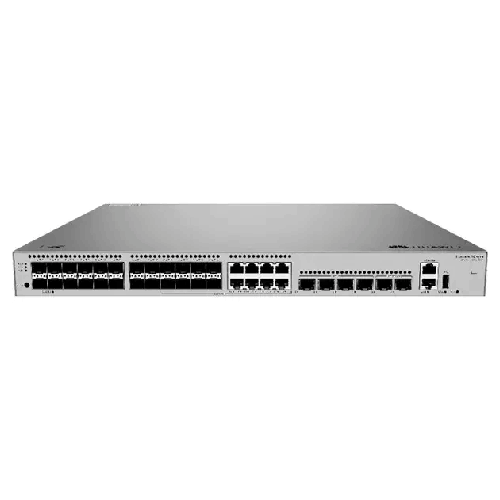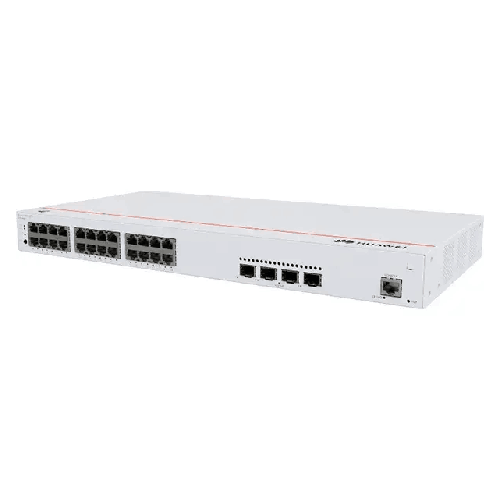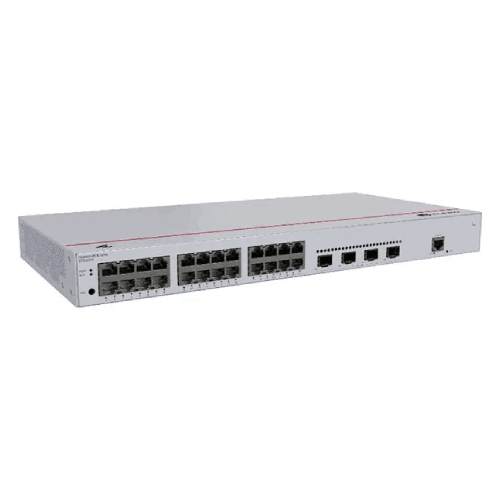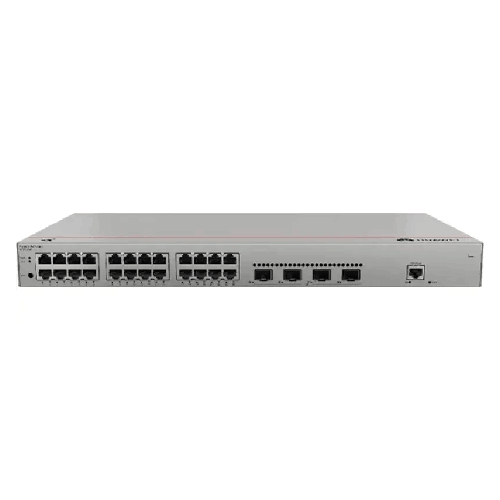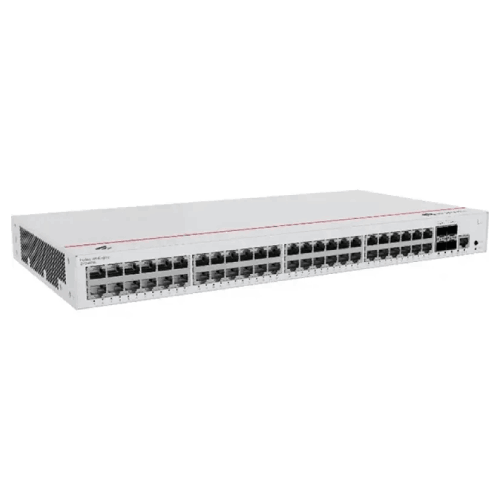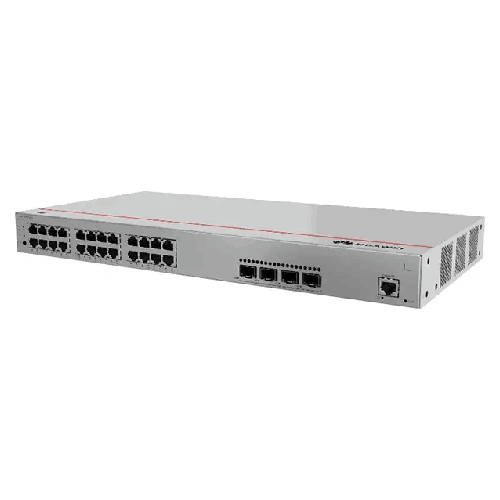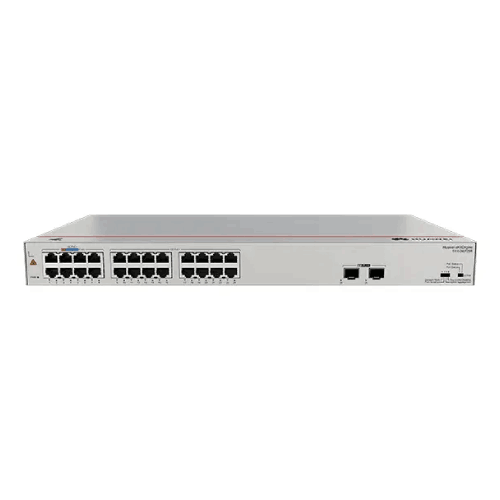
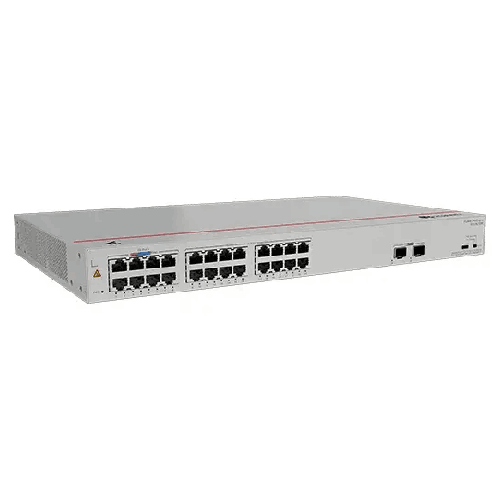
Huawei eKitEngine S110-24LP2SR Layer 2 Unmanaged 24-Port PoE Switch
Regular Price:৳0.00Availability: SKU: 6.54.130.9169
Quick Overview
-
Support
Saturday – Thursday: 09 AM - 06 PM. -
Payment
Cash on Delivery | Card | Online Payment -
Shipping Cost
Inside Dhaka 100tk | Outside Dhaka 150tk -
Warranty Policy
Read More
Description
Huawei eKitEngine S110-24LP2SR Layer 2 Unmanaged 24-Port PoE Switch Price in Bangladesh
The Huawei eKitEngine S110-24LP2SR Layer 2 Unmanaged 24-Port PoE Switch is a Gigabit Ethernet access switch designed for networks that need a higher number of PoE-capable copper connections while maintaining a straightforward, unmanaged operating model. It provides 24 × 10/100/1000BASE-T PoE+ ports together with 2 × GE SFP ports, creating a practical combination of copper access connectivity and fiber-oriented uplink capability. Huawei specifies a 52 Gbit/s switching capacity and 38.69 Mpps packet forwarding rate for this model.
For businesses, offices, retail environments, educational institutions, hotels, surveillance deployments, and other SME applications in Bangladesh, the S110-24LP2SR offers a convenient way to connect multiple Ethernet devices through one access switch. Its 24 PoE+ ports can provide both data connectivity and power to compatible PoE devices, reducing the need for separate power arrangements at every compatible endpoint.
The switch supports Gigabit Ethernet on its copper ports, allowing computers, network printers, IP cameras, wireless access points, and other compatible network devices to operate through the same access infrastructure. The additional two GE SFP interfaces can be used for suitable Gigabit optical uplinks, depending on the selected SFP transceiver and fiber architecture.
Huawei positions the S110 series as an unmanaged switch family. This is an important distinction for buyers. The S110-24LP2SR is designed for straightforward connectivity rather than the extensive software configuration available from managed switch platforms. For networks that primarily need Ethernet connectivity and PoE deployment without complex switch administration, this operating model can simplify installation and day-to-day use.
✅ 24-Port Gigabit PoE+ Connectivity
The S110-24LP2SR features 24 × 10/100/1000BASE-T RJ45 ports, with all 24 supporting PoE+. These ports can operate at 10 Mbps, 100 Mbps, or 1000 Mbps depending on the connected Ethernet device and network conditions.
Having 24 copper ports makes the model particularly useful when a network has more connected endpoints than a typical 8-port or 16-port access switch can accommodate. A single switch can provide connectivity for a larger group of office computers, IP cameras, access points, and other Ethernet equipment.
The Gigabit capability is useful for applications where network traffic can be relatively demanding. IP surveillance systems, wireless access points, office workstations, shared network resources, and other connected devices can benefit from Gigabit-class access connectivity.
However, the actual throughput experienced by an individual endpoint depends on the capabilities of the endpoint, cabling, upstream network, traffic conditions, and overall network design.
✅ 124W Maximum PoE Power
A major feature of the Huawei S110-24LP2SR is its integrated PoE+ capability. Huawei specifies a maximum PoE power capacity of 124W for the switch.
This allows compatible powered devices to receive electrical power through Ethernet cabling while simultaneously communicating over the same connection. For suitable network installations, this can significantly simplify cabling and endpoint deployment.
For example, a compatible IP camera can receive network connectivity and power from the switch through one Ethernet cable. A compatible wireless access point can similarly use PoE instead of requiring a separate local power adapter.
The 124W figure represents the total available PoE power budget, not 124W per port. Therefore, buyers should calculate the combined power requirements of all intended PoE devices before deployment.
Huawei's specifications indicate that the model can support a full load scenario equivalent to eight devices at 15.4W or four devices at 30W, while the total maximum PoE budget is 124W.
This makes power-budget planning particularly important for CCTV and wireless deployments.
✅ 52 Gbit/s Switching Capacity
Huawei specifies a 52 Gbit/s switching capacity for the S110-24LP2SR.
Switching capacity describes the internal switching bandwidth available within the switch architecture. For a 24-port Gigabit access switch, this specification provides an important reference point when assessing its ability to handle traffic across its Ethernet interfaces.
In practical terms, the S110-24LP2SR is designed around Gigabit access connectivity rather than slower Fast Ethernet-only networking. This makes it suitable for modern SME access environments where multiple connected endpoints may generate network traffic simultaneously.
Actual network performance remains dependent on the connected devices, upstream bandwidth, cabling quality, traffic patterns, and network topology.
✅ 38.69 Mpps Packet Forwarding Rate
The S110-24LP2SR has a specified packet forwarding rate of 38.69 Mpps.
Packet forwarding performance is relevant when a switch handles many individual Ethernet frames across multiple interfaces. This specification provides buyers with a measurable indication of the platform's forwarding capability.
For an office network, surveillance environment, or access-point deployment, traffic can originate from many connected devices at the same time. A defined forwarding rate is therefore useful when comparing network-switch specifications.
As with switching capacity, the stated forwarding rate should be viewed as a hardware specification rather than a guarantee of a specific application-level throughput.
✅ Two GE SFP Uplink Ports
Alongside its 24 copper ports, the S110-24LP2SR provides 2 × GE SFP ports.
These interfaces give network designers the option of using compatible Gigabit SFP transceivers for fiber-based uplink connections. This can be useful when the switch needs to connect to another network device over an optical link.
Fiber can be advantageous in situations where the upstream network connection requires a different physical medium from the copper access connections. For example, a switch serving one section of a building may use an optical uplink toward an upstream network device.
The exact transmission distance and fiber characteristics depend on the selected SFP transceiver and fiber infrastructure. Therefore, buyers should select the appropriate optical module based on the project's requirements rather than assuming a particular distance from the SFP interface alone.
✅ Unmanaged Layer 2 Operation
The Huawei S110-24LP2SR belongs to the S110 family of unmanaged switches. Huawei's S110 documentation identifies the series as offering simple operating modes rather than the extensive management features associated with fully managed switch families.
This can be useful in installations where the primary requirement is straightforward Ethernet and PoE connectivity.
An unmanaged switch generally reduces the configuration burden because users do not need to establish the same level of software-based switch administration required by a managed platform.
At the same time, buyers should understand the trade-off. If a project requires advanced VLAN administration, detailed access-control policies, extensive monitoring, sophisticated Layer 3 routing, or centralized switch management, a suitable managed Huawei switch should be considered instead.
For straightforward access connectivity, however, the unmanaged approach can be practical and easy to deploy.
✅ Suitable for IP Surveillance
The combination of 24 PoE+ ports and Gigabit Ethernet makes the S110-24LP2SR particularly relevant to IP surveillance installations.
A CCTV deployment may involve multiple IP cameras positioned around an office, retail location, school, hotel, warehouse, or commercial building. Using a PoE switch allows compatible cameras to receive both network connectivity and electrical power over Ethernet.
The 24-port configuration provides more endpoint capacity than smaller PoE switches, while the 124W total PoE budget provides a clearly defined power ceiling for project planning.
Huawei's S110 documentation includes the S110-24LP2SR in its product specifications, while Huawei's broader SME networking materials position the S110 family for SME and video-security scenarios.
For a surveillance project, buyers should still calculate the actual power consumption of every selected camera, particularly if the cameras include additional features that affect their power requirements.
✅ Wireless Access Point Deployment
PoE is also useful when deploying compatible wireless access points.
A wireless access point is often installed in a ceiling, corridor, wall area, or other location where a conventional electrical outlet may not be convenient. With a compatible PoE design, the network cable can provide both data connectivity and power.
The S110-24LP2SR can therefore be considered for small and medium wireless infrastructure projects where multiple PoE-capable access points need Ethernet connectivity.
Again, the total power requirements should be checked before deployment. The switch's maximum PoE capacity is 124W, so the combined requirements of the access points and any other powered devices must remain within the available budget.
✅ Rack, Desk, and Wall Installation
Huawei specifies rack mounting, desk mounting, and wall mounting for the S110-24LP2SR.
This gives installers flexibility when selecting the physical location for the switch.
A structured network cabinet can provide a suitable environment for rack installation, while a small office or shop may use a desktop or wall-mounted arrangement.
The switch has basic dimensions of 43.6 × 442 × 260 mm, while the maximum listed dimensions are 43.6 × 442 × 267 mm. Huawei lists a weight of approximately 3.2 kg without packaging.
Before installation, sufficient room should be allowed for Ethernet cables, SFP connections, power connections, ventilation, and future maintenance.
✅ Natural Heat Dissipation
Huawei specifies natural heat dissipation for the S110-24LP2SR.
This means the product is designed without relying on an active fan-based cooling system. A fanless or naturally cooled design can be useful in environments where minimizing mechanical noise is desirable.
Even with natural heat dissipation, proper installation remains important. Network equipment should not be placed in an enclosed location that prevents appropriate heat dissipation.
The installation environment should also remain within Huawei's specified operating conditions. Huawei lists a long-term operating temperature of 0°C to 40°C at an altitude of 0–1800 m, with operating humidity of 5% to 95% RH, non-condensing.
✅ Built-In AC Power Supply
The S110-24LP2SR uses a built-in AC power supply. Huawei specifies a rated input of 100–240V AC, 50/60Hz, with an operating input range of 90–300V AC at 47–63Hz.
For Bangladesh installations, buyers should still ensure that the switch is connected to a properly protected electrical supply.
Huawei also specifies power-supply surge protection of ±6kV in differential and common mode on the current product specification.
Where network availability is important, appropriate site-level electrical protection and backup power planning should be considered as part of the overall installation.
✅ Practical Power Consumption
Huawei lists typical power consumption of approximately 24W, while maximum power consumption is 24W without PoE and 165W at full PoE load, including the 124W PoE budget.
These figures are useful when planning the electrical requirements of a networking cabinet or equipment location.
The actual consumption of a deployed switch depends on the traffic and PoE load. A switch with only a few low-power PoE devices connected will generally have a different total power requirement from a switch operating close to its maximum PoE budget.
For projects with multiple cameras or access points, calculating the expected PoE demand beforehand helps avoid designing a network that exceeds the switch's available power capacity.
✅ Metal Chassis and Compact Network Design
Huawei specifies a metal chassis for the S110-24LP2SR.
The 43.6 mm height and 442 mm width give the switch a compact rack-oriented form factor, while its 260 mm basic depth allows installers to account for cabinet depth and cable-management requirements.
The switch weighs approximately 3.2 kg without packaging and 3.7 kg with packaging according to Huawei's current specifications.
For structured installations, buyers should consider both the physical dimensions of the switch and the additional space required for connected cables.
✅ Key Features
- 24 × Gigabit PoE+ RJ45 Ports: Provides 24 × 10/100/1000BASE-T copper ports with PoE+ support.
- 2 × GE SFP Ports: Provides two Gigabit SFP interfaces for compatible optical uplinks.
- 124W Maximum PoE Budget: Supports up to 124W total PoE power for compatible powered endpoints.
- 52 Gbit/s Switching Capacity: Provides the specified switching capacity for Gigabit-class access networking.
- 38.69 Mpps Forwarding Rate: Provides the specified packet-forwarding capability for network traffic.
- Unmanaged Operation: Designed for straightforward network deployment without the configuration requirements of a conventional managed switch.
- Natural Heat Dissipation: Uses natural cooling rather than an active fan-based cooling system.
- Built-In AC Power: Uses an integrated AC power supply with a 90–300V AC input range.
- Flexible Installation: Supports rack, desk, and wall mounting.
- Metal Chassis: Provides a metal physical enclosure for the networking hardware.
- 8K MAC Address Entries: Huawei's S110 series datasheet lists 8K MAC address entries for the 16/24-port models.
✅ Usage / Applications
- IP CCTV Surveillance: Connect compatible PoE+ IP cameras through Gigabit Ethernet.
- Office Networks: Provide access connectivity for computers, printers, and other Ethernet devices.
- Wireless Access Points: Connect and power compatible PoE-capable Wi-Fi access points.
- Retail Stores: Support networking for surveillance, computers, access points, and other connected equipment.
- Hotels and Guesthouses: Provide Ethernet and PoE access for compatible network infrastructure.
- Schools and Training Centers: Connect computers, cameras, access points, and administrative network equipment.
- Commercial Buildings: Provide a 24-port access layer for localized network segments.
- Small and Medium Businesses: Offer Gigabit access connectivity with integrated PoE.
- Video-Security Networks: Centralize multiple PoE surveillance endpoints within one access switch.
- Fiber-Uplink Networks: Use the two GE SFP interfaces for compatible optical uplink connections.
- Network Expansion: Add additional Gigabit and PoE access capacity to an existing infrastructure.
- Small Hospitality Networks: Connect compatible cameras and wireless infrastructure through PoE.
✅ Benefits of This Product
- 24-Port Capacity: Provides more copper access connections than smaller 8-port and 16-port models.
- Integrated PoE+: Allows compatible powered devices to receive power through Ethernet cabling.
- 124W PoE Budget: Provides a defined total power budget for compatible PoE deployments.
- Gigabit Connectivity: Supports 10/100/1000BASE-T on all 24 copper ports.
- Fiber Uplink Support: Two GE SFP interfaces provide an optical connectivity option.
- Simple Deployment: The unmanaged design avoids the configuration requirements of a managed switch.
- High Port Density: Combines 24 PoE+ copper ports with two SFP uplinks in one device.
- Natural Cooling: Fanless natural heat dissipation can be useful where mechanical fan noise is undesirable.
- Flexible Installation: Rack, desk, and wall mounting support different deployment environments.
- Defined Performance: 52 Gbit/s switching capacity and 38.69 Mpps forwarding provide clear hardware specifications for planning.
✅ Ideal For
The Huawei eKitEngine S110-24LP2SR is ideal for businesses and organizations that need a larger number of Gigabit PoE connections without requiring the complexity of a fully managed switch. With 24 PoE+ RJ45 ports, the model can support network environments containing multiple compatible IP cameras, wireless access points, computers, and other Ethernet devices.
It is particularly suitable for small and medium businesses, offices, retail stores, schools, hotels, surveillance installations, and commercial network deployments where a centralized PoE access switch is required.
The two GE SFP ports also make it useful for installations where the access switch needs a compatible fiber-based uplink to another network device. Meanwhile, its unmanaged design can simplify deployment where advanced VLAN, routing, ACL, or centralized switch-management functions are not required.
For CCTV projects, the 124W PoE budget should be carefully compared with the combined power requirements of the selected cameras. For Wi-Fi deployments, the same principle applies to PoE-capable access points.
Overall, the S110-24LP2SR is best considered when a project requires 24 Gigabit PoE+ access ports, two GE SFP interfaces, straightforward operation, and a clearly defined 124W PoE budget.
✅ Why Choose the Huawei eKitEngine S110-24LP2SR?
The Huawei eKitEngine S110-24LP2SR combines a 24-port Gigabit access configuration with PoE+ and two GE SFP uplink interfaces. This makes it suitable for network environments where several Ethernet endpoints need to be connected through one centralized access switch.
Its 24 × 10/100/1000BASE-T PoE+ ports provide a significant amount of copper access capacity, while the 2 × GE SFP ports provide an option for compatible optical uplinks. Huawei specifies 52 Gbit/s switching capacity and 38.69 Mpps packet forwarding for the model.
The 124W PoE budget is particularly relevant for surveillance and wireless-network installations. Instead of calculating only the number of ports required, buyers can compare the total power requirements of their intended endpoints against the available PoE budget.
Another important factor is the switch's unmanaged positioning. The S110 family is intended for straightforward networking rather than extensive switch administration. This can be advantageous for deployments where the primary requirement is reliable Ethernet and PoE connectivity without advanced configuration.
The product also supports rack, desk, and wall mounting and uses natural heat dissipation, giving installers flexibility in choosing the physical deployment environment.
For buyers comparing 24-port PoE switches, the most important considerations remain port count, Gigabit capability, PoE budget, uplink type, physical installation, and management requirements. When those requirements align with an unmanaged PoE access design, the S110-24LP2SR provides a clearly documented Huawei platform.
✅ Why Buy This Product from BME?
Choosing the correct networking switch requires more than comparing the number of Ethernet ports. Buyers should also consider the PoE budget, uplink architecture, installation location, endpoint requirements, and whether the network requires managed or unmanaged operation.
BME can be considered by Bangladesh businesses and organizations sourcing professional networking equipment for office, surveillance, commercial, education, hospitality, and other infrastructure projects.
For the Huawei S110-24LP2SR, buyers should pay particular attention to the 124W total PoE budget. A project with 24 PoE devices does not necessarily require 24 identical amounts of power, so the actual consumption of every intended camera, access point, or other powered device should be calculated before purchase.
The two GE SFP ports should also be considered when planning the upstream connection. If the project requires fiber, the correct compatible SFP transceivers and fiber infrastructure should be selected according to the required network design.
BME customers can also evaluate the switch according to the overall project requirements rather than choosing equipment solely based on the port count. This is especially useful when deciding between an unmanaged access switch and a more configurable managed Huawei model.
For Bangladesh buyers searching for a Huawei 24-port PoE switch, Gigabit PoE+ switch, CCTV switch, fiber-uplink switch, or SME network switch, the S110-24LP2SR can be evaluated against the actual network requirements and PoE power budget.
✅ Buying Guide
1. Count the Required Ethernet Ports
Determine how many computers, cameras, access points, printers, and other network devices will connect to the switch. The S110-24LP2SR provides 24 copper Ethernet ports.
2. Calculate the PoE Budget
Check the power requirement of every PoE device. The total combined requirement should remain within the switch's 124W maximum PoE capacity.
3. Check Ethernet Speed
The copper ports support 10/100/1000BASE-T, making them suitable for Gigabit Ethernet access networks.
4. Identify the Required Uplink
Determine whether the switch will connect upstream through copper or fiber. The S110-24LP2SR provides two GE SFP ports for compatible optical connections.
5. Confirm Management Requirements
This is an unmanaged switch. If the project requires advanced configuration and monitoring features, evaluate a suitable managed switch instead.
6. Check Physical Installation
Huawei supports rack, desk, and wall installation. Check the available space and account for cable connections before installation.
7. Verify Power Requirements
The switch uses an integrated AC power supply. Huawei specifies 90–300V AC input and 47–63Hz.
8. Plan the PoE Endpoint Distribution
Avoid assuming that all 24 ports can simultaneously deliver the maximum power of a high-power PoE device. The total PoE load must remain within 124W.
9. Consider Fiber Compatibility
If using the SFP uplinks, verify the required SFP type, fiber type, distance, and compatibility before ordering the optical modules.
10. Consider Future Expansion
If the current network is approaching 24 access devices, consider whether additional switches or a different network architecture will be required as the installation grows.
✅ Customers Ask About / Frequently Asked Questions
Q1. What is the Huawei S110-24LP2SR?
It is an unmanaged Gigabit PoE+ switch with 24 × 10/100/1000BASE-T PoE+ ports and 2 × GE SFP ports.
Q2. How many PoE ports does the S110-24LP2SR have?
It has 24 PoE+ RJ45 ports.
Q3. What is the maximum PoE power?
Huawei specifies a maximum PoE power capacity of 124W.
Q4. What is the switching capacity?
The switch has a 52 Gbit/s switching capacity.
Q5. What is the forwarding rate?
Huawei specifies 38.69 Mpps packet forwarding performance.
Q6. Does the switch have SFP ports?
Yes. It has 2 × GE SFP ports.
Q7. Is the S110-24LP2SR a managed switch?
No. Huawei positions the S110 series as an unmanaged switch family.
Q8. Can it be used for IP cameras?
Yes, it can be considered for compatible PoE+ IP-camera deployments, subject to the total 124W PoE budget.
Q9. Can it power Wi-Fi access points?
Compatible PoE-capable access points can be connected and powered, provided their power requirements fit within the available PoE budget.
Q10. Does it support Gigabit Ethernet?
Yes. All 24 RJ45 ports support 10/100/1000BASE-T.
Q11. How can the switch be installed?
Huawei specifies rack, desk, and wall mounting.
Q12. Does the switch use a fan?
Huawei specifies natural heat dissipation for this model.
✅ Why Buy This Product?
The Huawei eKitEngine S110-24LP2SR provides a practical combination of 24 Gigabit PoE+ access ports, two GE SFP interfaces, 52 Gbit/s switching capacity, and a 124W total PoE budget.
Its 24 copper ports make it suitable for installations that need more access connections than smaller PoE switches provide. The PoE+ functionality can simplify compatible IP camera and wireless access-point deployments by carrying power and network data over Ethernet.
The two GE SFP ports provide additional flexibility for suitable fiber-based uplinks, while the unmanaged architecture keeps deployment straightforward for networks that do not require advanced switch configuration.
For Bangladesh offices, retail businesses, schools, hotels, surveillance projects, and SME networks, the S110-24LP2SR can be evaluated according to the required port count, PoE budget, uplink architecture, and management requirements.
If you are looking for a Huawei 24-port Gigabit PoE switch in Bangladesh, this model offers a clearly specified configuration for network access applications where 24 PoE+ ports and two GE SFP uplinks are required.
What is the price of Huawei eKitEngine S110-24LP2SR Layer 2 Unmanaged 24-Port PoE Switch in Bangladesh?
Write a review
Question Answer
Have question about this product? Get specific details about this product from expert.