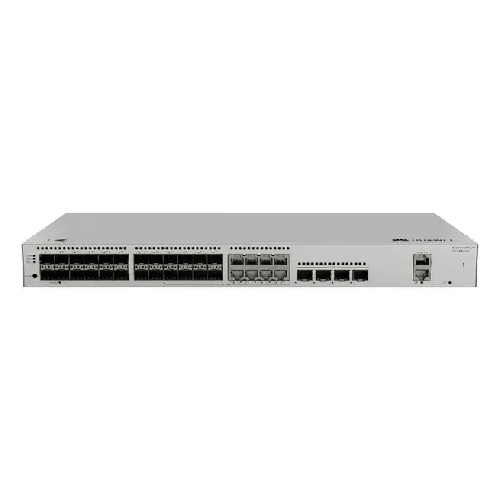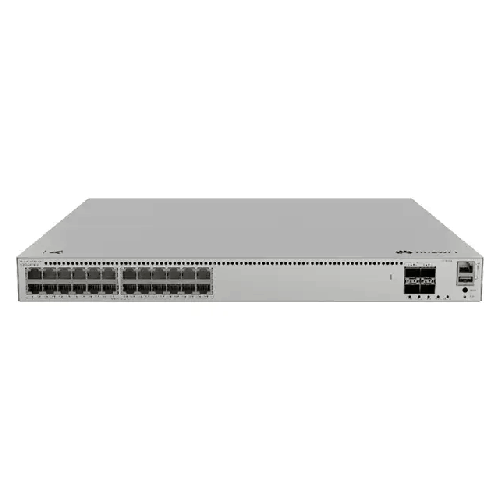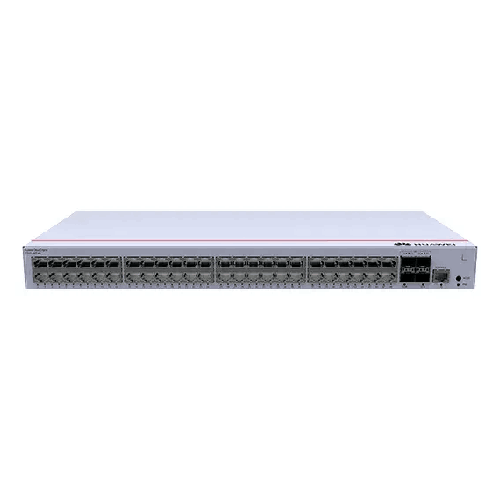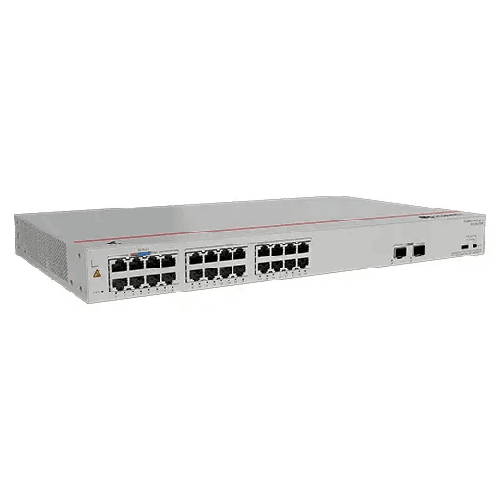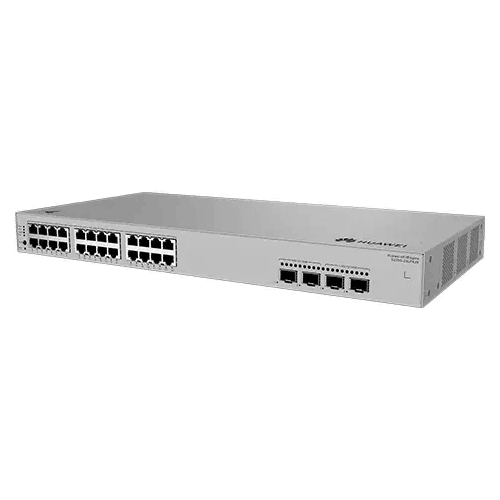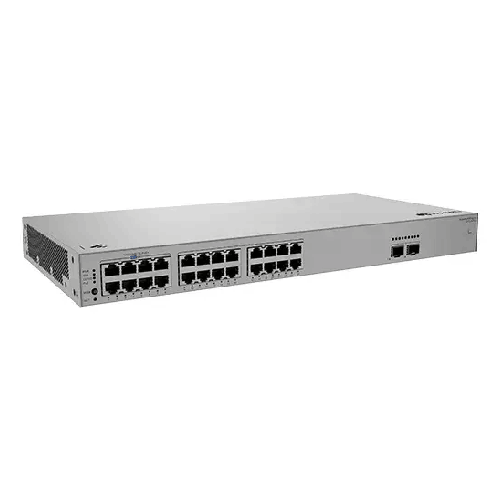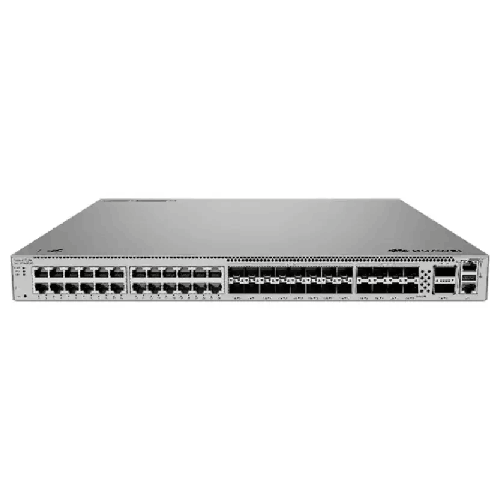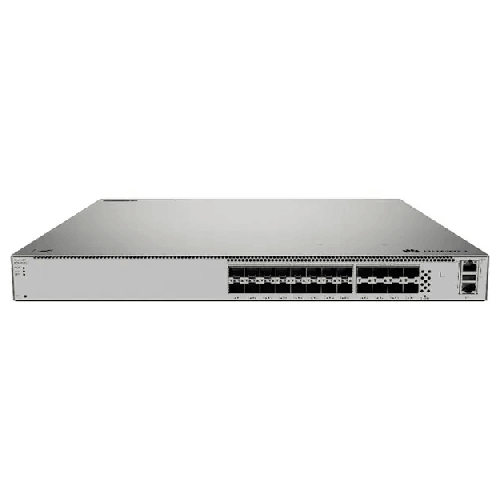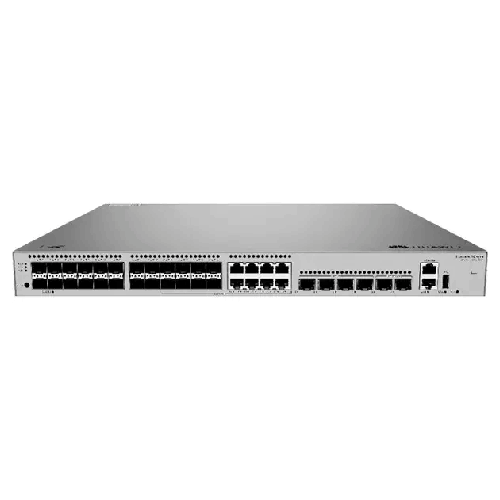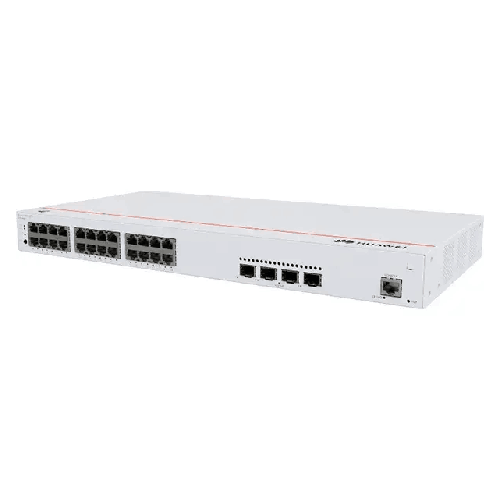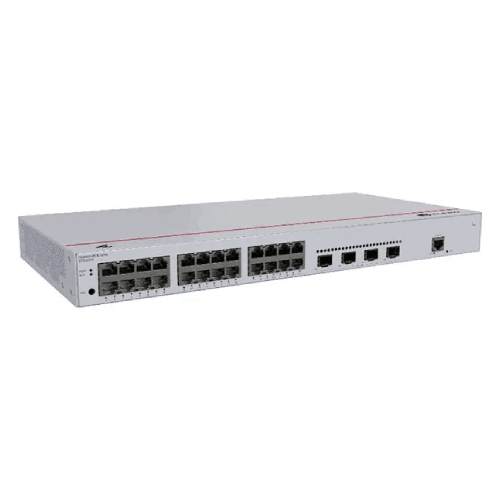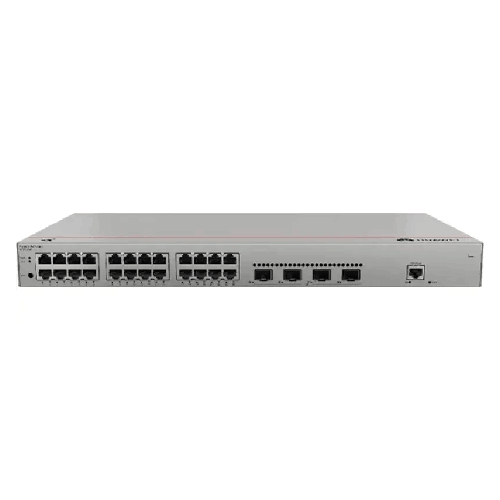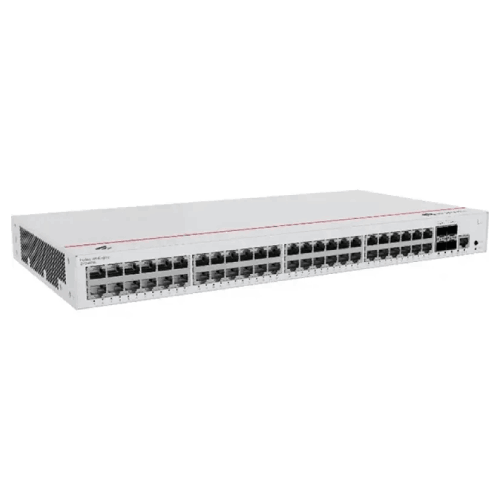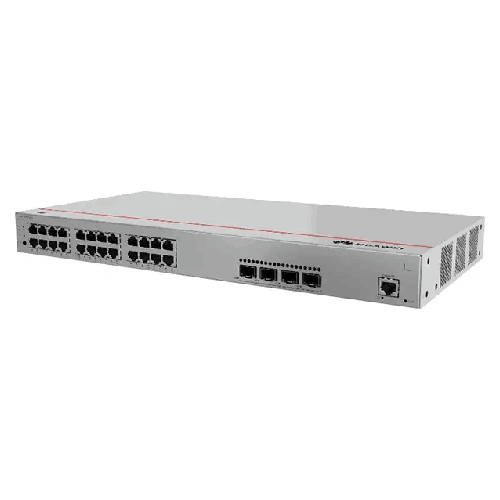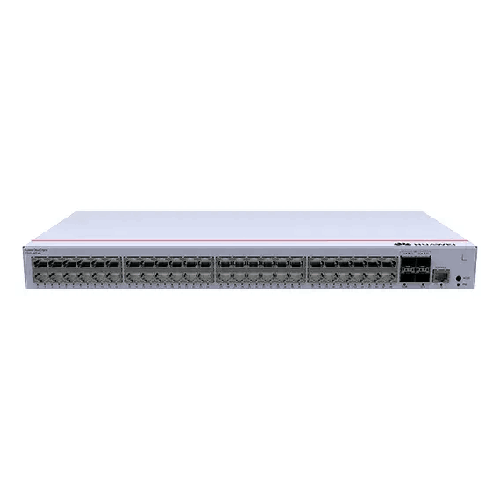
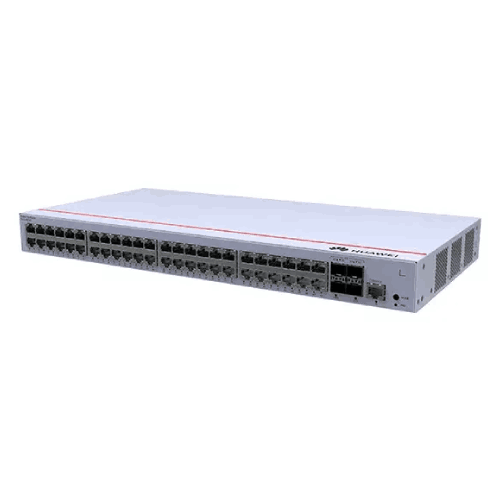
Huawei eKitEngine S310-48T4S Layer 3 Managed 48-Port Non PoE Switch
Regular Price:৳0.00Availability: SKU: 6.54.130.9167
Quick Overview
-
Support
Saturday – Thursday: 09 AM - 06 PM. -
Payment
Cash on Delivery | Card | Online Payment -
Shipping Cost
Inside Dhaka 100tk | Outside Dhaka 150tk -
Warranty Policy
Read More
Description
Huawei eKitEngine S310-48T4S Layer 3 Managed 48-Port Non PoE Switch Price in Bangladesh
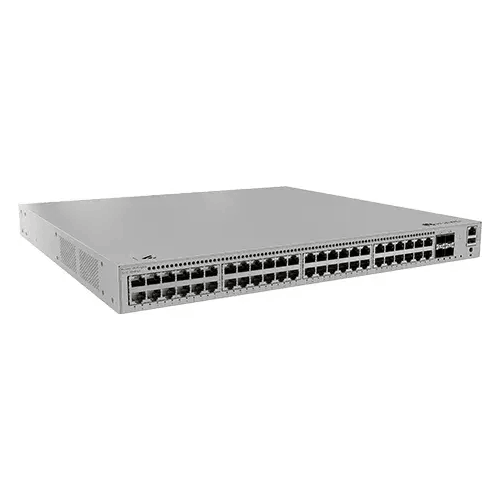
The Huawei eKitEngine S310-48T4S is a high-density managed Ethernet switch designed for organizations that need a large number of Gigabit copper network connections together with flexible Gigabit fiber uplink options. The switch provides 48 × 10/100/1000BASE-T Ethernet ports and 4 × GE SFP ports, creating a practical access-switching platform for offices, businesses, educational facilities, hotels, commercial buildings, and other structured network environments. Huawei specifies a 104 Gbit/s switching capacity and 77 Mpps packet-forwarding rate for the model.
Unlike PoE versions in the S310 family, the S310-48T4S is a non-PoE switch. Its copper ports are intended for Ethernet data connectivity rather than supplying PoE power to connected devices. This makes it particularly appropriate when the network already has local power available for endpoints or when PoE is not required.
The switch combines conventional Gigabit RJ45 connectivity with four GE SFP interfaces. This mixed interface design allows organizations to connect a large number of copper-based devices while retaining fiber connectivity for suitable uplinks or network segments.
Huawei's current product listing identifies the S310-48T4S as a model with 48 Gigabit copper ports, 4 Gigabit SFP ports, built-in AC power, 104 Gbit/s switching capacity, and 77 Mpps forwarding performance.
48-Port Gigabit Ethernet Connectivity
The S310-48T4S provides 48 × 10/100/1000BASE-T ports, supporting 10Mbps, 100Mbps, and 1000Mbps Ethernet connectivity.
Forty-eight copper ports provide substantial access density in a single 1U-class network switch. This can be useful for organizations where numerous computers, printers, IP phones with separate power, access points with local power, servers, network appliances, and other Ethernet devices need to be connected within the same network infrastructure.
For a business office, for example, a single S310-48T4S can provide wired Ethernet connectivity for a large group of employees without requiring several smaller switches simply to achieve the necessary port count.
The Gigabit capability also provides an appropriate access speed for many modern office networks. Devices that support Gigabit Ethernet can establish connections at up to 1Gbps according to their own capabilities and the wider network configuration.
Because the S310-48T4S is non-PoE, devices requiring electrical power must have an appropriate independent power source.
Four GE SFP Ports
In addition to its 48 copper ports, the switch provides 4 × Gigabit Ethernet SFP ports. Huawei identifies these interfaces as 1G SFP ports.
SFP connectivity provides flexibility when the network needs optical links rather than copper Ethernet. Depending on the selected compatible transceiver and network architecture, these interfaces can be used for fiber connections between network switches or other compatible equipment.
This can be especially useful in larger buildings where copper cabling is not suitable for a particular link distance or where fiber is already part of the structured network.
For example, the 48 copper interfaces can serve users and local network devices on a floor, while one or more GE SFP interfaces can connect the access switch to an upstream network through compatible fiber equipment.
The exact optical module and fiber type should always be selected according to the required distance, wavelength, connector type, and compatibility with the equipment at the other end.
104Gbps Switching Capacity
Huawei specifies a 104 Gbit/s switching capacity for the S310-48T4S.
Switching capacity is an important specification for a 48-port switch because multiple connected endpoints may communicate simultaneously.
In a typical business network, traffic may originate from dozens of computers, printers, servers, IP phones, access points, and other devices. The switch therefore needs to process traffic from multiple interfaces rather than serving a single point-to-point connection.
The 104Gbps specification provides a reference for the switching capability Huawei designed into this model.
It should be interpreted alongside the switch's 77Mpps packet-forwarding performance and the actual traffic profile of the intended installation.
77Mpps Packet Forwarding Performance
The Huawei S310-48T4S provides a documented 77 Mpps packet-forwarding rate.
Packet-forwarding performance describes the switch's ability to process network packets. This specification becomes relevant in networks where numerous devices generate traffic simultaneously.
A 48-port access switch may handle a mixture of office applications, file transfers, internet traffic, voice communications, management traffic, and other network flows.
The 77Mpps specification provides network planners with a documented performance reference when comparing this model with other switches in the Huawei eKitEngine portfolio.
L2+ Managed Network Architecture
Huawei's S310 series is documented as an L2+ managed switch series. The official Huawei portfolio identifies Layer 2 functions including 16K MAC entries and 4K VLANs, while documented Layer 3 capabilities include IPv4 static routing, PBR, and IPv6. Huawei also identifies iStack, ERPS, and SmartLink support.
This is an important distinction when describing the S310-48T4S.
Although the product title may use the phrase "Layer 3 Managed," Huawei's own current portfolio classifies the S310 family as L2+, rather than positioning it as a full-featured dynamic-routing Layer 3 platform. Therefore, the S310-48T4S should not be marketed as supporting every advanced routing protocol available on Huawei's higher-end enterprise switches unless that capability is specifically confirmed for the model.
For many SMB and enterprise access networks, however, IPv4 static routing, policy-based routing, IPv6, VLANs, and other Layer 2 management capabilities can provide the required functionality.
VLAN Support
Huawei documents support for up to 4K VLANs within the S310 series.
VLANs allow network administrators to divide a physical switching infrastructure into logically separated networks.
For example, an organization may use separate VLANs for employees, guests, voice devices, network management, servers, or other categories of traffic.
A 48-port switch with VLAN support can therefore serve more than just a flat Ethernet network. It can become part of a structured network architecture where different types of devices and users are logically separated.
The exact VLAN design should be planned around the organization's IP addressing, routing, security, and access-control requirements.
16K MAC Address Entries
Huawei documents up to 16K MAC address entries for the S310 series.
MAC address learning is fundamental to Ethernet switching. The switch learns the MAC addresses associated with its interfaces and uses that information when forwarding Ethernet frames.
With 48 Gigabit access ports, the S310-48T4S can serve a substantial number of network endpoints. The documented MAC address capacity gives network administrators a useful reference when evaluating the switch for larger access-layer deployments.
This is particularly relevant in office environments where one physical switch may serve computers, printers, phones, wireless infrastructure, servers, and other network-connected equipment.
IPv4 Static Routing and PBR
Huawei's S310 documentation identifies IPv4 static routing and Policy-Based Routing (PBR) among the series' Layer 3 capabilities.
Static routing can be useful in network designs where routing paths are known and relatively stable. PBR provides another mechanism for controlling traffic forwarding according to defined policies.
These features can allow the S310-48T4S to participate in more structured network architectures rather than functioning solely as a basic Layer 2 access switch.
However, network administrators should evaluate their exact routing requirements before purchase. If the project requires advanced dynamic routing protocols, the appropriate Huawei higher-level switch family should be considered instead.
IPv6 Support
Huawei identifies IPv6 as part of the S310 series' Layer 3 feature set.
IPv6 support is increasingly important for networks that need to accommodate modern addressing architectures.
For organizations planning network infrastructure for long-term use, IPv6 capability allows the switch to participate in network environments where IPv6 addressing and traffic are part of the architecture.
The exact IPv6 configuration should be planned according to the upstream router, firewall, addressing scheme, VLAN structure, and applications being deployed.
iStack Support
The current Huawei product page specifies iStack support for up to four switches of the same series in a stack.
Stacking can be useful when one switch is insufficient for a growing organization.
Instead of treating every switch as a completely independent unit, an appropriate stacking architecture can provide a coordinated switching environment.
For example, an organization that initially needs approximately 48 ports may later add another compatible S310 switch as the number of endpoints increases.
Stacking requirements should be checked carefully before deployment, including supported models, stacking connections, configuration, and software requirements.
ERPS and SmartLink
Huawei identifies ERPS and SmartLink among the S310 series networking capabilities.
ERPS can be used in Ethernet ring-oriented network architectures, while SmartLink provides another mechanism for link protection and redundancy scenarios.
These features are relevant to organizations that need more than a simple single-path Ethernet network.
Redundant network design should always be planned carefully because the correct topology, protection protocol, upstream configuration, and cabling arrangement are necessary for the intended behavior.
STP-Based Network Protection
Managed Ethernet switches are commonly deployed with loop-prevention mechanisms when redundant physical links are present.
Huawei's S310 documentation includes ERPS and SmartLink alongside its Layer 2 management feature set.
These capabilities can help organizations build more structured networks where redundancy is part of the design.
The specific protocol and topology should be selected according to the network architecture rather than enabled without a defined design.
Non-PoE Design
The S310-48T4S is specifically a non-PoE model.
This distinction makes it different from related S310 models such as the S310-48P4S and S310-48P4X. Huawei lists the S310-48P4S separately with PoE support and a 380W PoE budget, while the S310-48T4S is listed simply with 48 GE copper ports and four GE SFP ports.
A non-PoE design can be appropriate when connected devices already have local power or when PoE is deliberately not required.
For example, a conventional office LAN consisting primarily of computers and printers may not need PoE from the network switch.
Choosing the non-PoE model can also prevent customers from paying for a PoE capability that their particular network does not require.
Built-In AC Power
Huawei specifies a built-in AC power supply for the S310-48T4S. The current product listing gives an AC input range of 90V to 264V at 45Hz to 65Hz.
Huawei's S310-series documentation lists the rated AC voltage as 100V to 240V AC at 50/60Hz, with the maximum supported AC input range extending beyond that rated range.
For Bangladesh installations, the electrical system should still be properly designed and protected according to the installation environment.
Because the power supply is integrated into the switch, there is no need to select a separate external adapter for the switch itself.
1U Rack-Oriented Design
The S310-48T4S has basic dimensions of 43.6 × 442 × 220 mm, with maximum depth of 227 mm including the specified rear protruding parts. Huawei classifies it as a 1U-class chassis.
The 442mm width is suited to standard rack-oriented network equipment installations.
Huawei also lists rack mounting, desk mounting, and wall mounting as supported installation types.
This provides flexibility depending on the network environment.
In a professional server or networking room, rack installation can keep the switch organized alongside patch panels, routers, firewalls, and other equipment. In smaller installations, desk or wall placement may be more appropriate.
Metal Chassis
Huawei specifies a metal chassis for the S310-48T4S.
A metal enclosure is consistent with professional network equipment and provides a robust physical housing for the switch's electronics.
The physical environment should nevertheless be kept within Huawei's documented temperature, humidity, ventilation, and installation requirements.
Intelligent Fan Cooling
The S310-48T4S uses air cooling with intelligent fan-speed adjustment and has one built-in fan module according to Huawei's current specifications.
Intelligent fan adjustment can regulate cooling according to equipment operating conditions.
Because this is a 48-port rack-oriented switch, proper airflow is important. Huawei lists airflow as air intake from the left and air exhaust from the right on the current product specification.
Rack installation should therefore avoid obstructing these airflow paths.
Operating Environment
Huawei specifies a long-term operating temperature of -5°C to +50°C at an altitude of 0–1800 meters. The documented operating relative humidity is 5% to 95%, non-condensing.
These specifications are useful when planning network-room installations.
In Bangladesh, equipment rooms can experience significant temperature and humidity variation, particularly where air conditioning is not continuously maintained.
Keeping the switch within the manufacturer's specified environmental conditions is therefore an important part of installation planning.
Power Consumption
Huawei specifies 27.55W static power consumption, 44.9W typical power consumption, and 52.05W maximum power consumption for the S310-48T4S on its current product listing.
Because this model does not provide PoE power, its electrical load does not include a large endpoint-power budget like the S310 PoE models.
This makes the S310-48T4S appropriate for installations where the switch only needs to handle network traffic and the connected devices have their own power supplies.
Surge Protection
Huawei specifies ±6kV differential-mode and ±6kV common-mode power-supply surge protection for the S310-48T4S.
This is a documented equipment specification and should be considered alongside proper building-level electrical protection.
Appropriate grounding, surge protection, rack power distribution, and structured cabling remain important elements of a professional installation.
Office Network Applications
The S310-48T4S is particularly suited to office environments that need a high number of Gigabit Ethernet ports without PoE.
A single 48-port switch can connect computers, printers, servers, IP phones with their own power, network storage systems, and other Ethernet equipment.
VLAN support can help separate different categories of traffic, while static routing and PBR can support more structured network designs where required.
The four GE SFP ports also provide flexibility for fiber-based connections to other network segments.
Campus and Educational Networks
Educational institutions often require large numbers of wired network connections across offices, classrooms, laboratories, libraries, and administrative areas.
The 48-port configuration can provide a dense access-layer connection point while the SFP interfaces can connect suitable fiber uplinks.
The managed architecture also allows administrators to use VLANs and other network controls when designing separate logical networks for different departments or services.
Commercial Building Networks
Commercial buildings can contain multiple network segments and many wired Ethernet endpoints.
The S310-48T4S can serve as an access switch where 48 Gigabit copper ports are required and PoE is not part of the deployment.
Its four GE SFP ports provide additional flexibility for fiber connectivity between network areas.
Hotel and Hospitality Networks
Hotels can require substantial wired connectivity for administrative offices, network equipment, guest services, and other operational systems.
The S310-48T4S can be considered for non-PoE portions of a hotel network where 48 Gigabit Ethernet ports and Gigabit fiber interfaces are appropriate.
Where access points, cameras, or phones require PoE, a PoE-capable model should be evaluated instead.
Server and Network Equipment Connectivity
The S310-48T4S can also be used as an access-layer switch for servers, storage appliances, printers, workstations, and other network equipment that does not need power from Ethernet.
The four GE SFP interfaces can provide optical connections where compatible fiber infrastructure is already installed.
For higher-speed server or aggregation requirements, customers should compare the S310-48T4S with Huawei models that provide 10GE SFP+ interfaces.
Why the S310-48T4S Is Different from the S310-48T4X
The S310-48T4S and S310-48T4X have the same 48 × Gigabit copper access-port concept, but their uplink interfaces differ.
The S310-48T4S has 4 × GE SFP ports and 104Gbps switching capacity with 77Mpps forwarding, while the S310-48T4X has 4 × 10GE SFP+ ports and 176Gbps switching capacity with 131Mpps forwarding.
Therefore, customers should not choose between the models solely on the number of ports.
If the network requires 10GbE uplinks, the S310-48T4X may be the relevant model to evaluate. If Gigabit SFP uplinks are sufficient, the S310-48T4S provides the corresponding interface configuration.
✅ Key Features
- 48 × Gigabit Ethernet Ports: Provides 48 × 10/100/1000BASE-T ports for high-density wired network access.
- 4 × GE SFP Ports: Provides four Gigabit SFP interfaces for compatible fiber or optical connectivity.
- 104Gbps Switching Capacity: Provides the switching capacity specified by Huawei for the model.
- 77Mpps Forwarding Rate: Provides documented packet-forwarding performance for high-density Ethernet traffic.
- Non-PoE Architecture: Focuses on Ethernet data connectivity without delivering PoE power to endpoints.
- L2+ Managed Networking: Provides Layer 2 management with documented IPv4 static routing, PBR, and IPv6 capabilities.
- 4K VLAN Support: Huawei documents support for up to 4K VLANs across the S310 series.
- 16K MAC Entries: Provides documented capacity for up to 16K MAC address entries.
- iStack Support: Supports stacking of up to four switches of the same series according to Huawei's current product specification.
- ERPS and SmartLink: Supports documented network protection and link-redundancy technologies.
- Built-In AC Power: Uses an integrated AC power supply.
- 1U-Class Rack Design: Provides a compact high-density chassis suitable for rack-oriented deployments.
✅ Usage / Applications
- Enterprise Office Networks: Connect workstations, printers, servers, and other wired Ethernet devices.
- SMB Networks: Provide high-density Gigabit connectivity for growing businesses.
- Educational Networks: Connect classrooms, offices, laboratories, and administrative systems.
- Hotel Networks: Support non-PoE wired network segments and infrastructure.
- Commercial Buildings: Provide centralized Ethernet access for business tenants and building systems.
- Campus Networks: Operate as an access switch within a structured campus network.
- Server Connectivity: Connect servers and network appliances where PoE is unnecessary.
- Network Storage: Provide Gigabit Ethernet connectivity for compatible storage systems.
- Fiber-Uplink Networks: Use the four GE SFP interfaces for suitable optical connections.
- Office LAN Expansion: Add up to 48 copper Ethernet access connections in a single platform.
- Network Equipment Rooms: Provide a rack-oriented access switching platform.
- Non-PoE Infrastructure: Serve environments where connected devices already have independent power.
✅ Benefits of This Product
- High Port Density: 48 Gigabit copper ports provide substantial access capacity in a single switch.
- Fiber Flexibility: Four GE SFP interfaces support suitable fiber-based connections.
- No Unnecessary PoE: The non-PoE design is appropriate when endpoints do not need switch-provided power.
- Managed Network Control: VLAN, MAC, routing, redundancy, and traffic-management capabilities provide greater control than an unmanaged switch.
- Gigabit Access: Provides 10/100/1000BASE-T connectivity for compatible Ethernet devices.
- Stacking Capability: Up to four same-series switches can be stacked according to Huawei's current specification.
- Compact Rack Design: The 1U-class chassis combines 48 copper ports and four SFP ports in a relatively compact form factor.
- Flexible Installation: Huawei lists rack, desk, and wall mounting options.
- Built-In Power: The integrated AC power supply simplifies switch-level power requirements.
- Structured Network Support: L2+ capabilities allow the switch to participate in more organized business and enterprise network architectures.
✅ Ideal For
The Huawei eKitEngine S310-48T4S is ideal for businesses, offices, educational institutions, commercial buildings, and other organizations that need a high-density Gigabit managed switch without PoE.
Its 48 × 10/100/1000BASE-T ports make it suitable for connecting large numbers of computers, printers, servers, storage devices, network appliances, and other Ethernet endpoints. The four GE SFP ports add flexibility for compatible fiber connections, which can be useful when the access switch needs to connect to another network segment through optical infrastructure.
This model is particularly appropriate when connected devices already have their own power sources. Organizations that require switch-provided power for cameras, access points, IP phones, or other powered devices should instead evaluate an appropriate PoE model.
The S310-48T4S can also suit structured access-layer deployments where VLAN segmentation, IPv4 static routing, PBR, IPv6, iStack, ERPS, and other managed-network capabilities are required. Huawei classifies the S310 series as L2+, so buyers with advanced dynamic-routing requirements should verify the feature set against the specific network design before procurement.
✅ Why Choose the Huawei eKitEngine S310-48T4S?
The S310-48T4S combines 48 Gigabit copper ports and four GE SFP interfaces in a 1U-class managed switch. This makes it particularly useful when the network requires a high number of copper access ports but does not require PoE.
Its 104Gbps switching capacity and 77Mpps forwarding performance provide the core performance specifications documented by Huawei for this model.
Another important advantage is the L2+ management architecture. Huawei documents 16K MAC entries, 4K VLANs, IPv4 static routing, PBR, IPv6, iStack, ERPS, and SmartLink within the S310 platform.
This gives network administrators more flexibility than an unmanaged 48-port switch.
The four GE SFP interfaces also provide an important distinction from models with only copper connectivity. They can be used for suitable optical links when the network design requires fiber connectivity.
At the same time, customers should carefully compare the S310-48T4S with the S310-48T4X if high-speed uplinks are important. The T4X model provides four 10GE SFP+ ports and significantly higher documented switching and forwarding specifications.
For a network that specifically needs 48 Gigabit non-PoE ports plus four Gigabit SFP interfaces, the S310-48T4S is built around that exact configuration.
✅ Why Buy This Product from BME?
Selecting a professional network switch requires more than checking the number of Ethernet ports. Uplink speed, PoE requirements, VLAN capacity, routing functions, stacking, physical dimensions, power requirements, and future expansion all influence whether a particular model fits the network.
BME can help customers evaluate the Huawei eKitEngine S310-48T4S according to the intended Bangladesh deployment, whether the requirement involves an office LAN, educational network, commercial building, server environment, campus access layer, or another structured Ethernet installation.
The most important distinction for this model is its non-PoE architecture. If your connected devices already have independent power, the S310-48T4S can provide the required Ethernet connectivity without paying for a PoE capability that is not needed.
Customers should also confirm whether four Gigabit SFP uplinks are sufficient. If the network requires 10GbE uplinks, Huawei's S310-48T4X should be evaluated instead because it provides four 10GE SFP+ ports.
For procurement, specifying the exact model number S310-48T4S helps avoid confusion with closely related Huawei S310 switches that use different uplink technologies or provide PoE.
✅ Buying Guide
1. Confirm the Port Requirement:
The S310-48T4S provides 48 × 10/100/1000BASE-T ports. Confirm that this port count is sufficient for current and planned Ethernet endpoints.
2. Confirm That PoE Is Not Required:
This is a non-PoE switch. If cameras, access points, or phones need switch-provided power, select an appropriate PoE model instead.
3. Check Uplink Speed:
The four uplinks are GE SFP. If your network requires 10GbE uplinks, compare the S310-48T4X or another suitable 10GE model.
4. Select Compatible SFP Modules:
Verify the optical module type, fiber type, connector, wavelength, and transmission distance required by the network.
5. Plan VLANs:
Use the documented VLAN capabilities to plan logical separation between departments, users, services, or network segments.
6. Evaluate Routing Requirements:
Huawei documents IPv4 static routing, PBR, and IPv6 for the S310 series. Confirm that these functions meet the intended design before purchasing.
7. Consider Stacking:
If multiple compatible switches are expected, evaluate Huawei iStack support for up to four same-series switches.
8. Check Rack Space:
The basic dimensions are 43.6 × 442 × 220 mm, with a maximum specified depth of 227mm.
9. Plan Airflow:
Huawei specifies air intake from the left and exhaust from the right. Avoid obstructing these paths during rack or cabinet installation.
10. Check Electrical Requirements:
The switch has a built-in AC power supply. Huawei lists 90–264V AC as the current maximum input range.
11. Check Environmental Conditions:
The specified long-term operating range is -5°C to +50°C at 0–1800m altitude, with 5%–95% non-condensing relative humidity.
12. Plan for Expansion:
If the network may require additional ports or higher-speed uplinks later, compare the S310-48T4S with models that provide 10GE SFP+ or other higher-capacity interfaces.
✅ Customers Ask About / Frequently Asked Questions
1. What is the Huawei eKitEngine S310-48T4S?
It is a managed Ethernet switch with 48 × 10/100/1000BASE-T ports and four GE SFP ports.
2. Is the S310-48T4S a PoE switch?
No. The S310-48T4S is a non-PoE model.
3. How many Gigabit Ethernet ports does it have?
It has 48 Gigabit RJ45 ports supporting 10/100/1000Mbps operation.
4. How many SFP ports does it have?
It provides 4 × GE SFP ports.
5. What is the switching capacity?
Huawei specifies 104 Gbit/s.
6. What is the packet-forwarding rate?
The documented forwarding performance is 77 Mpps.
7. Is it a Layer 3 switch?
Huawei's official S310 documentation classifies the series as L2+ managed and documents IPv4 static routing, PBR, and IPv6 capabilities.
8. Does it support VLANs?
Yes. Huawei documents up to 4K VLANs for the S310 series.
9. How many MAC addresses can it support?
Huawei documents up to 16K MAC address entries for the S310 series.
10. Does it support stacking?
Yes. Huawei's current product specification states iStack support for up to four switches of the same series.
11. Does it support 10GbE SFP+?
No. The S310-48T4S has 4 × GE SFP ports. The S310-48T4X is the related model with four 10GE SFP+ ports.
12. Can it be used for CCTV?
It can provide network connectivity for IP cameras, but it does not provide PoE power. Cameras would therefore require an appropriate independent power source or separate PoE equipment.
✅ Why Buy This Product
The Huawei eKitEngine S310-48T4S is a practical high-density managed switch for organizations that need 48 Gigabit Ethernet ports and four Gigabit SFP interfaces without PoE.
Its documented 104Gbps switching capacity and 77Mpps forwarding performance provide a suitable performance reference for structured access-layer networks.
The L2+ architecture adds network-management capabilities beyond basic unmanaged switching, including VLAN support, MAC address management, IPv4 static routing, PBR, IPv6, iStack, ERPS, and SmartLink.
Its compact 1U-class chassis, built-in AC power supply, metal enclosure, and flexible rack, desk, and wall installation options further support different professional deployment environments.
If your project requires 48 Gigabit copper ports, four Gigabit SFP uplinks, managed networking, and no PoE, the Huawei S310-48T4S can be evaluated as a dedicated access-switch option.
What is the price of Huawei eKitEngine S310-48T4S Layer 3 Managed 48-Port Non PoE Switch in Bangladesh?
Write a review
Question Answer
Have question about this product? Get specific details about this product from expert.