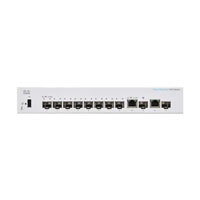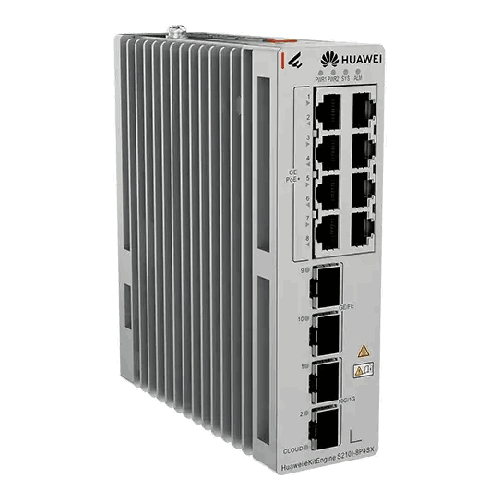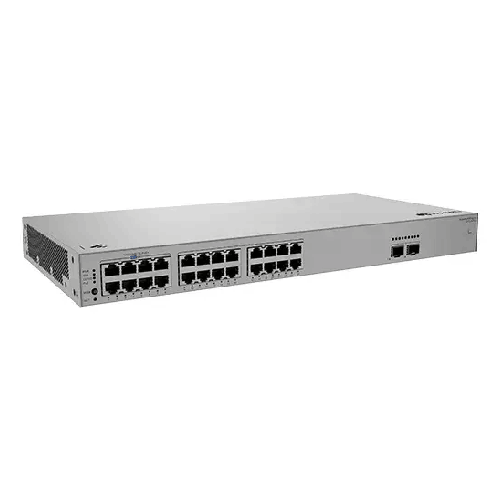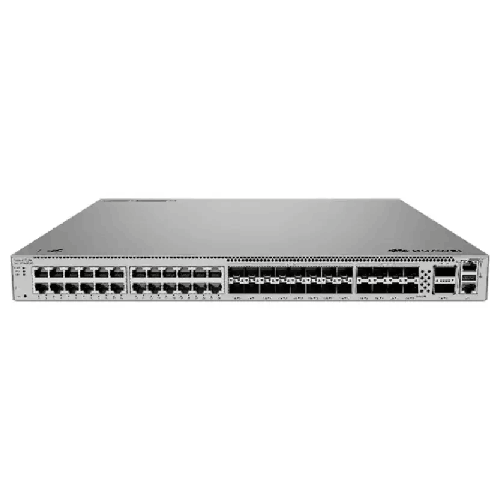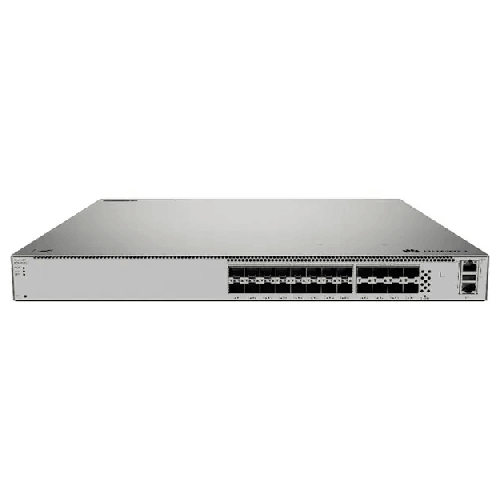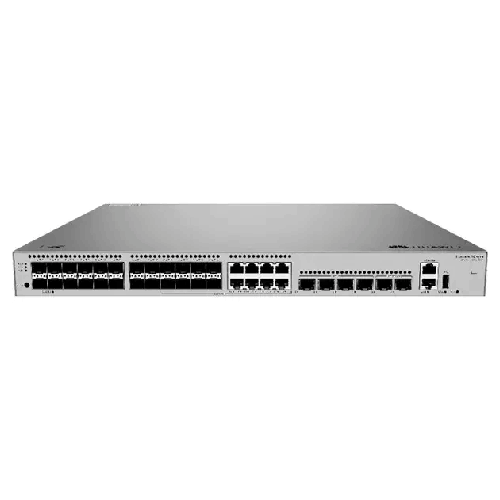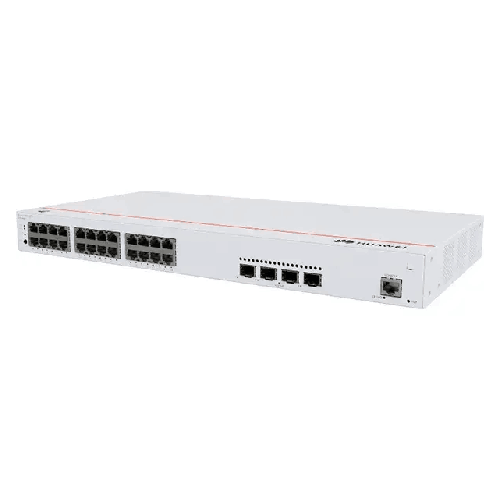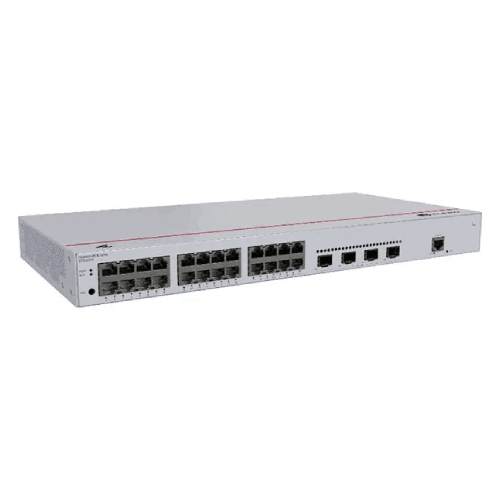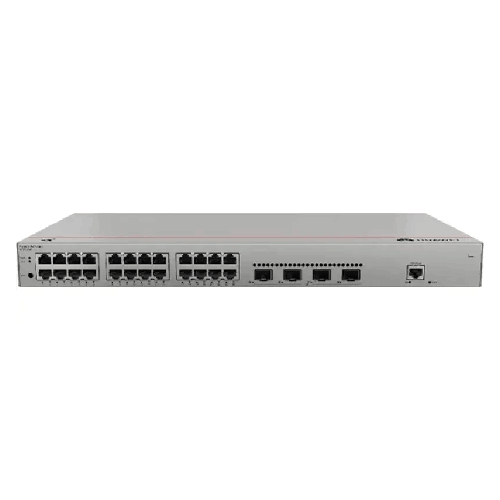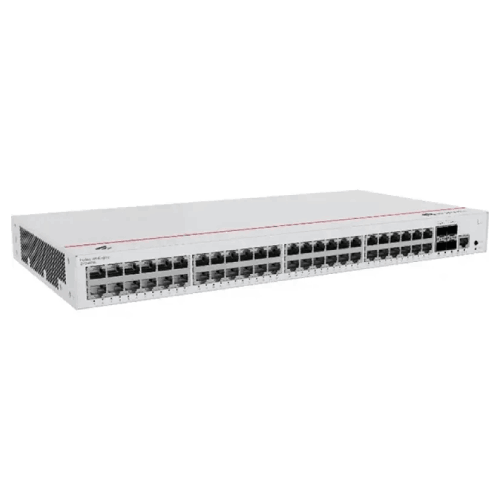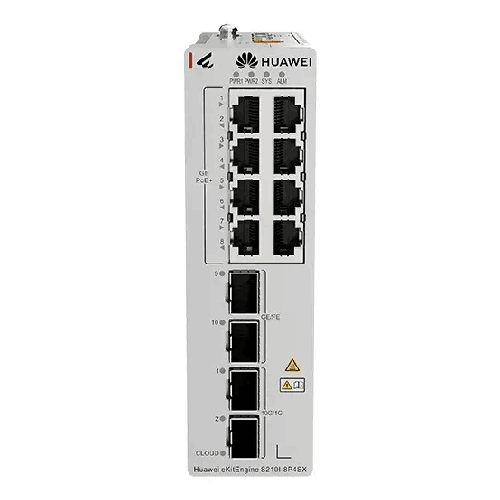
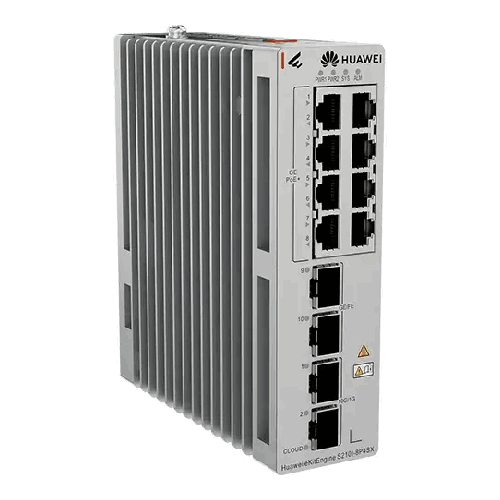
Huawei eKitEngine S210I-8P4SX Layer 2 Industrial Managed 8-Port PoE+ Access Switch
Regular Price:৳0.00Availability: SKU: 6.54.130.9164
Quick Overview
-
Support
Saturday – Thursday: 09 AM - 06 PM. -
Payment
Cash on Delivery | Card | Online Payment -
Shipping Cost
Inside Dhaka 100tk | Outside Dhaka 150tk -
Warranty Policy
Read More
Description
Huawei eKitEngine S210I-8P4SX Layer 2 Industrial Managed 8-Port PoE+ Access Switch Price in Bangladesh
The Huawei eKitEngine S210I-8P4SX Layer 2 Industrial Managed 8-Port PoE+ Access Switch is a compact industrial Ethernet access switch designed for network environments where reliable wired connectivity, PoE+ power delivery, high-speed optical uplinks, and extended-temperature operation are important.
Unlike a conventional office access switch, the S210I-8P4SX is designed around industrial deployment requirements. It combines 8 × 10/100/1000BASE-T PoE+ ports, 2 × GE SFP ports, and 2 × 10GE SFP+ ports in a compact chassis. Huawei specifies a 60Gbps switching capacity and 44.6Mpps packet forwarding rate for this model.
The switch is also fanless, uses natural heat dissipation, supports DIN-rail installation, and is designed for extended-temperature environments. Huawei's current product documentation specifies long-term operating conditions that can reach –40°C to +60°C in a sealed cabinet, –40°C to +70°C in a vented cabinet with at least 80 LFM airflow, or –40°C to +75°C in a blower-equipped cabinet with at least 200 LFM airflow, at altitudes from 0 to 1800 meters.
These characteristics make the S210I-8P4SX relevant to industrial automation networks, factory infrastructure, transportation systems, surveillance installations, smart-building deployments, utility environments, and other locations where conventional office-oriented switches may not provide the required physical installation or temperature characteristics.
8 Gigabit PoE+ Ethernet Ports
The Huawei S210I-8P4SX provides 8 × 10/100/1000BASE-T Ethernet ports with PoE+ support. Huawei identifies these ports as 1G/100M/10M interfaces with PoE+.
This configuration provides a compact access layer for industrial Ethernet endpoints. Compatible powered devices can receive network connectivity and electrical power through the same Ethernet connection, reducing the requirement for separate power connections at each endpoint.
Potential applications include compatible IP cameras, wireless access points, industrial network devices, VoIP equipment, monitoring equipment, and other Ethernet endpoints that support the required PoE standard.
The eight-port configuration is especially useful when a distributed industrial location does not require the port density of a conventional 24-port access switch. Instead, the S210I-8P4SX provides a smaller footprint that can be positioned closer to field equipment.
240W Maximum PoE Capability
Huawei specifies a maximum PoE power consumption of 240W for the S210I-8P4SX. However, there is an important purchasing detail: Huawei states that the switch itself is supplied without a power module, and when the recommended PAC240S56-CN 240W power module is used, a maximum of 220W PoE power is available. Huawei also specifies that the maximum PoE power should be configured to a value no greater than 220W through the web system to prevent overload-related power failures.
This distinction is important for procurement and network planning.
The headline 240W figure describes the switch's maximum PoE power consumption specification, while the recommended PAC240S56-CN configuration provides up to 220W available PoE power. Therefore, customers should not assume that the switch automatically provides 240W of usable PoE capacity without considering the selected power module.
The PoE budget should always be calculated from the actual power requirements of connected devices. Maintaining reasonable power headroom is particularly important in industrial installations where network availability can be critical.
2 GE SFP Ports
In addition to its eight copper access ports, the S210I-8P4SX provides 2 × GE SFP ports supporting 1G/100M connectivity.
These interfaces provide flexibility for optical or compatible SFP-based network connections. They can be used as part of an upstream or distributed network design where optical Ethernet connectivity is appropriate.
For industrial environments, fiber-based connections can be particularly useful when network equipment is distributed over longer distances or when electrical isolation between network locations is desirable.
The exact SFP module and fiber type should be selected according to the required transmission distance, network topology, and supported Huawei compatibility specifications.
2 × 10GE SFP+ High-Speed Interfaces
One of the most notable characteristics of the S210I-8P4SX is the inclusion of 2 × 10GE SFP+ ports. Huawei specifies these interfaces as supporting 10G/1G connectivity.
For an industrial access switch with only eight copper PoE+ ports, 10GE uplink capability provides considerable flexibility for connecting the access layer to a higher-level aggregation or core network.
Industrial networks can generate traffic from multiple sources, including surveillance cameras, wireless access points, machine monitoring systems, control systems, and other connected devices. A higher-speed uplink can provide additional bandwidth between the local access switch and upstream networking equipment.
The actual network architecture should determine whether one or both 10GE interfaces are used, and whether the connected upstream equipment and transceivers support the required configuration.
60Gbps Switching Capacity
Huawei specifies a 60Gbps switching capacity for the S210I-8P4SX.
Switching capacity represents an important hardware-level specification when evaluating an Ethernet switch. It indicates the capacity of the switching architecture to handle traffic across its interfaces.
For an eight-port industrial access switch with Gigabit Ethernet access ports and 10GE uplinks, the 60Gbps specification provides a useful reference for evaluating the platform's internal switching capability.
As with any switch specification, however, switching capacity should not be viewed independently. Actual application performance depends on the complete network design, interface configuration, uplink utilization, packet characteristics, and connected equipment.
44.6Mpps Packet Forwarding Rate
The S210I-8P4SX is specified with a 44.6Mpps packet forwarding rate.
Packet forwarding rate describes how many millions of packets per second the switching platform can process under the specified test methodology.
This specification is useful when comparing industrial Ethernet switches because industrial networks may carry different types of traffic simultaneously. Large data transfers, monitoring traffic, control communications, surveillance streams, and management traffic can all contribute to the overall packet-processing workload.
The 44.6Mpps figure should be considered together with the 60Gbps switching capacity and the actual traffic pattern of the intended installation.
Industrial Layer 2 Managed Networking
The S210I-8P4SX is a Layer 2 managed industrial switch, providing a more controlled networking platform than an unmanaged industrial Ethernet switch.
Huawei's S210I documentation describes S210I switches as access devices in industrial and high-reliability networking scenarios. Huawei specifically illustrates S210I switches forming ring-network structures with S310 aggregation switches using STP/RSTP/ERPS technologies.
This is relevant for industrial network architecture because access switches are often deployed as distributed nodes rather than centralized office switches.
Managed Layer 2 networking allows administrators to configure the switch according to the requirements of the wider Ethernet architecture. VLANs, loop-prevention mechanisms, traffic policies, and other supported functions can be used as appropriate to the network design.
The exact configuration should be determined by the network engineer based on the requirements of the industrial system and upstream infrastructure.
Extended-Temperature Industrial Design
The S210I-8P4SX is designed for environments where operating temperatures may be significantly outside the range of a standard office switch.
Huawei specifies long-term operating temperature conditions from –40°C to +60°C for a sealed cabinet, –40°C to +70°C for a vented cabinet with at least 80 LFM airflow, and –40°C to +75°C for a blower-equipped cabinet with at least 200 LFM airflow, at 0–1800m altitude.
The correct temperature rating therefore depends on the cabinet and airflow configuration.
This is particularly relevant for industrial control cabinets, outdoor telecommunications enclosures, transportation infrastructure, utility locations, and other areas where ambient conditions can differ substantially from a controlled office environment.
When deploying the switch, the cabinet type and required airflow conditions should be evaluated against the manufacturer's stated environmental requirements.
Fanless Natural Heat Dissipation
The S210I-8P4SX uses a fanless design with natural heat dissipation. Huawei's current product specification identifies its heat dissipation mode as natural heat dissipation.
A fanless architecture can be advantageous in industrial environments because there are no internal cooling fans that require routine fan replacement or that introduce another moving component into the equipment.
It can also be useful in environments where acoustic output needs to be minimized.
However, fanless does not mean that installation conditions can be ignored. The switch still requires an appropriate thermal environment and must be installed according to Huawei's specified cabinet, airflow, and temperature conditions.
DIN-Rail Installation
The S210I-8P4SX supports DIN-rail mounting, making it particularly appropriate for industrial control cabinets and other equipment enclosures designed around DIN-rail infrastructure. Huawei also lists rack mounting as a supported installation type.
DIN-rail mounting allows the switch to be positioned alongside other industrial automation and electrical components without requiring a conventional 19-inch rack as the primary mounting structure.
This can simplify the physical organization of distributed industrial networking equipment.
Huawei's official S210I datasheet also identifies DIN-rail mounting as part of the product's ordering configuration.
Compact Industrial Chassis
The S210I-8P4SX is designed with a compact industrial form factor.
Huawei specifies basic dimensions of approximately 150 × 44 × 133mm, excluding protruding parts. The maximum dimensions are approximately 162 × 44 × 142mm, depending on rear protrusions.
This compact size allows the switch to be installed in locations where a conventional full-size rack switch would be impractical.
The unit weighs approximately 0.986kg without packaging and approximately 1.35kg with packaging.
The relatively small footprint makes it easier to integrate the switch into distributed industrial cabinets and localized network points.
Redundant DC Power Architecture
One of the most important industrial characteristics of the S210I-8P4SX is its 1+1 redundant power supply architecture.
Huawei specifies a DC external power supply mode and lists input requirements of 54V DC to 57V DC for PoE/PoE+ configurations and 48V DC for PoE configurations.
Huawei's S210I datasheet describes the series as supporting dual redundant DC power supplies, with the S210I-8P4SX specifically listed with dual redundant 9.6–60V DC power supplies in its ordering description.
Redundant power can be valuable in industrial networks where maintaining network availability is an important design consideration.
The exact power architecture must be implemented using compatible power equipment and according to Huawei's installation requirements.
Important: Power Module Is Not Included
The current Huawei product page explicitly identifies the S210I-8P4SX as being supplied without a power module.
Huawei lists the PAC60S12-AN 60W AC power adapter as an optional accessory and the PAC240S56-CN 240W AC PoE power adapter as an optional accessory. Huawei's official datasheet states that these power accessories need to be purchased separately.
This is a critical point for customers purchasing the switch in Bangladesh.
The switch should therefore not be treated as a complete plug-and-play PoE solution unless the required compatible power module or power architecture is also included in the purchase configuration.
For deployments requiring the maximum PoE capability, Huawei recommends the PAC240S56-CN. Under that configuration, Huawei specifies that up to 220W of PoE power is available and that the PoE maximum should be configured to no more than 220W through the web interface.
Low Static Power Consumption
Huawei specifies a static power consumption of 9.52W for the S210I-8P4SX. Typical power consumption is listed as 15.56W.
Maximum power consumption is listed as 16.24W without PoE and 257.6W under full PoE load, where the PoE component is specified as 240W.
These figures help network designers estimate the electrical requirements of the switch under different operating scenarios.
The actual system-level electrical requirement will depend on the selected power module, connected PoE devices, traffic conditions, and operating environment.
Industrial Environmental Protection
Huawei specifies a long-term relative humidity range of 5% RH to 95% RH, non-condensing for the S210I-8P4SX.
The non-condensing requirement is important. A high humidity rating does not mean that the switch should be exposed to liquid water or condensation.
Industrial equipment should be installed inside an appropriate enclosure or cabinet when environmental exposure requires protection. The cabinet design should also maintain the airflow conditions necessary for the selected operating-temperature configuration.
Power Surge Protection
Huawei specifies DC power surge protection of ±2kV in common mode and ±1kV in differential mode for the S210I-8P4SX.
This specification is relevant when evaluating the switch for industrial electrical environments.
Nevertheless, surge protection at the switch does not eliminate the need for appropriate site-level electrical protection. Industrial installations should use suitable grounding, surge protection, power conditioning, and other electrical measures according to the site's engineering requirements.
Industrial Network Ring Applications
Huawei's official S210I datasheet describes a high-reliability ring network in which S210I access switches connect to S310 aggregation equipment using STP/RSTP/ERPS ring networking.
This illustrates an important deployment concept for industrial and distributed networks.
Instead of connecting every access switch through a simple star topology, engineers may design resilient ring structures when the supported network architecture and equipment configuration allow it.
The purpose of such architectures is to provide alternative paths and improve network resilience against certain link failures.
The exact redundancy technology and topology should always be engineered according to the complete network design rather than assumed from the switch alone.
Industrial Surveillance Networks
The S210I-8P4SX can be considered for industrial surveillance environments where multiple PoE-enabled IP cameras need to be connected near a production area, warehouse, facility perimeter, transportation location, or other distributed site.
Its eight PoE+ Gigabit ports provide a compact access point for compatible powered cameras.
The 10GE SFP+ interfaces can then provide high-speed optical connectivity toward an upstream aggregation network when the wider architecture supports it.
When planning CCTV deployments, however, camera bitrate, recording server capacity, storage, VLAN design, uplink bandwidth, and PoE consumption should all be calculated.
Factory and Industrial Automation Networks
The industrial design of the S210I-8P4SX makes it suitable for consideration in factory and industrial automation network architectures.
The combination of compact DIN-rail installation, extended-temperature operation, fanless cooling, DC power, and redundant power architecture addresses several requirements that can arise in industrial control cabinets.
The eight Gigabit PoE+ ports can provide connectivity for compatible network endpoints, while GE SFP and 10GE SFP+ interfaces provide options for connecting distributed industrial access networks to higher-level infrastructure.
The appropriate deployment depends on the requirements of the automation system and the protocols, devices, and network architecture used at the site.
Transportation and Distributed Infrastructure
Transportation infrastructure often includes distributed equipment locations where network switches need to operate in cabinets rather than conventional office IT rooms.
The S210I-8P4SX's DIN-rail mounting and extended-temperature capabilities can be useful characteristics for such installations.
Potential environments can include transportation-related equipment rooms, roadside cabinets, station infrastructure, monitoring locations, and other distributed network points.
The actual suitability of the switch for a particular transportation project should be assessed against the project's environmental, electrical, certification, and networking requirements.
Industrial Wireless Networks
Industrial facilities increasingly use wireless access points to provide connectivity across warehouses, production areas, logistics spaces, and other environments.
When compatible wireless access points support PoE+, the S210I-8P4SX can provide both Ethernet connectivity and power through the same cable.
The 10GE SFP+ uplinks can also provide higher-speed connectivity toward the upstream network where the wireless infrastructure generates significant traffic.
The number of access points that can be powered simultaneously must be calculated according to their actual power requirements and the available PoE budget.
✅ Key Features
- 8 × Gigabit PoE+ Ports: Provides 8 × 10/100/1000BASE-T PoE+ access interfaces.
- 2 × GE SFP Ports: Supports 1G/100M SFP connectivity for compatible optical or network connections.
- 2 × 10GE SFP+ Ports: Provides 10G/1G high-speed uplink connectivity.
- 240W Maximum PoE Specification: Huawei specifies 240W maximum PoE power consumption; with the recommended PAC240S56-CN module, up to 220W PoE is available.
- 60Gbps Switching Capacity: Provides the specified internal switching capacity for the industrial access platform.
- 44.6Mpps Forwarding Rate: Provides high-speed packet processing capability for the switch's specified hardware architecture.
- Industrial Extended-Temperature Design: Supports extended operating temperatures depending on cabinet and airflow configuration.
- Fanless Cooling: Uses natural heat dissipation without internal cooling fans.
- DIN-Rail Mounting: Designed for installation in industrial cabinets and DIN-rail environments.
- 1+1 Redundant Power: Supports redundant DC power architecture for higher availability designs.
- Metal Chassis: Provides a compact metal industrial enclosure.
- Compact Form Factor: Approximately 150 × 44 × 133mm in basic dimensions.
✅ Usage / Applications
- Factory Automation Networks: Connect compatible Ethernet and PoE-enabled industrial endpoints.
- Industrial CCTV: Provide PoE connectivity for compatible surveillance cameras.
- Warehouse Networks: Connect cameras, wireless infrastructure, and distributed network devices.
- Industrial Wireless: Power compatible PoE+ access points in production and logistics areas.
- Transportation Infrastructure: Deploy inside suitable industrial network cabinets and distributed equipment locations.
- Smart Buildings: Connect compatible network devices in distributed building infrastructure.
- Utility Networks: Consider for suitable distributed utility networking applications.
- Control Cabinets: Use DIN-rail installation for compact cabinet-based networking.
- Campus Infrastructure: Provide distributed access connectivity in challenging environmental locations.
- Factory Monitoring: Connect networked monitoring and data-collection devices.
- Industrial Access Networks: Operate as an access switch within a larger aggregation architecture.
- High-Reliability Ring Networks: Use within supported STP/RSTP/ERPS network designs.
✅ Benefits of This Product?
- Industrial-Grade Deployment Orientation: Designed specifically for extended-temperature and industrial access environments.
- Compact Access Switching: Provides eight Gigabit PoE+ ports in a small industrial chassis.
- High-Speed Uplinks: Includes two 10GE SFP+ ports for high-bandwidth upstream connectivity.
- Additional Optical Connectivity: Two GE SFP interfaces provide further 1G/100M connectivity options.
- Centralized PoE: Allows compatible powered devices to receive network connectivity and power through Ethernet.
- Fanless Architecture: Natural heat dissipation eliminates internal cooling fans.
- DIN-Rail Friendly: Fits industrial cabinet installations without requiring a conventional network rack.
- Redundant DC Power: Supports 1+1 redundant power architecture for appropriately designed deployments.
- Extended Temperature Capability: Designed for significantly broader temperature conditions than typical office switching equipment.
- Compact Physical Design: Useful where cabinet space is limited.
- 10GE Uplink Flexibility: Helps accommodate high-bandwidth upstream network connections.
- Industrial Network Resilience Options: Huawei documents S210I use in STP/RSTP/ERPS ring architectures.
✅ Ideal For
The Huawei eKitEngine S210I-8P4SX is ideal for industrial and distributed networking environments that require a compact managed switch with PoE+, optical uplinks, and extended-temperature capabilities.
It is particularly suitable for applications where an ordinary office switch may not fit the physical or environmental requirements of the installation. Its DIN-rail mounting, fanless natural cooling, DC power architecture, and extended operating-temperature specifications make it appropriate for consideration in industrial cabinets, factory environments, transportation infrastructure, warehouses, utility-related networks, and other distributed locations.
The eight Gigabit PoE+ ports provide access connectivity for compatible powered devices, while the two GE SFP and two 10GE SFP+ interfaces provide flexible options for connecting the access network to optical and higher-speed upstream infrastructure.
It is also relevant to industrial surveillance and wireless deployments where PoE-powered cameras or access points need to be installed away from a central IT room.
One important purchasing consideration is the power configuration. Huawei specifies that the S210I-8P4SX is supplied without a power module. Therefore, customers should select the required compatible power arrangement as part of the project rather than treating the switch as a complete powered installation.
✅ Why Choose the Huawei eKitEngine S210I-8P4SX?
The Huawei eKitEngine S210I-8P4SX is differentiated primarily by its industrial physical design and connectivity combination.
Instead of simply providing a small number of Gigabit PoE ports, it combines 8 × Gigabit PoE+ access ports, 2 × GE SFP ports, and 2 × 10GE SFP+ ports in a compact industrial chassis. This gives network engineers several options for connecting local endpoints and building upstream links.
Its industrial characteristics are equally important. The switch is fanless, uses natural heat dissipation, supports DIN-rail installation, and is designed for extended-temperature conditions that vary according to cabinet and airflow configuration.
The redundant DC power architecture provides another important feature for industrial network design. Huawei's official S210I documentation describes dual redundant DC power support, while the product page identifies a 1+1 redundant power configuration.
The switch also provides 60Gbps switching capacity and 44.6Mpps packet forwarding performance, providing a technical platform for distributed Ethernet access networks.
For organizations building industrial Ethernet infrastructure, the combination of compact physical design, PoE+, 10GE uplinks, optical interfaces, extended-temperature capability, fanless operation, DIN-rail mounting, and redundant power makes the S210I-8P4SX a purpose-oriented option for industrial access networking.
✅ Why Buy This Product from BME?
Business Machine & Equipment (BME) provides a Bangladesh-focused platform for professional IT, networking, and business technology equipment. When purchasing an industrial switch such as the Huawei eKitEngine S210I-8P4SX, specifying the exact model is particularly important because industrial Huawei switches can differ substantially in port configuration, PoE capability, temperature range, mounting options, and power architecture.
Before ordering, customers should confirm that the required model is specifically S210I-8P4SX and that its eight PoE+ ports, two GE SFP ports, and two 10GE SFP+ interfaces match the planned network topology.
The power configuration should receive particular attention. Huawei's current product information states that this switch is supplied without a power module. The official S210I documentation lists the PAC60S12-AN 60W AC adapter and PAC240S56-CN 240W AC PoE power adapter as optional accessories that need to be purchased separately.
For a PoE deployment, customers should therefore confirm the required power module and expected PoE load before finalizing procurement.
BME can also serve as a starting point for comparing this industrial model with other Huawei eKitEngine switches based on port density, PoE requirements, uplink speed, environmental conditions, and installation method.
For larger industrial projects, the complete network architecture should be reviewed before selecting equipment. Power redundancy, fiber connectivity, cabinet conditions, temperature, PoE demand, uplink capacity, and network-ring requirements can all affect the final equipment selection.
✅ Buying Guide
1. Confirm the Exact Model:
Verify that the required product is Huawei eKitEngine S210I-8P4SX rather than another S210I model.
2. Count PoE Endpoints:
The switch provides 8 × 10/100/1000BASE-T PoE+ ports. Confirm that eight access interfaces are sufficient for the planned endpoint deployment.
3. Calculate the PoE Budget:
Huawei specifies 240W maximum PoE power consumption. When using the recommended PAC240S56-CN power module, up to 220W PoE is available, and Huawei recommends configuring the maximum PoE power to no more than 220W.
4. Select the Correct Power Module:
The switch is supplied without a power module. Huawei lists the PAC60S12-AN and PAC240S56-CN as optional power accessories.
5. Check Uplink Requirements:
The switch provides 2 × GE SFP and 2 × 10GE SFP+ interfaces. Confirm the required uplink speed and optical connectivity before procurement.
6. Review Industrial Temperature Conditions:
Check whether the intended cabinet is sealed, vented, or blower-equipped because Huawei's maximum operating-temperature specifications vary according to the airflow arrangement.
7. Plan DIN-Rail Installation:
Confirm that the intended industrial cabinet or enclosure supports the required mounting arrangement.
8. Evaluate Redundant Power:
If high availability is required, design the DC power system around the switch's 1+1 redundant power capability.
9. Plan Fiber Connectivity:
Choose compatible GE or 10GE optical modules and fiber according to distance and network topology.
10. Check Environmental Humidity:
Huawei specifies 5%–95% relative humidity, non-condensing. Ensure the installation environment remains within the specified conditions.
11. Plan Network Redundancy:
For industrial networks requiring ring architectures, evaluate supported STP/RSTP/ERPS designs and the complete network topology. Huawei documents S210I access switches in such ring-network scenarios.
12. Verify Electrical Protection:
Review grounding, surge protection, DC power quality, and cabinet-level electrical protection before deployment.
✅ Customers Ask About / Frequently Asked Questions
Q1. What is the Huawei S210I-8P4SX?
The Huawei eKitEngine S210I-8P4SX is a Layer 2 industrial managed access switch with 8 Gigabit PoE+ RJ45 ports, 2 GE SFP ports, and 2 10GE SFP+ ports.
Q2. How many PoE ports does the S210I-8P4SX have?
It has 8 × 10/100/1000BASE-T PoE+ ports.
Q3. Does it have 10GE uplinks?
Yes. It provides 2 × 10GE SFP+ ports supporting 10G/1G connectivity.
Q4. Does it have GE SFP ports?
Yes. It has 2 × GE SFP ports supporting 1G/100M connectivity.
Q5. What is the switching capacity?
Huawei specifies 60Gbps switching capacity.
Q6. What is the packet forwarding rate?
The specified forwarding rate is 44.6Mpps.
Q7. What is the maximum PoE power?
Huawei specifies 240W maximum PoE power consumption. However, with the recommended PAC240S56-CN 240W power module, Huawei states that 220W PoE power is available, and the configured maximum should not exceed 220W.
Q8. Is the power module included?
No. Huawei's current product page identifies the S210I-8P4SX as without a power module. Compatible power accessories are listed separately.
Q9. Is the switch fanless?
Yes. Huawei specifies natural heat dissipation and a fanless design.
Q10. Can it be DIN-rail mounted?
Yes. DIN-rail mounting is supported, making it suitable for industrial cabinets and similar installations.
Q11. Does it support redundant power?
Yes. Huawei specifies a 1+1 redundant power configuration, and the S210I documentation describes dual redundant DC power supplies.
Q12. What is the operating temperature range?
The temperature depends on cabinet and airflow conditions. Huawei specifies –40°C to +60°C in a sealed cabinet, –40°C to +70°C with at least 80 LFM ventilation, and –40°C to +75°C with at least 200 LFM blower airflow at 0–1800m altitude.
Q13. Is the S210I-8P4SX suitable for industrial networks?
Yes. Its extended-temperature design, fanless cooling, DIN-rail mounting, DC power architecture, and industrial-oriented form factor are specifically suited to industrial access networking.
Q14. Can it be used for IP cameras?
Yes, compatible PoE-enabled IP cameras can be connected to its eight PoE+ access ports, subject to the cameras' power requirements and the available PoE budget.
Q15. Can it power industrial wireless access points?
Yes, compatible PoE+ wireless access points can be connected to its PoE ports, provided the total power demand remains within the configured PoE budget.
Q16. What is the chassis material?
Huawei specifies a metal chassis.
Q17. What are the dimensions?
The basic dimensions are approximately 150 × 44 × 133mm, while the maximum dimensions are approximately 162 × 44 × 142mm.
Q18. What is the weight?
The switch weighs approximately 0.986kg without packaging and 1.35kg with packaging.
✅ Why Buy This Product
The Huawei eKitEngine S210I-8P4SX Layer 2 Industrial Managed 8-Port PoE+ Access Switch is designed for network deployments that require more than basic Ethernet switching.
Its combination of 8 Gigabit PoE+ ports, 2 GE SFP interfaces, and 2 10GE SFP+ interfaces provides a compact access-layer platform with both copper and optical connectivity options. Huawei specifies 60Gbps switching capacity and 44.6Mpps packet forwarding performance for the model.
Its industrial characteristics are particularly important. The fanless design, natural heat dissipation, DIN-rail mounting, extended-temperature operating capability, DC power architecture, and 1+1 redundant power support make it suitable for consideration in industrial cabinets and distributed network locations.
The switch can support compatible PoE-powered IP cameras, wireless access points, and other Ethernet devices while providing high-speed uplink options toward the wider network.
For customers looking for a Huawei industrial PoE+ switch in Bangladesh, the S210I-8P4SX provides a purpose-built combination of industrial installation flexibility, PoE access connectivity, optical interfaces, and extended-environment capability.
Before purchase, pay particular attention to the power-module requirement, because the switch is supplied without a power module.
What is the price of Huawei eKitEngine S210I-8P4SX Layer 2 Industrial Managed 8-Port PoE+ Access Switch in Bangladesh?
Write a review
Question Answer
Have question about this product? Get specific details about this product from expert.