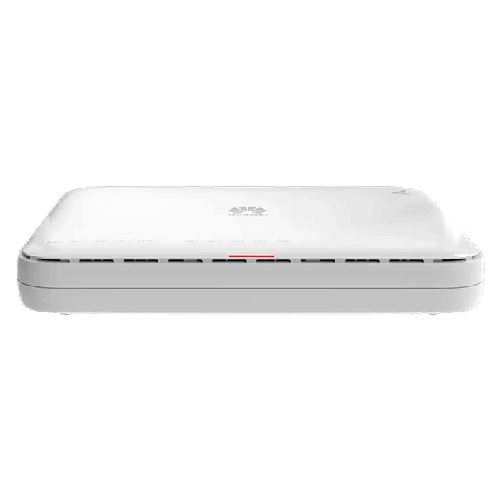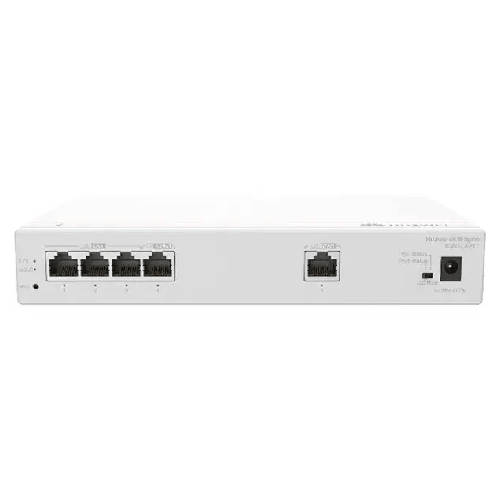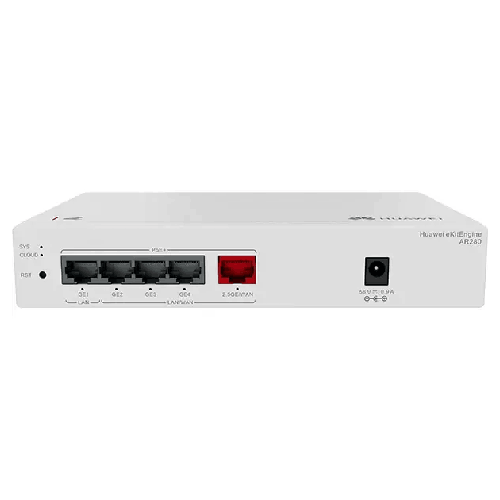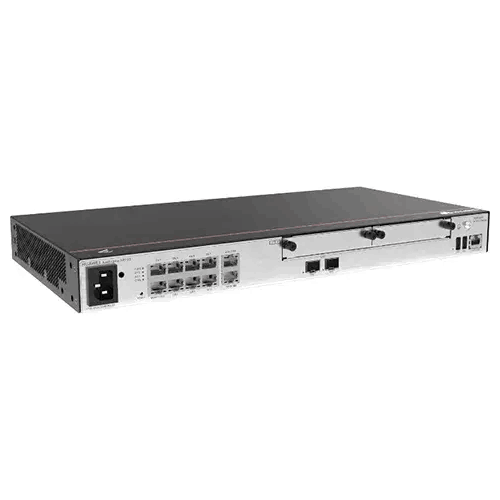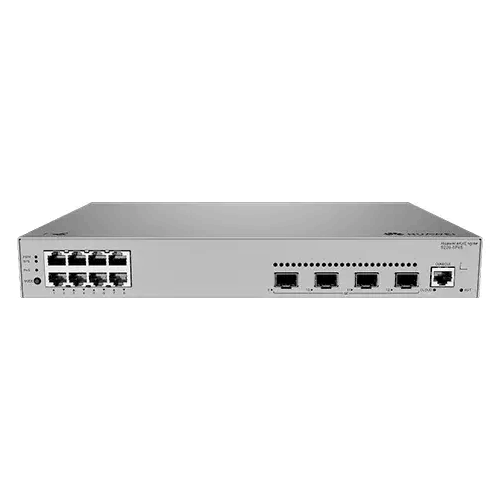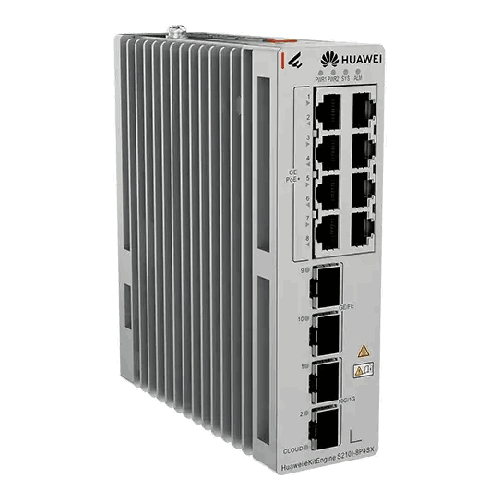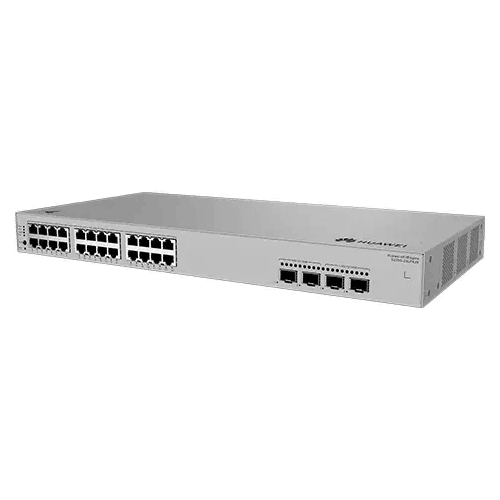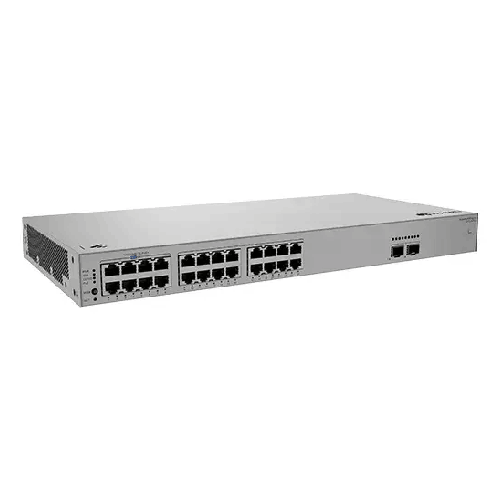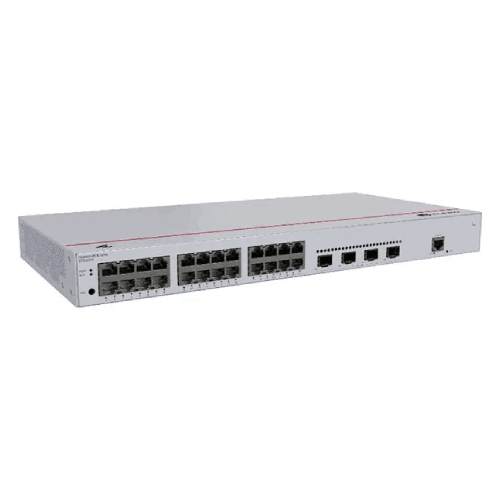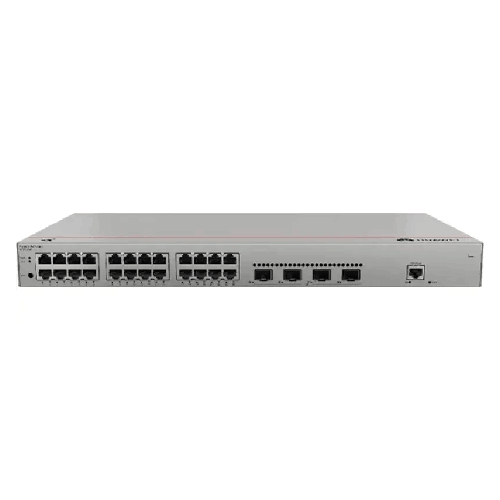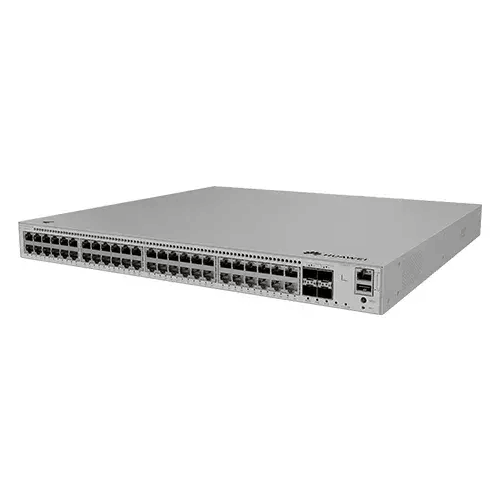
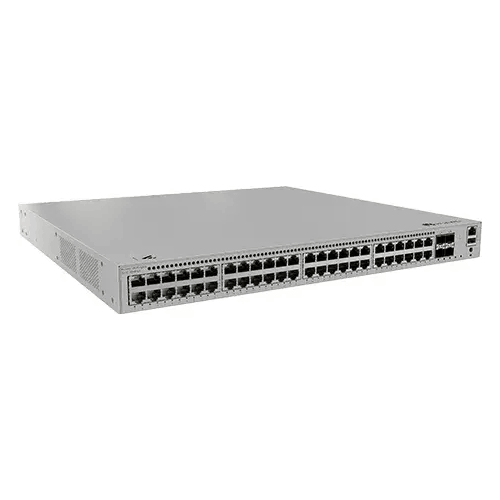
Huawei eKitEngine S310-48HP4X Layer 3 Managed 48-Port High Density Full Power PoE Switch
Regular Price:৳0.00Availability: SKU: 6.54.130.9166
Quick Overview
-
Support
Saturday – Thursday: 09 AM - 06 PM. -
Payment
Cash on Delivery | Card | Online Payment -
Shipping Cost
Inside Dhaka 100tk | Outside Dhaka 150tk -
Warranty Policy
Read More
Description
Huawei eKitEngine S310-48HP4X Layer 3 Managed 48-Port High Density Full Power PoE Switch Price in Bangladesh
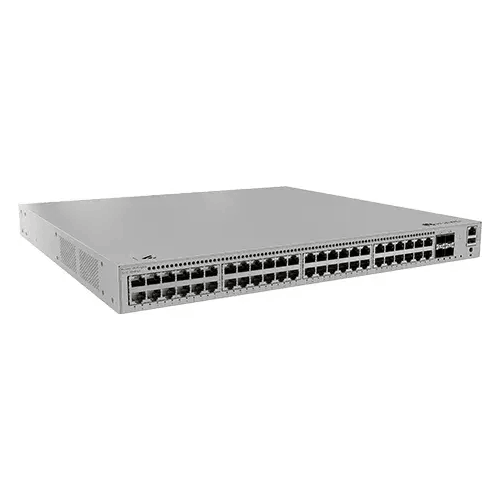
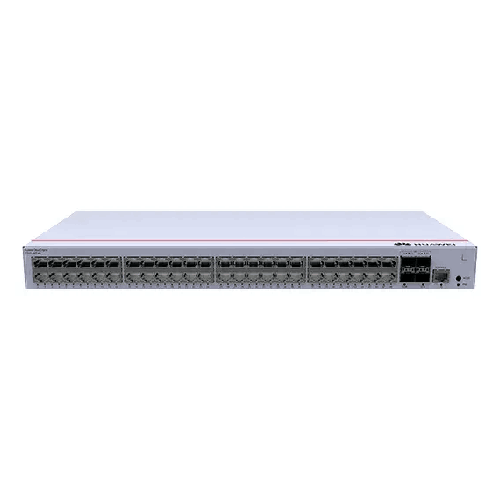
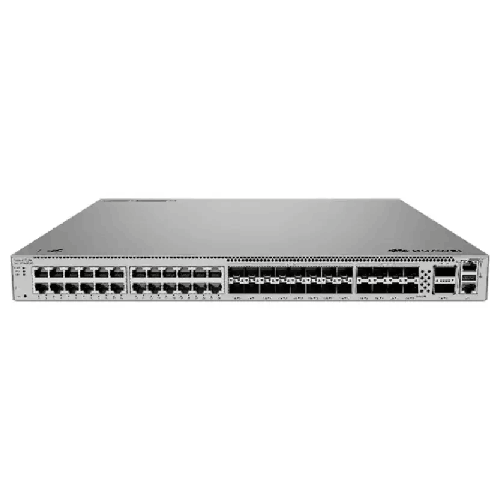
The Huawei eKitEngine S310-48HP4X is a high-density managed Ethernet switch designed for networks that need a large number of Gigabit PoE+ access connections together with high-speed 10GE uplinks. The switch provides 48 × 10/100/1000BASE-T PoE+ ports and 4 × 10GE SFP+ ports, making it suitable for structured business networks where numerous powered Ethernet endpoints must be connected from a centralized switching platform. Huawei specifies 176 Gbit/s switching capacity, 131 Mpps packet forwarding performance, and an 846W maximum PoE power budget for this model.
The S310-48HP4X is particularly relevant to deployments containing large numbers of IP cameras, wireless access points, IP phones, access-control equipment, and other compatible PoE-powered devices. Instead of requiring an independent power source for every compatible endpoint, PoE+ allows network connectivity and power to be delivered through Ethernet cabling, simplifying infrastructure planning in many installations.
At the same time, the four 10GE SFP+ ports provide higher-speed uplink connectivity for connecting the switch to aggregation equipment, core network infrastructure, servers, storage environments, or other compatible 10GbE devices. This combination of 48 Gigabit access ports and four 10GE uplinks gives the S310-48HP4X a practical architecture for high-density access-layer deployments.
Huawei identifies the S310 series as an L2+ managed switch family. Its documented Layer 3 capabilities include IPv4 static routing, IPv6, and DHCP relay, alongside Layer 2 functions such as VLANs, MAC management, STP/RSTP/MSTP, ERPS, QoS, ACL, and network management functions.
48 Gigabit PoE+ Access Ports
The defining feature of the Huawei S310-48HP4X is its 48 × 10/100/1000BASE-T PoE+ ports. Each copper access interface supports Fast Ethernet and Gigabit Ethernet connectivity, while also providing PoE+ functionality for compatible powered devices.
With 48 access ports in a single switch, organizations can consolidate a substantial number of Ethernet endpoints into one rack-mounted platform. This is particularly useful where the network includes many cameras, access points, IP phones, or other powered devices.
For example, a surveillance deployment can connect multiple IP cameras directly to the switch's PoE+ ports. A wireless infrastructure can similarly connect numerous compatible access points without requiring separate power adapters at each access-point location.
The Gigabit Ethernet capability also makes the switch suitable for ordinary wired clients. Computers, printers, network appliances, phones, access points, and other compatible devices can connect through the copper interfaces according to their supported Ethernet speeds.
846W High-Capacity PoE
The S310-48HP4X is designed for high-density PoE environments, with Huawei specifying a maximum PoE power capacity of 846W.
This is substantially more than the PoE budget found on many smaller office switches. The high power budget is particularly relevant when a deployment has many powered endpoints or when individual devices have comparatively high power requirements.
A high-capacity PoE switch can simplify centralized power planning. Instead of deploying numerous local power adapters, compatible endpoints can draw power through the network cabling connected to the switch.
However, the 846W figure represents the total documented PoE power budget, so network planners should calculate the actual combined power requirements of the intended devices. The number of powered devices that can be connected at their required power levels depends on their individual consumption.
Huawei's hardware documentation also indicates that the 846W PoE+ design supports different combinations of 802.3af and 802.3at devices. The documentation notes a maximum of 48 ports at 15.4W under 802.3af and 25 ports at 30W under 802.3at in the stated configuration.
Therefore, the switch should be planned according to the actual power consumption of the endpoint population rather than simply multiplying a theoretical per-port PoE value across all 48 interfaces.
Four 10GE SFP+ Uplink Ports
The S310-48HP4X includes 4 × 10GE SFP+ ports, providing high-speed uplink connectivity beyond the 1GbE copper access layer. Huawei specifies that these interfaces support 10GE/1GE operation.
These 10GE interfaces can be used where the access switch needs higher-bandwidth connections to upstream network equipment. This is especially useful in high-density deployments because a large number of Gigabit access devices can generate substantial aggregate traffic.
For example, a business might connect dozens of workstations, access points, IP cameras, or other devices through the 48 copper ports while using 10GbE uplinks toward aggregation or core switching infrastructure.
The SFP+ architecture also provides flexibility for compatible optical or direct-attach connectivity depending on the selected transceiver, cabling, and network design.
When purchasing optical modules, customers should verify compatibility between the selected SFP+ module, fiber type, transmission distance, and the connected network equipment.
176Gbps Switching Capacity
Huawei specifies a 176 Gbit/s switching capacity for the S310-48HP4X.
Switching capacity is an important specification when evaluating a high-density switch because the device may simultaneously handle traffic from many connected access devices.
The 176Gbps specification reflects the switching capability documented by Huawei for this model. It should be considered together with the 131Mpps packet-forwarding specification and the actual traffic profile of the network.
A high-density PoE switch may simultaneously carry surveillance video, wireless traffic, voice, office applications, internet traffic, and other data. The S310-48HP4X is designed around this type of multi-endpoint access architecture.
131Mpps Packet Forwarding Performance
The S310-48HP4X provides a documented 131 Mpps packet forwarding rate.
Packet forwarding performance describes the switch's packet-processing capability and is particularly relevant when the network handles numerous traffic flows and smaller packets.
In a 48-port access switch, traffic can originate from many endpoints simultaneously. Cameras may generate continuous video streams, wireless clients can create variable traffic patterns, and office computers can produce bursty application traffic.
The 131Mpps specification provides an important performance reference when evaluating the switch for high-density network access applications.
L2+ Managed Networking
The Huawei eKitEngine S310 series is documented by Huawei as an L2+ managed switch series. Huawei lists Layer 2 capabilities including 16K MAC address entries and up to 4K VLANs, while its Layer 3 capabilities include IPv4 static routing, IPv6, and DHCP relay.
This distinction is important when selecting a switch. The S310-48HP4X provides more network functionality than a basic unmanaged Ethernet switch, but it should not automatically be represented as having the same dynamic routing feature set as Huawei's higher-tier S530 or S620 L3 switch families.
For SMB and enterprise access networks where static routing and Layer 2 segmentation are sufficient, the S310-48HP4X can provide a practical managed platform.
VLAN Support for Network Segmentation
Huawei documents up to 4K VLANs for the S310 series.
VLANs allow administrators to logically separate different categories of traffic while using the same physical switching infrastructure.
For example, an organization may design separate logical networks for employees, guests, IP cameras, voice devices, wireless access points, and network management.
VLAN segmentation can make network administration more structured and can help control how different groups of endpoints communicate.
The exact VLAN architecture should be designed according to the organization's addressing, security, routing, and access-control requirements.
16K MAC Address Capacity
Huawei identifies 16K MAC address entries for the S310 series.
MAC address learning allows the switch to identify connected Ethernet devices and make forwarding decisions based on their Layer 2 addresses.
In a 48-port switch serving a large number of endpoints, sufficient MAC address capacity is important because the switch may learn addresses from computers, cameras, access points, phones, printers, and other network devices.
The documented 16K MAC entry capacity gives network planners a useful reference when assessing the S310-48HP4X for larger access-layer environments.
STP, RSTP, MSTP and ERPS
Huawei's S310 series documentation identifies support for STP, RSTP, MSTP, and ERPS, providing mechanisms for managing Layer 2 network topology and redundancy.
Spanning Tree Protocol technologies are designed to help prevent Layer 2 loops when redundant physical paths exist.
RSTP can provide faster topology convergence than traditional STP, while MSTP allows multiple spanning-tree instances to be organized within a network.
Huawei also lists ERPS for the S310 series. This can be relevant in network architectures that use Ethernet ring topologies.
These capabilities should be configured according to the overall network design. They are not a substitute for proper topology planning.
iStack Support
Huawei specifies iStack support for up to four switches of the same series in a stack for the S310-48HP4X.
Stacking can be useful when an organization needs multiple switches but wants them to operate as a coordinated switching system.
A stack can provide a more organized approach to managing multiple compatible switches and can simplify expansion in environments where one 48-port switch is not sufficient.
The specific stacking topology and cabling requirements should be verified before installation, particularly when selecting the appropriate hardware and software configuration.
QoS and Traffic Management
Managed switching becomes particularly important when different applications share the same physical network.
Quality of Service mechanisms can be used to classify and prioritize traffic according to network requirements. In a business network, voice traffic may require different treatment from ordinary file transfers, while surveillance traffic can generate sustained bandwidth demand.
The S310 family provides managed traffic-control capabilities suitable for structured network deployments.
When designing QoS policies, administrators should first identify critical applications, traffic classes, bandwidth requirements, and congestion points rather than applying arbitrary priority rules.
Security and Access Management
A managed network switch provides considerably more control than an unmanaged device.
The S310 series provides Layer 2 management capabilities that can be used to structure access networks through VLANs, MAC-based controls, traffic policies, and other documented functions.
For organizations deploying CCTV, wireless access points, IP phones, and employee computers on the same physical switching infrastructure, network segmentation and access-control policies can help create a more organized architecture.
Security configuration should always be aligned with the organization's broader firewall, authentication, endpoint-security, and network-access policies.
High-Density CCTV Deployment
The S310-48HP4X is particularly relevant to larger IP surveillance networks because its 48 PoE+ ports can connect many compatible cameras from a centralized switch.
The 846W PoE budget provides substantial centralized power capacity for a high-density camera installation, subject to the actual consumption of the selected cameras.
For example, an organization can plan camera groups around different areas of a building, floor, warehouse, educational campus, hotel, or commercial property.
The four 10GE SFP+ ports can then provide higher-speed uplinks toward the network's aggregation or core layer.
Actual surveillance design should consider camera resolution, codec, frame rate, retention architecture, uplink bandwidth, storage requirements, VLAN design, and PoE consumption.
Wireless Access Point Deployment
Modern enterprise wireless networks can contain a significant number of access points.
The S310-48HP4X can provide both Ethernet connectivity and PoE+ power to compatible access points through its 48 copper ports.
This can simplify deployment across offices, hotels, educational buildings, healthcare environments, and other facilities where numerous wireless access points are required.
The four 10GE SFP+ interfaces can provide high-speed uplinks toward aggregation or core network equipment, depending on the network architecture.
When planning a wireless deployment, the switch should be evaluated together with access-point throughput, client density, uplink capacity, PoE consumption, and the wireless controller or management platform.
Enterprise Office Networking
In a large office, a 48-port switch can consolidate many wired devices into one access-layer platform.
The S310-48HP4X can connect computers, phones, wireless access points, cameras, printers, and other compatible Ethernet devices.
VLANs can be used to logically separate traffic categories, while Layer 2+ capabilities provide additional network control.
The high-density port arrangement can also help reduce the number of individual switches required in an appropriately sized network rack.
Hotel and Hospitality Networks
Hotels can have diverse networking requirements across guest areas, administrative offices, security systems, wireless infrastructure, and other operational services.
A high-density PoE switch can provide a centralized access platform for compatible network endpoints.
The S310-48HP4X can be considered where 48 Gigabit PoE+ ports and 10GE uplinks align with the hotel's network architecture.
Because PoE requirements vary between access points, cameras, phones, and other devices, the total 846W budget should be evaluated against the planned endpoint load.
Campus and Educational Networks
Schools, colleges, training centers, and larger educational facilities can have many network endpoints distributed across classrooms, offices, common areas, and security locations.
The 48-port configuration allows a significant number of endpoints to be concentrated at the access layer.
PoE support can simplify deployment of compatible access points, IP phones, cameras, and other powered network equipment.
The S310's VLAN and management functions can also support logical network segmentation where required by the institution's network design.
Physical Design and Rack Installation
The S310-48HP4X is a 1U-class rack-mountable switch. Huawei's current product page specifies basic dimensions of 43.6 × 442 × 420 mm, with maximum depth of 446 mm including protruding components.
Its 442mm width corresponds to a standard rack-oriented network equipment form factor.
The switch can also be used in desk-mounted installations according to Huawei's current product listing, although its 48-port high-density design is particularly relevant to structured equipment-room or network-rack deployments.
Before installation, ensure that the rack provides adequate depth, cable clearance, ventilation, and power distribution.
Metal Chassis and Cooling
Huawei specifies a metal chassis for the S310-48HP4X. The switch uses built-in fans and air cooling with intelligent fan-speed adjustment.
The high PoE capacity means that thermal management is an important consideration. Power conversion, PoE delivery, and network processing all contribute to the switch's thermal load.
Huawei specifies two fan modules for the S310-48HP4X.
The documented long-term operating temperature is -5°C to +50°C at altitudes of 0–1800m, with 5%–95% relative humidity without condensation.
A well-ventilated rack and appropriate cable management can help maintain the environmental conditions required by the equipment.
Power Supply
The S310-48HP4X uses a pluggable AC power supply. Huawei specifies an input range of 90V AC to 290V AC at 45–65Hz, and also lists support for high-voltage DC input from 190V DC to 290V DC.
Huawei's hardware documentation describes the model with a 1000W AC power configuration and identifies a maximum PoE load of 846W in the documented configuration.
Because this is a high-power network device, the installation should use an appropriate electrical circuit and suitable rack power distribution.
Power Consumption
Huawei specifies 36.75W static power consumption and 52.78W typical power consumption for the S310-48HP4X. The current product page lists maximum power consumption of 74.66W without PoE and 991.74W at full PoE load, with 846W attributed to PoE.
These figures illustrate why power planning is particularly important for a high-density PoE switch.
The actual electrical demand will vary according to the connected PoE devices and network workload.
For installations with many cameras or wireless access points, customers should calculate the expected PoE load before selecting the rack power infrastructure.
Surge Protection
Huawei specifies power-port surge protection of ±6kV in differential and common mode for the S310-48HP4X.
This provides a documented equipment-level protection specification, but it should not be interpreted as eliminating the need for proper electrical protection.
Professional installations should still consider grounding, surge protection, rack power distribution, cabling, and local electrical requirements as part of the complete infrastructure.
Suitable for Bangladesh Business Networks
For Bangladesh organizations planning high-density Ethernet deployments, the S310-48HP4X can be considered when the network requires many Gigabit PoE+ ports and high-speed 10GE uplinks.
It can be relevant to offices, commercial buildings, hotels, educational facilities, surveillance installations, wireless networks, and other professional environments.
The switch's 846W PoE budget can be particularly useful in deployments with many powered endpoints.
At the same time, the four 10GE SFP+ ports provide a practical pathway toward higher-speed aggregation.
Before purchase, however, customers should verify the exact number of PoE devices, combined power requirements, required uplink bandwidth, fiber or DAC requirements, rack dimensions, and desired Layer 3 functionality.
✅ Key Features
- 48 × Gigabit PoE+ Ports: Provides 48 × 10/100/1000BASE-T PoE+ interfaces for high-density Ethernet access.
- 846W PoE Budget: Provides a high-capacity PoE budget for deployments with many compatible powered endpoints.
- 4 × 10GE SFP+ Ports: Provides four high-speed 10GE/1GE SFP+ interfaces for compatible uplinks.
- 176Gbps Switching Capacity: Provides the switching capacity specified by Huawei for this model.
- 131Mpps Forwarding Performance: Provides the documented packet-forwarding capability of the switch.
- L2+ Managed Architecture: Supports Layer 2 management together with IPv4 static routing, IPv6, and DHCP relay capabilities documented for the S310 series.
- 4K VLAN Support: Huawei documents up to 4K VLANs for the S310 series.
- 16K MAC Entries: Provides documented capacity for up to 16K MAC address entries.
- iStack Support: Supports stacking of up to four switches of the same series.
- Layer 2 Redundancy: Supports STP, RSTP, MSTP, and ERPS according to Huawei's S310 documentation.
- Rack-Friendly 1U Design: Uses a 43.6mm-high, 442mm-wide chassis suitable for rack-oriented network deployment.
- Intelligent Fan Cooling: Uses built-in fans with intelligent fan-speed adjustment.
✅ Usage / Applications
- Enterprise Office Networks: Connect high numbers of computers, phones, access points, cameras, and other Ethernet endpoints.
- High-Density CCTV: Centralize compatible IP cameras through 48 PoE+ ports.
- Wireless Access Networks: Provide PoE connectivity for compatible Wi-Fi access points.
- Hotel Networks: Support high-density wired, wireless, and security infrastructure.
- Educational Campuses: Connect classrooms, offices, wireless infrastructure, and security devices.
- Healthcare Networks: Provide managed Ethernet access for appropriate network endpoints.
- Commercial Buildings: Centralize access-layer Ethernet and PoE devices.
- IP Telephony: Supply network connectivity and PoE power to compatible IP phones.
- Security Systems: Connect compatible PoE access-control and surveillance equipment.
- SMB Infrastructure: Provide a high-density managed switching platform for growing organizations.
- Fiber-Uplink Networks: Use 10GE SFP+ interfaces for high-speed connections to compatible upstream equipment.
- Access-Layer Deployments: Operate as a high-density access switch within a structured network architecture.
✅ Benefits of This Product
- High Port Density: 48 Gigabit PoE+ ports consolidate a large number of network endpoints.
- Large PoE Capacity: The 846W budget is suitable for installations with substantial PoE requirements.
- High-Speed Uplinks: Four 10GE SFP+ ports provide higher-speed uplink options.
- Centralized Power Delivery: Compatible PoE devices can receive network connectivity and power through Ethernet cabling.
- Managed Network Control: VLAN, MAC, Layer 2 redundancy, QoS, and access-management functions support structured network administration.
- Static Routing Capability: Huawei documents IPv4 static routing as part of the S310 L2+ feature set.
- Stacking Capability: Up to four same-series switches can be stacked according to Huawei's current specification.
- Rack-Efficient Design: The 1U-class form factor provides substantial port density without requiring a large chassis.
✅ Ideal For
The Huawei eKitEngine S310-48HP4X is ideal for organizations that need a high-density Gigabit PoE+ access switch with high-speed 10GE uplinks and managed networking capabilities.
It is particularly relevant to businesses deploying numerous IP cameras, wireless access points, IP phones, and other compatible PoE endpoints. The 48-port configuration allows many devices to be consolidated into one access switch, while the 846W PoE budget provides substantial centralized power capacity.
The four 10GE SFP+ interfaces make the switch suitable for network designs where the access layer requires higher-speed connections toward aggregation or core equipment.
The S310-48HP4X can also be considered for offices, hotels, educational institutions, commercial buildings, surveillance systems, and other professional network environments.
Customers should select this model after confirming their PoE budget, endpoint count, uplink bandwidth, optical requirements, rack space, and Layer 3 feature requirements. For organizations requiring dynamic routing protocols such as OSPF or BGP directly on the access switch, Huawei's higher-tier L3 switch families should be evaluated instead; the S310 series is documented as L2+ with IPv4 static routing, IPv6, and DHCP relay.
✅ Why Choose the Huawei eKitEngine S310-48HP4X?
The S310-48HP4X is built around a clear high-density access-switching requirement: many Gigabit PoE+ ports combined with high-speed uplinks.
Its 48 × 10/100/1000BASE-T PoE+ ports make it possible to connect a large number of compatible powered devices from a centralized switching platform, while the 846W PoE capacity supports installations with a substantial aggregate power requirement.
The four 10GE SFP+ ports are another important part of the design. High-density Gigabit access networks can generate significant aggregate traffic, so 10GbE uplinks can provide a suitable path toward higher-level switching infrastructure when the rest of the network supports it.
The switch also provides managed networking rather than simple unmanaged connectivity. Huawei's S310 documentation identifies 16K MAC entries, 4K VLANs, IPv4 static routing, IPv6, DHCP relay, iStack, STP, RSTP, MSTP, ERPS, and other management features.
Its 1U-class rack form factor further supports centralized network-room deployment.
For customers who need a 48-port high-density PoE+ switch with 10GE uplinks, the S310-48HP4X offers a specification profile specifically built around that requirement.
✅ Why Buy This Product from BME?
When purchasing a high-capacity network switch such as the Huawei eKitEngine S310-48HP4X, correct model selection is important because apparently similar Huawei switches can have substantially different PoE budgets, uplink speeds, port speeds, and Layer 3 capabilities.
BME can help customers evaluate the S310-48HP4X according to their intended Bangladesh deployment, whether the requirement involves CCTV, wireless access points, IP telephony, office networking, hotel infrastructure, educational networks, or another structured Ethernet application.
Before purchasing, customers should provide the required number of PoE devices, estimated combined PoE consumption, desired uplink speed, fiber requirements, number of VLANs, routing requirements, and expected network expansion.
The 846W PoE capacity makes this model particularly different from standard 48-port PoE switches with lower power budgets. Therefore, it is important to match the switch's PoE capacity to the actual endpoint population rather than choosing a model based only on port count.
For procurement teams, specifying the exact model S310-48HP4X helps prevent confusion with related models such as the S310-48P4X and S310-48PN4X, which have different PoE or port specifications. Huawei's current listings show these models separately.
✅ Buying Guide
1. Confirm the Required Number of Ports:
The S310-48HP4X provides 48 Gigabit PoE+ copper ports. Confirm that the planned endpoint count fits the available access ports.
2. Calculate Total PoE Demand:
Add the power requirements of all planned PoE devices and compare the result with the 846W PoE budget.
3. Check Device PoE Compatibility:
Verify that cameras, access points, phones, and other powered devices are compatible with the PoE standards and power levels required by the deployment.
4. Evaluate Uplink Requirements:
The switch provides four 10GE SFP+ ports. Confirm whether your upstream network equipment supports compatible 10GbE connections.
5. Select Compatible Optics or Cabling:
Choose appropriate SFP+ transceivers, fiber, or compatible direct-attach solutions according to distance and connected-device requirements.
6. Plan VLAN Architecture:
Define separate VLANs where required for staff, guests, CCTV, voice, wireless, and management traffic.
7. Confirm Layer 3 Requirements:
The S310 series provides IPv4 static routing, IPv6, and DHCP relay. If the project requires OSPF, BGP, or other dynamic routing functions on the switch itself, verify the requirement against a higher-tier Huawei L3 platform.
8. Plan Stacking Requirements:
If multiple compatible switches will be deployed, evaluate Huawei's iStack capability, which supports up to four switches of the same series.
9. Check Rack Dimensions:
The chassis is 43.6 × 442 × 420mm in its basic dimensions, with a maximum listed depth of 446mm. Ensure the rack provides sufficient depth and rear clearance.
10. Plan Electrical Capacity:
A fully loaded PoE deployment can reach the documented maximum power consumption of 991.74W, so the rack power infrastructure should be planned accordingly.
11. Check Environmental Conditions:
Huawei specifies -5°C to +50°C long-term operation at 0–1800m altitude and 5%–95% non-condensing relative humidity.
12. Plan Cooling and Cable Management:
Because the switch uses active air cooling and can operate with a substantial PoE load, maintain appropriate rack ventilation and avoid blocking the documented airflow paths.
✅ Customers Ask About / Frequently Asked Questions
1. What is the Huawei eKitEngine S310-48HP4X?
It is a high-density managed switch with 48 × 10/100/1000BASE-T PoE+ ports and four 10GE SFP+ ports.
2. How many PoE ports does the S310-48HP4X have?
It has 48 Gigabit PoE+ ports.
3. What is the PoE budget?
Huawei specifies a maximum PoE power capacity of 846W.
4. How many 10GE ports does it have?
It has 4 × 10GE SFP+ ports, supporting 10GE and 1GE operation according to Huawei's product specification.
5. What is the switching capacity?
The documented switching capacity is 176 Gbit/s.
6. What is the packet forwarding rate?
Huawei specifies 131 Mpps.
7. Is the S310-48HP4X a Layer 3 switch?
Huawei classifies the S310 family as L2+ managed, with documented Layer 3 functions including IPv4 static routing, IPv6, and DHCP relay.
8. Does it support VLANs?
Yes. Huawei documents up to 4K VLANs for the S310 series.
9. How many MAC addresses can it support?
Huawei documents up to 16K MAC address entries for the S310 series.
10. Does it support stacking?
Yes. The current Huawei product specification states support for iStack with up to four switches of the same series.
11. Can it be used for IP cameras?
Yes, it can be considered for compatible PoE IP-camera deployments. The total power requirements of the cameras should be checked against the 846W PoE budget.
12. Does it have 10GbE uplinks?
Yes. It provides four 10GE SFP+ ports.
✅ Why Buy This Product
The Huawei eKitEngine S310-48HP4X is designed for high-density Ethernet environments where a large number of Gigabit PoE+ endpoints must be connected to a centrally managed switching platform.
Its 48 Gigabit PoE+ ports, 846W PoE budget, four 10GE SFP+ ports, 176Gbps switching capacity, and 131Mpps forwarding rate make it suitable for network designs involving substantial numbers of cameras, wireless access points, IP phones, and other compatible Ethernet devices.
The S310's managed L2+ architecture adds VLAN, MAC, Layer 2 redundancy, IPv4 static routing, IPv6, DHCP relay, iStack, and other documented networking functions.
For businesses and institutions in Bangladesh that need a 48-port high-power PoE+ switch with 10GE uplinks, the S310-48HP4X is a model worth evaluating against the project's endpoint count, PoE consumption, uplink bandwidth, and routing requirements.
What is the price of Huawei eKitEngine S310-48HP4X Layer 3 Managed 48-Port High Density Full Power PoE Switch in Bangladesh?
Write a review
Question Answer
Have question about this product? Get specific details about this product from expert.