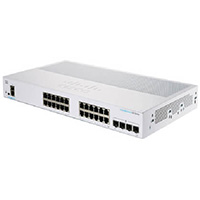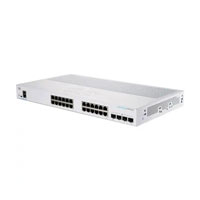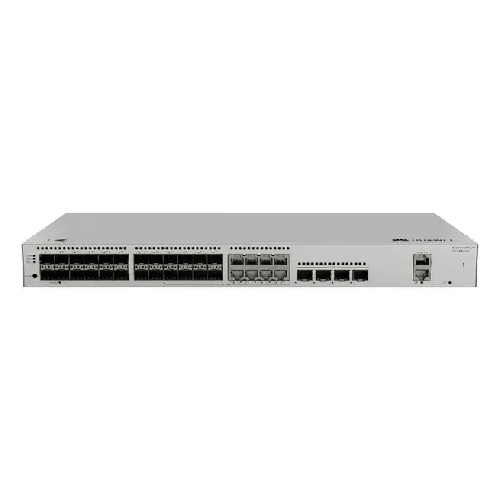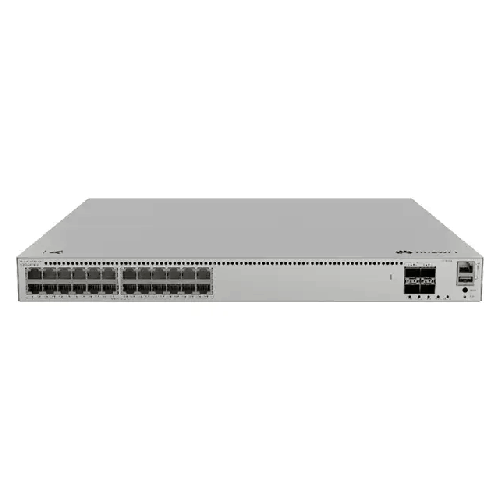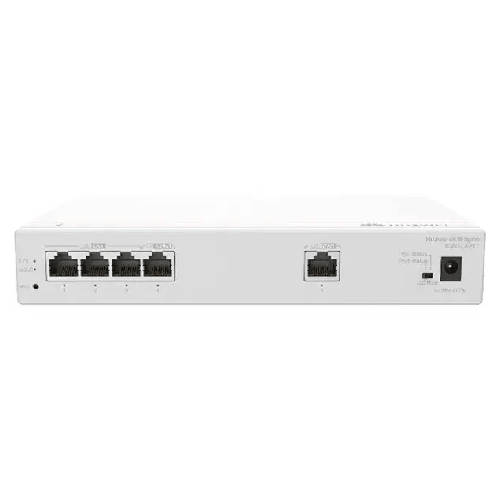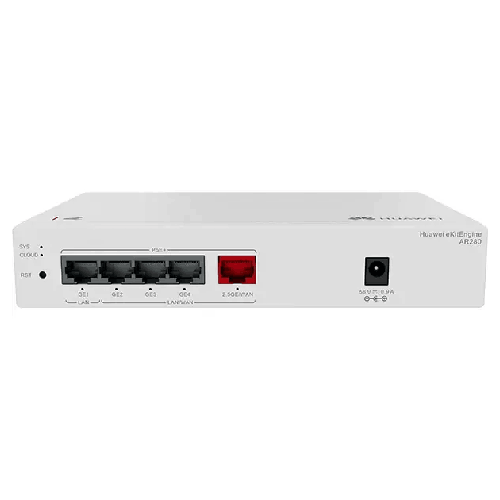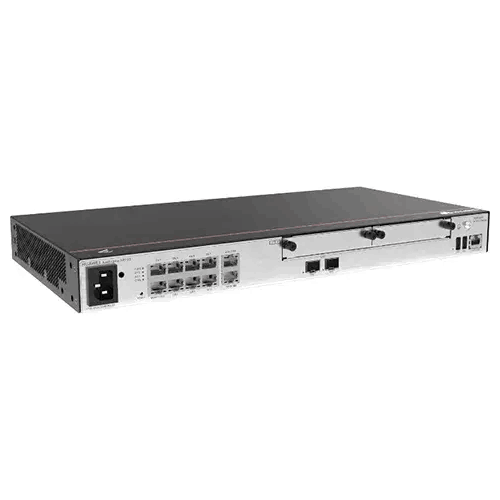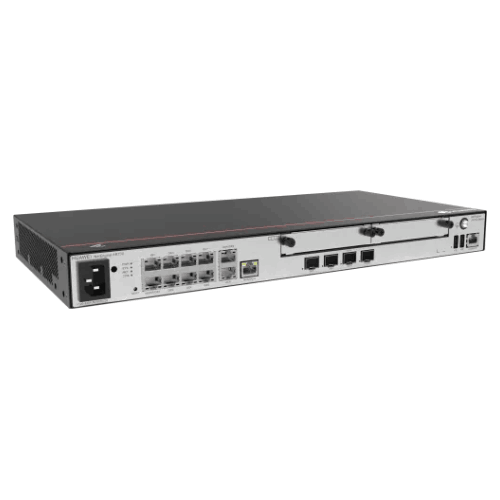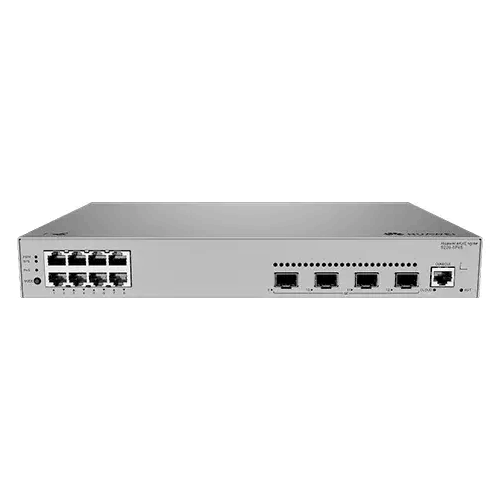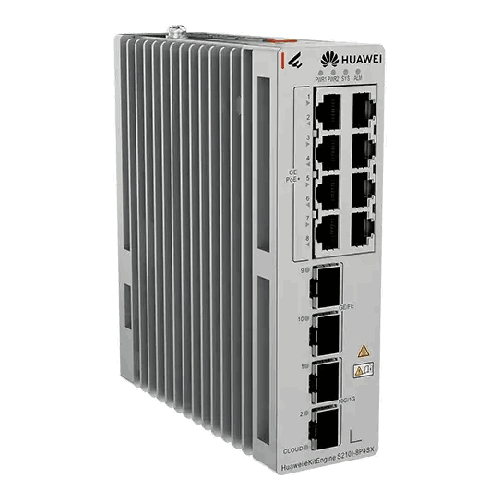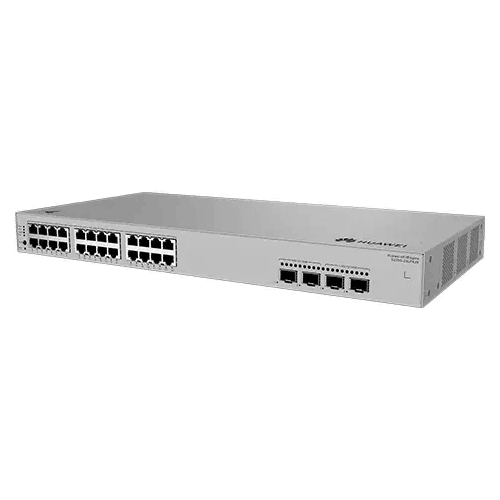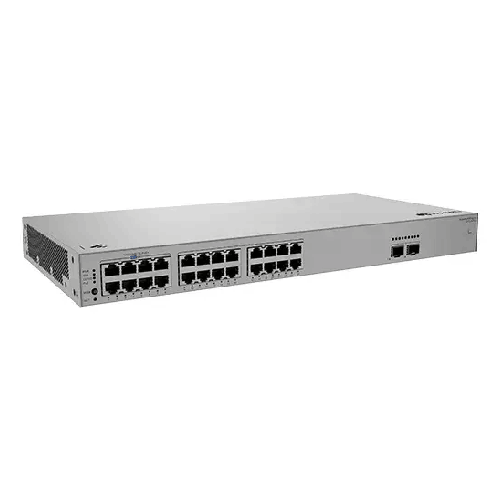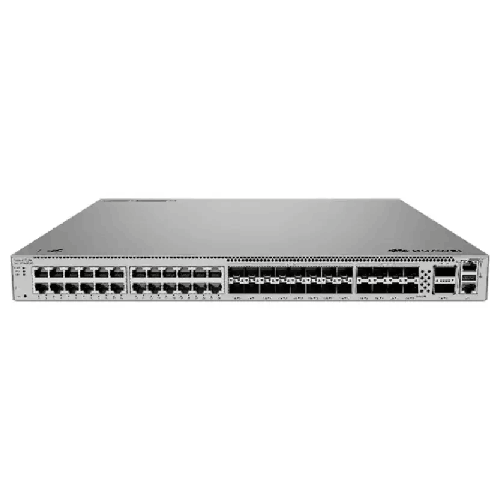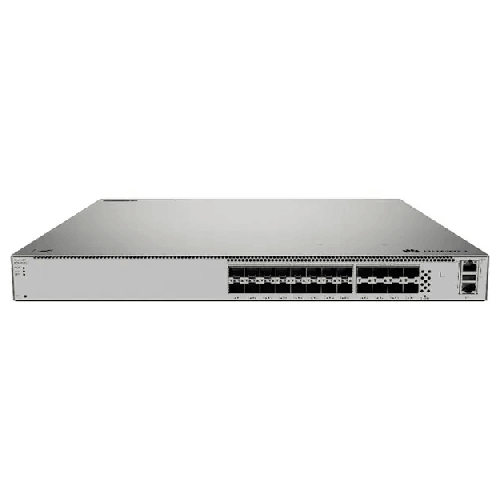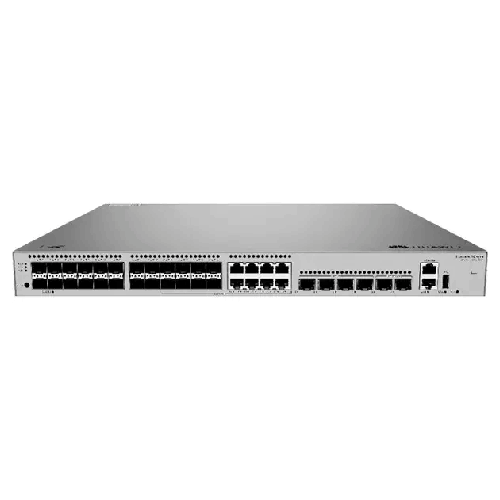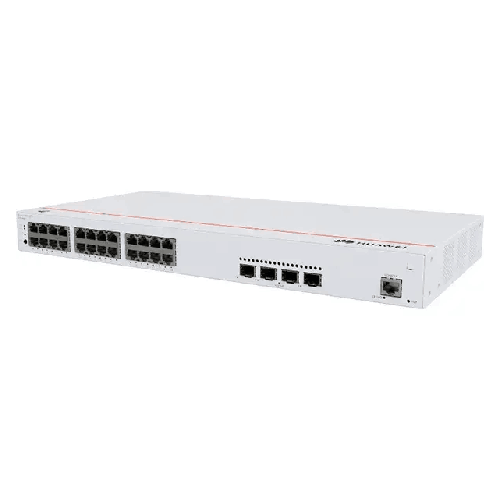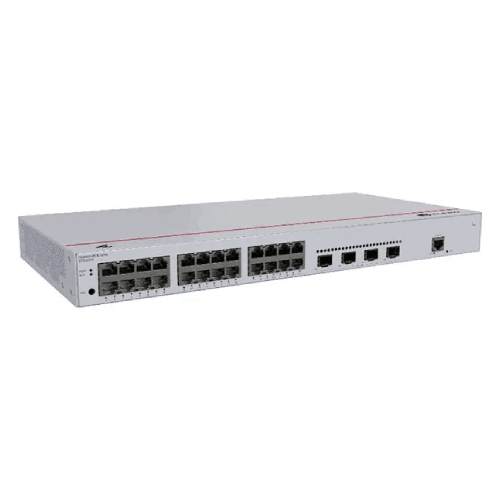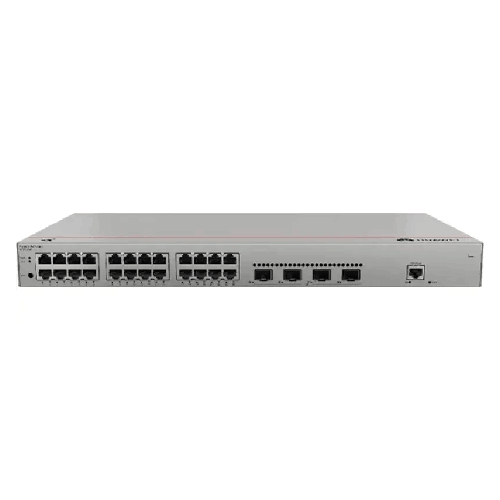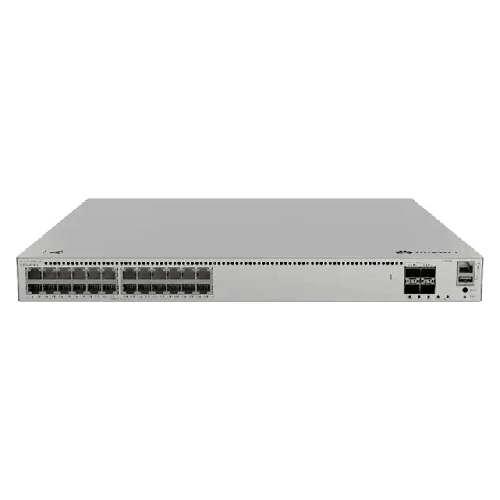
Huawei eKit S310-24PN4X 24-Port Managed PoE+ Switch
Regular Price:৳0.00Availability: SKU: 6.54.130.9154
Quick Overview
-
Support
Saturday – Thursday: 09 AM - 06 PM. -
Payment
Cash on Delivery | Card | Online Payment -
Shipping Cost
Inside Dhaka 100tk | Outside Dhaka 150tk -
Warranty Policy
Read More
Description
Huawei eKit S310-24PN4X 24-Port Managed PoE+ Switch Price in Bangladesh
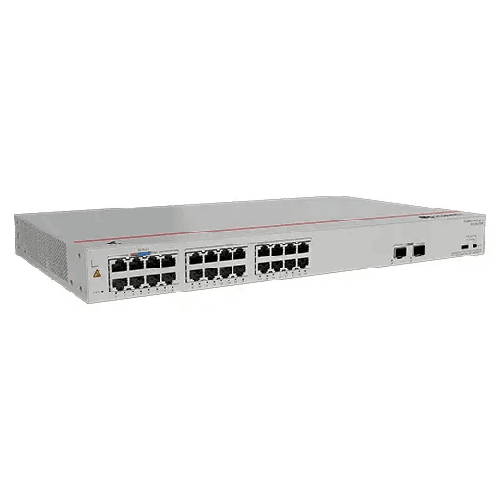
The Huawei eKit S310-24PN4X is a high-performance managed PoE+ switch designed for modern business networks that require faster Ethernet access, high-capacity uplinks, centralized network connectivity, and Power over Ethernet deployment. The switch combines 24 multi-gigabit copper ports with four 10GE SFP+ uplink ports, providing a practical platform for connecting high-speed access devices while maintaining fast backbone connectivity. Huawei specifies 24 × 10/100/1000/2.5GBASE-T ports with PoE+ support and four × 10GE SFP+ ports on this model.
Unlike a conventional Gigabit-only access switch, the Huawei eKit S310-24PN4X supports up to 2.5G Ethernet on its copper access interfaces. This makes it suitable for network environments where newer Wi-Fi access points, high-performance workstations, servers, storage devices, and other bandwidth-intensive endpoints can benefit from multi-gigabit connectivity. At the same time, the four 10GE SFP+ ports provide higher-speed uplink options for connecting the switch to aggregation, core, server, or other network infrastructure.
Huawei rates the S310-24PN4X at 200 Gbit/s switching capacity and 144 Mpps packet forwarding rate. These specifications provide an indication of the switch's ability to handle substantial traffic across its switching architecture and make the model appropriate for networks where multiple connected devices may generate significant concurrent traffic.
Another major advantage of the Huawei eKit S310-24PN4X is its PoE+ capability. The switch provides up to 400 W of maximum PoE power consumption, allowing compatible powered devices to receive both network connectivity and electrical power through Ethernet cabling. This can simplify deployment for devices such as compatible wireless access points, IP cameras, VoIP equipment, and other PoE-enabled network endpoints.
The combination of multi-gigabit access ports and 10GE uplinks makes this switch particularly relevant to organizations upgrading their LAN infrastructure. As wireless standards and endpoint capabilities continue to increase, a 1GbE-only access layer can become a bottleneck in some deployments. A 2.5GbE access interface provides additional bandwidth while retaining compatibility with common 10/100/1000 Ethernet speeds.
High-Speed 2.5G Ethernet Connectivity
The defining feature of the S310-24PN4X is its 24 × 10/100/1000/2.5GBASE-T access-port configuration. Each of these ports supports multiple Ethernet speeds, including 10 Mbps, 100 Mbps, 1 Gbps, and 2.5 Gbps. Huawei identifies these interfaces as 2.5GE RJ45 ports with PoE+ support.
This multi-speed design allows organizations to connect a mixture of existing Gigabit devices and newer 2.5GbE-capable equipment without requiring an entirely separate access infrastructure. Existing 10/100/1000 Ethernet endpoints can continue operating while compatible multi-gigabit devices can take advantage of the higher interface speed.
For offices deploying newer wireless access points, this capability can be particularly useful. A suitable 2.5GbE connection can provide more Ethernet bandwidth between the access point and the network switch than a traditional 1GbE connection, provided that the access point, cabling, and network architecture support the higher rate.
The 24-port configuration also provides a substantial number of access interfaces in a single switch. This can help consolidate connectivity for office workstations, wireless infrastructure, surveillance devices, VoIP endpoints, and other Ethernet-connected equipment.
Four 10GE SFP+ Uplink Ports
The S310-24PN4X includes four 10GE SFP+ ports, with Huawei specifying support for 10G and 1G connections on these interfaces.
These uplinks provide an important distinction between the access layer and the network backbone. While the 24 copper ports are designed for connecting endpoint devices, the 10GE SFP+ interfaces can be used for higher-speed network interconnection where compatible optical or other supported SFP+ connectivity is required.
Four high-speed uplink ports also provide flexibility when designing network topology. Depending on the broader infrastructure and supported configuration, organizations can use high-speed links to connect network layers or other compatible infrastructure.
For businesses upgrading from conventional Gigabit switching, the availability of 10GE uplinks can reduce the risk of creating a heavily congested uplink when many access ports are active simultaneously.
400W PoE+ Capability
Power over Ethernet is one of the most useful features of the Huawei eKit S310-24PN4X. Huawei specifies PoE support with a maximum PoE power consumption of 400 W. The product is also specifically identified as providing 24 × 2.5GBASE-T PoE+ ports.
PoE simplifies network installation by allowing compatible powered devices to receive power through the Ethernet connection rather than requiring a separate electrical connection at every endpoint.
In a business environment, this can be useful for compatible wireless access points, IP surveillance cameras, VoIP phones, and other powered network devices. Instead of designing separate power arrangements for every compatible endpoint, the network infrastructure can provide both data connectivity and power through the Ethernet cabling.
The 400 W PoE capacity should be considered at the network-design stage. Actual deployment capacity depends on the power requirements of the connected devices and the available PoE budget. Therefore, organizations should calculate the expected power demand of their endpoints before finalizing a PoE deployment.
200 Gbit/s Switching Capacity
Huawei specifies a 200 Gbit/s switching capacity for the S310-24PN4X.
Switching capacity is an important specification when evaluating a network switch because it provides a measure of the aggregate switching capability of the platform. For a 24-port multi-gigabit switch with 10GE uplinks, high internal switching capacity helps support simultaneous traffic across multiple interfaces.
This is particularly relevant in environments where many users and devices are active at the same time. Business applications, cloud services, file transfers, video conferencing, wireless clients, surveillance traffic, and other workloads can generate substantial network activity.
The S310-24PN4X is therefore positioned as more than a basic connectivity device. Its port configuration and switching specifications are designed for modern networks that need greater bandwidth at both the access and uplink layers.
144 Mpps Packet Forwarding Rate
The switch provides a packet forwarding rate of 144 Mpps, according to Huawei's product specifications.
Packet forwarding performance is relevant because network traffic is made up of individual packets that must be processed and forwarded to their appropriate destinations. A higher forwarding rate is particularly relevant to networks carrying large volumes of concurrent traffic.
When evaluating the S310-24PN4X, the forwarding rate should therefore be considered together with the 200 Gbit/s switching capacity, 24 multi-gigabit ports, and four 10GE uplinks rather than viewed as an isolated specification.
Managed Network Architecture
The Huawei eKit S310-24PN4X is a managed switch, making it suitable for organizations that need more control over their network infrastructure than an unmanaged switch can provide.
Managed switching is valuable in professional environments because network administrators may need to configure, monitor, segment, troubleshoot, and maintain the network according to the organization's requirements.
For a business network, this type of switch can serve as an access-layer component connecting users and devices to the wider LAN infrastructure. Its combination of 2.5GbE access connectivity and 10GE uplinks also allows it to fit into network architectures where higher bandwidth is required between access and upstream infrastructure.
Specific software features should be evaluated against the organization's network design and the applicable Huawei documentation before procurement. The core product specifications establish the hardware capabilities described on this page.
iStack Support
Huawei specifies iStack support for up to four switches of the same series in a stack.
Stacking can be useful in network environments where multiple switches need to be deployed while maintaining a more coordinated switching architecture. Instead of treating each switch as an entirely isolated unit, stacking technology can help simplify the management and expansion of compatible switch deployments.
For growing businesses, this capability can be relevant when the number of network endpoints increases beyond the practical capacity of a single switch. The S310-24PN4X can therefore be considered as part of a scalable switching strategy rather than only as a standalone device.
Metal Chassis and Professional Deployment
The Huawei eKit S310-24PN4X uses a metal chassis, providing a conventional professional networking form factor suitable for structured network installations. Huawei specifies the chassis height as 1U in its S310 series documentation.
The official Huawei product page lists rack mounting and desk mounting as installation options for the model.
For a structured IT room or network cabinet, a 1U switch can be integrated into a rack-based installation while maintaining a relatively compact vertical footprint. The physical design should still be evaluated alongside rack depth, cable routing, airflow, power availability, and the requirements of the surrounding infrastructure.
Cooling and Thermal Management
The S310-24PN4X uses built-in fans and air cooling with intelligent fan-speed adjustment. Huawei specifies two fan modules for the model.
This cooling approach is relevant for a switch with high-speed interfaces and a substantial PoE budget. Network switches installed in active IT environments can generate heat during operation, particularly when connected devices consume significant PoE power.
Huawei specifies an operating temperature range of –5°C to +45°C at an altitude of 0 to 1800 meters on its current product page. The product documentation also specifies 5% to 95% relative humidity, non-condensing.
For deployment in Bangladesh, proper ventilation and rack airflow remain important. The installation environment should follow the manufacturer's requirements rather than placing a high-load network switch in a confined or poorly ventilated space.
Power Supply
The Huawei eKit S310-24PN4X uses a built-in AC power supply. Huawei specifies an AC input range of 90 V AC to 290 V AC at 45–65 Hz, with high-voltage DC input of 190 V DC to 290 V DC on its product specification page.
Huawei also specifies ±6 kV surge protection for both differential-mode and common-mode conditions.
The switch's documented typical power consumption is 54.8 W, while the maximum power consumption is listed as 77.70 W without PoE and 517.30 W under full PoE load, with 400 W attributed to PoE.
These figures are useful for planning electrical infrastructure, UPS capacity, rack power distribution, and thermal requirements.
Physical Dimensions and Weight
The S310-24PN4X has basic dimensions of 43.6 × 442.0 × 420.0 mm, while the maximum dimensions are listed as 43.6 × 442.0 × 446.0 mm. Huawei lists the unpacked weight at 4.71 kg and packaged weight at 6.89 kg.
These specifications should be considered when preparing a rack, cabinet, shelf, or desk-based deployment. In particular, the approximately 420 mm basic depth means the installation space should be checked before purchasing, especially where the switch will be placed inside a compact network cabinet.
Network Deployment for Modern Businesses
The Huawei eKit S310-24PN4X can be used as an access switch in a wide range of business networking environments. Its 24 multi-gigabit PoE+ ports can connect compatible endpoints, while its 10GE SFP+ interfaces provide higher-speed connections toward upstream network equipment.
A typical deployment may involve office users connected through Ethernet, wireless access points connected through PoE+, IP cameras receiving both power and data, and high-speed uplinks connecting the switch to the wider network.
Because the access ports support multiple Ethernet speeds, organizations can gradually adopt faster endpoints without immediately replacing every existing Ethernet device.
Suitable for Wi-Fi Infrastructure
Modern wireless access points can generate substantially more traffic than earlier Wi-Fi generations. A switch with 2.5GbE access connectivity can therefore be useful where compatible access points require more than a conventional 1GbE Ethernet connection.
The PoE+ capability also simplifies deployment of compatible wireless access points because power and network connectivity can be delivered over Ethernet.
The S310-24PN4X's 10GE uplinks provide additional bandwidth between the access layer and upstream infrastructure, which can be important when multiple high-speed wireless clients are active simultaneously.
Suitable for IP Surveillance Networks
IP cameras are another important PoE application. Compatible cameras can receive network connectivity and power from PoE-enabled switch ports, reducing the need for individual power arrangements.
A 24-port configuration allows a substantial number of compatible network cameras and other endpoints to be connected through one switching platform. The 400 W PoE capability can also provide considerable aggregate power capacity, although the actual number of cameras supported depends on their individual power requirements.
For surveillance installations, network administrators should calculate camera bandwidth, power consumption, storage requirements, uplink capacity, and recording architecture before selecting the final network topology.
Business Office Connectivity
The S310-24PN4X can also be used to connect office computers, network printers, compatible VoIP devices, wireless access points, IP cameras, and other Ethernet endpoints.
Its multi-gigabit ports are particularly relevant for businesses where high-speed desktop connectivity is required. At the same time, legacy devices that support lower Ethernet speeds can continue to operate through the same multi-speed RJ45 infrastructure.
This makes the switch relevant to network modernization projects where an organization wants to increase bandwidth without immediately redesigning every endpoint connection.
Data-Intensive Network Applications
Organizations that frequently move large files, use centralized storage, operate high-performance workstations, or support bandwidth-intensive applications may benefit from the S310-24PN4X's multi-gigabit access and 10GE uplink architecture.
The four 10GE SFP+ ports provide a high-speed path toward compatible upstream infrastructure, while the 2.5GBASE-T ports provide faster access connectivity than traditional Gigabit Ethernet.
Actual application performance will depend on the complete network path, including endpoint hardware, cabling, transceivers where applicable, upstream switches, storage systems, servers, and software.
Bangladesh Business Networking Use Cases
For organizations in Bangladesh, the Huawei eKit S310-24PN4X can be considered for office networks, corporate LANs, educational institutions, surveillance deployments, hospitality environments, multi-user workplaces, and other professional installations that require managed switching and PoE+.
Its 2.5GbE ports can also support network upgrade strategies where newer equipment is being introduced alongside existing Gigabit devices.
Before deployment, buyers should confirm the required PoE budget, rack depth, uplink requirements, network topology, and compatibility with the rest of the infrastructure.
Maintenance and Deployment Considerations
Professional network equipment should be installed in a clean, dry, and adequately ventilated environment. Airflow should not be blocked, and sufficient clearance should be maintained around the switch according to the installation requirements.
Because the S310-24PN4X uses active cooling, the fan and ventilation path should be kept free from excessive dust accumulation. Regular inspection can help maintain appropriate thermal conditions.
Network administrators should also document connected devices, PoE consumption, uplink utilization, and configuration changes. This is especially useful in larger deployments where troubleshooting can otherwise become time-consuming.
A Practical Platform for Network Modernization
The main value of the Huawei eKit S310-24PN4X comes from the combination of several capabilities in one platform: 24 multi-gigabit PoE+ access ports, four 10GE SFP+ uplinks, 400 W PoE capacity, 200 Gbit/s switching capacity, 144 Mpps forwarding performance, and iStack support for up to four switches of the same series.
This combination gives network planners a platform for supporting faster endpoints while retaining compatibility with lower-speed Ethernet devices.
For businesses planning a network refresh, the switch can be evaluated as an access-layer component where both increased Ethernet bandwidth and PoE deployment are important.
✅ Key Features
- 24 × 2.5GBASE-T PoE+ Ports: Provides 24 RJ45 access interfaces supporting 2.5G, 1G, 100M, and 10M Ethernet connectivity with PoE+.
- Four 10GE SFP+ Uplinks: Provides four high-speed SFP+ interfaces supporting 10G and 1G connections.
- 400W PoE Capacity: Supports up to 400 W of PoE power for compatible powered devices.
- 200 Gbit/s Switching Capacity: Provides substantial switching capability for high-volume network traffic.
- 144 Mpps Packet Forwarding: Supports high-rate packet processing for demanding network environments.
- iStack Support: Allows up to four switches of the same series to be stacked according to Huawei's specification.
- Built-In AC Power: Uses an integrated AC power supply for deployment convenience.
- Metal Chassis: Uses a metal enclosure for professional networking installations.
- Intelligent Fan-Speed Adjustment: Uses air cooling with intelligent fan-speed control.
- 1U Chassis: The S310 series datasheet identifies the model with a 1U chassis height.
✅ Usage / Applications
- Business Office Networks: Connect computers, printers, access points, phones, and other Ethernet devices.
- High-Speed Wi-Fi Infrastructure: Connect compatible multi-gigabit wireless access points through 2.5GbE PoE+ ports.
- IP Surveillance: Provide network connectivity and PoE power to compatible IP cameras.
- VoIP Deployment: Connect compatible PoE-powered IP telephony equipment.
- Enterprise Access Networks: Serve as an access-layer switch for modern business LAN infrastructure.
- Education Networks: Support connected classrooms, administrative systems, wireless access points, and surveillance devices.
- Hospitality Networks: Connect compatible access points, IP cameras, VoIP devices, and wired endpoints.
- Network Upgrade Projects: Introduce 2.5GbE access connectivity while retaining support for 10/100/1000 Ethernet devices.
- High-Bandwidth Workgroups: Support compatible workstations and endpoints requiring more than standard Gigabit Ethernet.
- PoE Infrastructure: Centralize data connectivity and power delivery for supported network devices.
✅ Benefits of This Product?
- Faster Access Connectivity: 2.5GbE support provides greater Ethernet bandwidth than conventional Gigabit-only access.
- Flexible Ethernet Speeds: The RJ45 ports support 2.5G, 1G, 100M, and 10M connectivity.
- Simplified PoE Deployment: Compatible powered devices can receive power and data through Ethernet.
- High PoE Capacity: The switch supports up to 400 W of PoE power.
- Fast Uplink Architecture: Four 10GE SFP+ ports provide high-speed upstream connectivity.
- Scalable Design: iStack supports stacking up to four switches of the same series.
- Professional Form Factor: The 1U chassis is suitable for structured network installations.
- Better Upgrade Flexibility: Existing lower-speed Ethernet devices can coexist with compatible 2.5GbE endpoints.
- Centralized Connectivity: Multiple network device categories can be consolidated onto one managed switching platform.
✅ Ideal For
The Huawei eKit S310-24PN4X is ideal for businesses and organizations that need a combination of multi-gigabit Ethernet access, PoE+, and high-speed uplink connectivity. It is particularly relevant for network environments where 2.5GbE-capable devices are being introduced and where conventional 1GbE access switching may limit available bandwidth.
It can be considered for corporate offices, educational institutions, surveillance networks, hospitality deployments, professional Wi-Fi infrastructure, and other managed LAN environments. The 24 PoE+ ports provide a practical foundation for connecting compatible powered devices, while the four 10GE SFP+ ports provide high-speed connectivity toward upstream infrastructure.
The switch is also suitable for organizations planning a gradual network upgrade. Because the RJ45 interfaces support multiple Ethernet speeds, compatible existing 10/100/1000 devices can operate alongside newer 2.5GbE equipment.
For larger deployments, iStack support for up to four switches of the same series provides an additional scaling option.
✅ Why Choose the Huawei eKit S310-24PN4X?
The Huawei eKit S310-24PN4X brings together several specifications that are important for modern access-layer networking. Its 24 × 10/100/1000/2.5GBASE-T PoE+ interfaces provide both multi-gigabit Ethernet connectivity and power delivery for compatible devices. This is particularly useful for businesses deploying newer wireless access points and other bandwidth-intensive endpoints.
The four 10GE SFP+ ports add another important layer of flexibility. Instead of relying solely on Gigabit uplinks, network administrators can use compatible 10GE infrastructure for higher-speed interconnection.
Huawei specifies 200 Gbit/s switching capacity and 144 Mpps packet forwarding performance for this model. These specifications complement its multi-gigabit access architecture and make it appropriate for networks where many connected endpoints can generate simultaneous traffic.
The 400 W PoE capability further improves its suitability for centralized PoE deployments. Rather than installing separate power infrastructure for every compatible powered endpoint, organizations can use PoE-enabled Ethernet connections where supported.
The switch also supports iStack for up to four switches of the same series, providing an option for scaling compatible deployments.
✅ Why Buy This Product from BME?
When purchasing professional network infrastructure in Bangladesh, selecting the correct model is as important as selecting the brand. The Huawei eKit S310-24PN4X has a specific combination of 2.5GbE PoE+ access ports, 10GE SFP+ uplinks, switching capacity, forwarding performance, and PoE budget. BME can help buyers evaluate these specifications against their actual network requirements before procurement.
For business and institutional buyers, accurate product identification is particularly important because Huawei's S310 series includes multiple models with different port configurations and performance specifications. The S310-24PN4X should therefore be selected based on its exact model number and required interface configuration.
BME's product-focused approach is intended to help customers identify the appropriate networking equipment for office infrastructure, surveillance, wireless deployments, enterprise LANs, and other professional applications.
Before placing an order, buyers should confirm the required quantity, PoE demand, uplink configuration, rack depth, installation environment, and compatibility with existing network equipment. This is especially important for projects involving multiple switches or high-power PoE endpoints.
✅ Buying Guide
1. Confirm the Model Number: Make sure the required model is specifically S310-24PN4X, not another S310-series switch with a different port configuration.
2. Check Access-Port Requirements: This model provides 24 × 10/100/1000/2.5GBASE-T PoE+ ports. Confirm that this matches the requirements of your connected endpoints.
3. Calculate PoE Demand: The maximum PoE capacity is 400 W. Add the expected power requirements of your PoE devices and make sure the deployment remains within the available budget.
4. Plan the Uplinks: The switch provides four 10GE SFP+ ports supporting 10G/1G connectivity. Confirm the required upstream interfaces and compatible transceivers or connections for the intended network design.
5. Check Rack Space: Huawei specifies a 1U chassis and a basic depth of 420 mm. Confirm that your rack or cabinet has sufficient depth and cable-routing space.
6. Review Power Infrastructure: Consider the switch's power consumption and the additional electrical demand generated by connected PoE devices.
7. Check Environmental Conditions: Ensure the installation location provides appropriate temperature, humidity, ventilation, and airflow according to Huawei's specifications.
8. Plan for Expansion: If the network may grow, consider whether iStack support for up to four switches of the same series is relevant to the planned architecture.
9. Verify Network Compatibility: Check the capabilities of connected servers, access points, cameras, storage devices, uplink equipment, and other network components.
10. Purchase by Exact Model: For procurement documents and quotations, use the complete model designation to avoid receiving a different S310-series configuration.
✅ Customers Ask About / Frequently Asked Questions
Q1. What is the Huawei eKit S310-24PN4X?
The Huawei eKit S310-24PN4X is a managed PoE+ switch with 24 × 10/100/1000/2.5GBASE-T ports and four × 10GE SFP+ ports.
Q2. Does the S310-24PN4X support 2.5GbE?
Yes. Huawei specifies 24 × 2.5GE RJ45 interfaces supporting 2.5G/1G/100M/10M Ethernet speeds.
Q3. How many 10G uplink ports does it have?
The switch has four 10GE SFP+ ports supporting 10G and 1G connections.
Q4. Does the Huawei S310-24PN4X support PoE+?
Yes. The 24 × 2.5GE RJ45 ports support PoE+, and Huawei specifies a maximum PoE power capacity of 400 W.
Q5. What is the switching capacity?
The Huawei eKit S310-24PN4X has a switching capacity of 200 Gbit/s.
Q6. What is its packet forwarding rate?
Huawei specifies a packet forwarding rate of 144 Mpps.
Q7. Can the S310-24PN4X be stacked?
Yes. Huawei specifies iStack support for up to four switches of the same series in a stack.
Q8. What type of power supply does it use?
The switch has a built-in AC power supply. Huawei also specifies high-voltage DC input capability in its product specifications.
Q9. Is the S310-24PN4X suitable for rack installation?
Yes. Huawei identifies the S310 series model as a 1U switch, and the official product information lists rack mounting as an installation option.
Q10. What is the operating temperature range?
Huawei specifies –5°C to +45°C at an altitude of 0–1800 meters for this model.
Q11. What is the PoE power budget?
The maximum PoE power consumption is specified as 400 W. The total maximum power consumption under full PoE load is listed as 517.30 W.
Q12. Is this switch suitable for Bangladesh business networks?
Its 2.5GbE access ports, PoE+, 10GE uplinks, and managed architecture make it technically suitable for many modern business network designs. The final suitability should be determined by the required endpoint speeds, PoE demand, uplink design, and existing infrastructure.
✅ Why Buy This Product
The Huawei eKit S310-24PN4X is designed for organizations that need more than standard Gigabit access switching. Its 24 multi-gigabit PoE+ ports support up to 2.5GbE while remaining compatible with lower Ethernet speeds, creating a flexible access layer for mixed-generation network devices.
Its four 10GE SFP+ interfaces provide high-speed uplink capability, while the 200 Gbit/s switching capacity and 144 Mpps forwarding rate provide the performance specifications expected from a modern high-capacity access switch.
The 400 W PoE capacity can simplify the deployment of compatible powered devices, while iStack support provides a path for scaling compatible switch installations.
For businesses upgrading wireless infrastructure, surveillance systems, office networks, or other Ethernet environments, the S310-24PN4X provides a combination of multi-gigabit connectivity, PoE+, high-speed uplinks, and managed switching in a professional 1U platform.
What is the price of Huawei eKit S310-24PN4X 24-Port Managed PoE+ Switch in Bangladesh?
Write a review
Question Answer
Have question about this product? Get specific details about this product from expert.