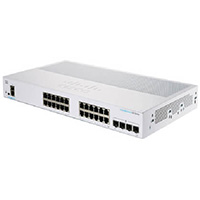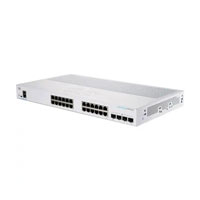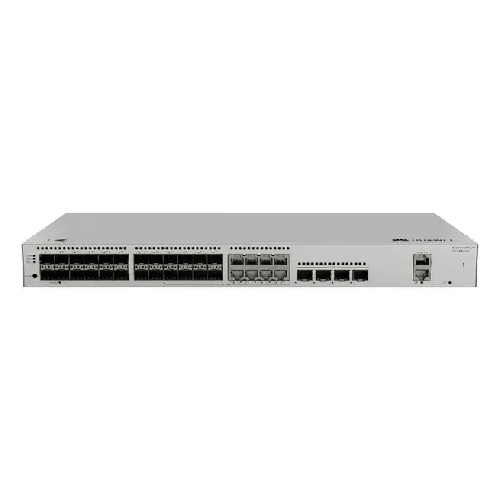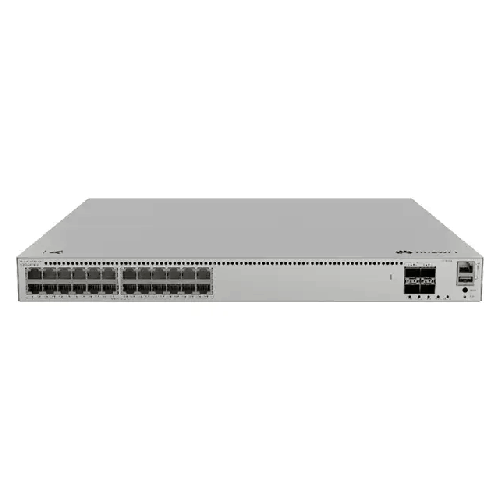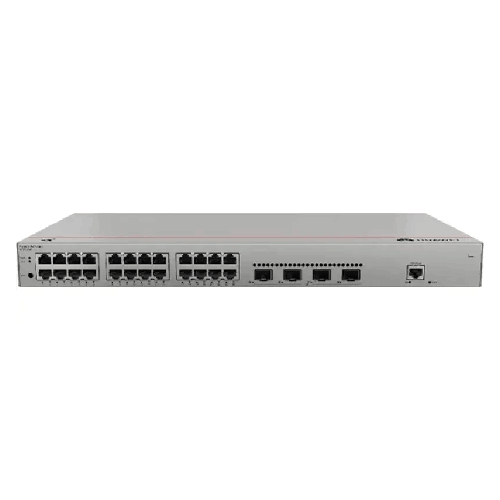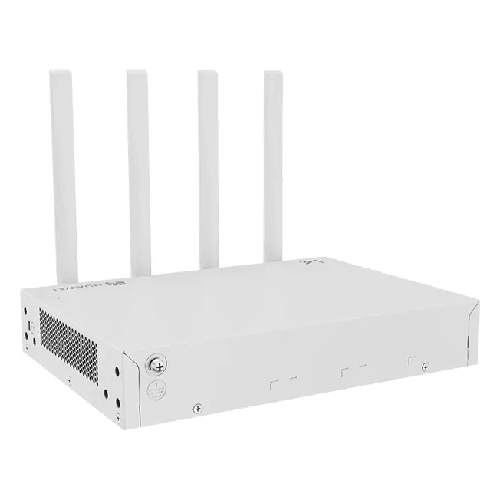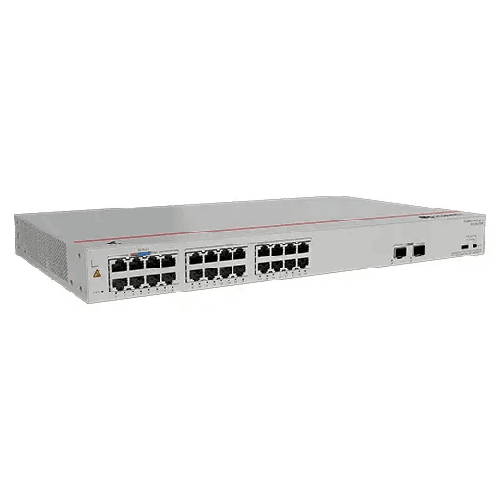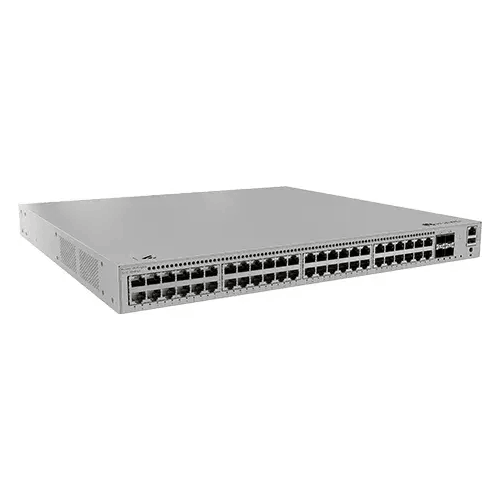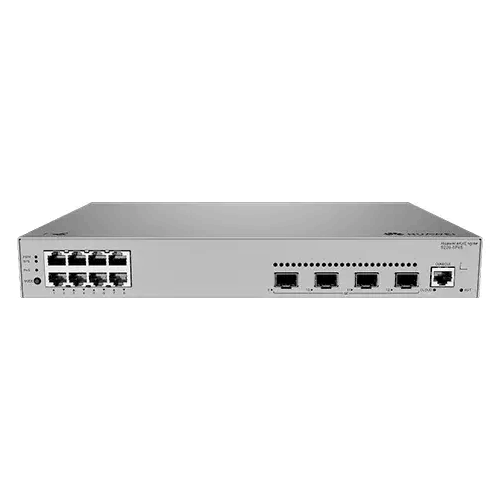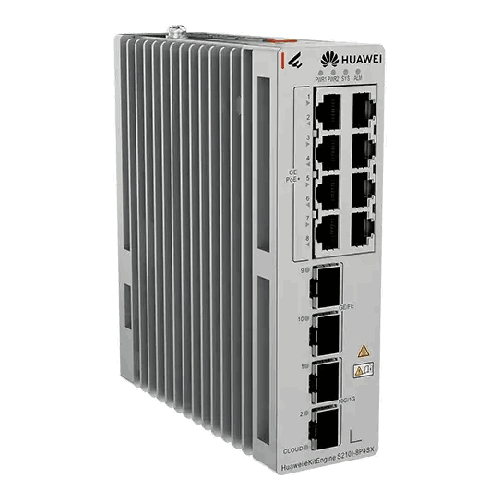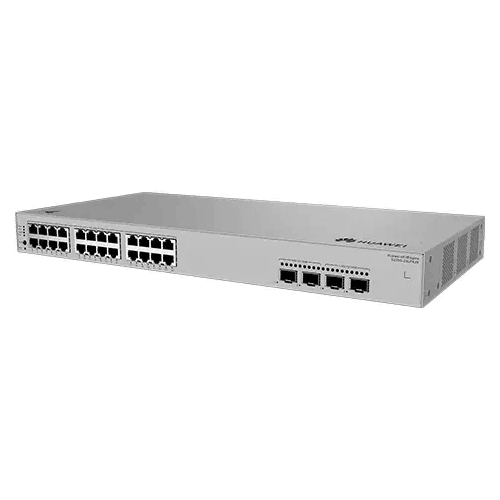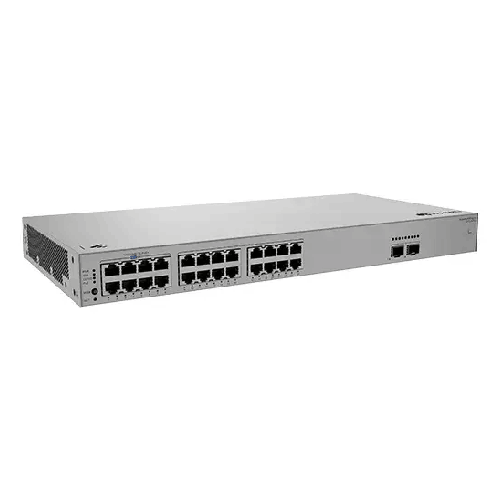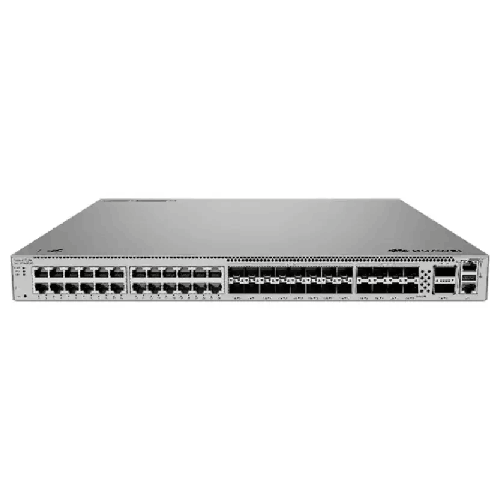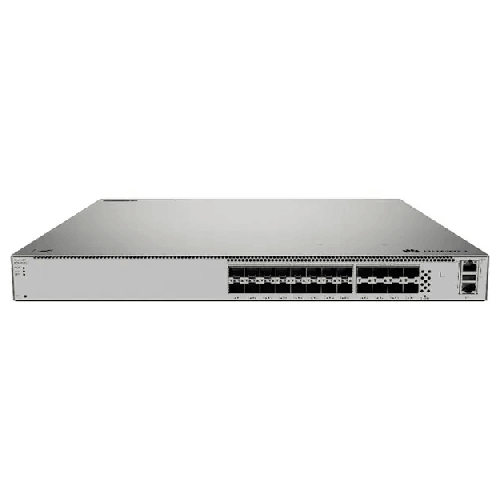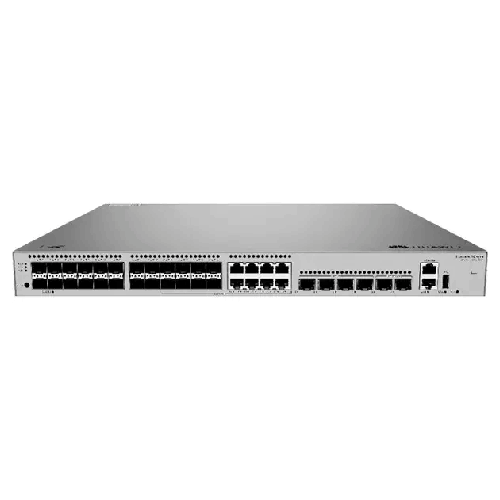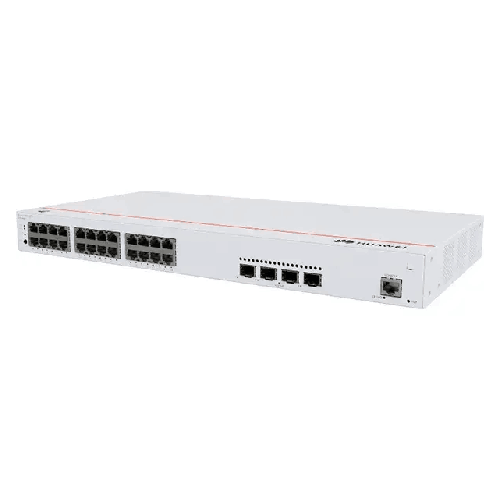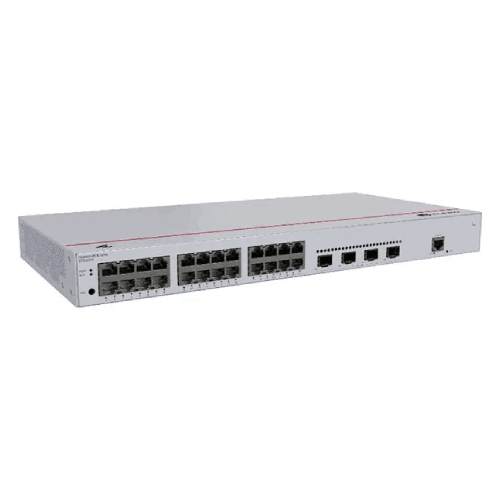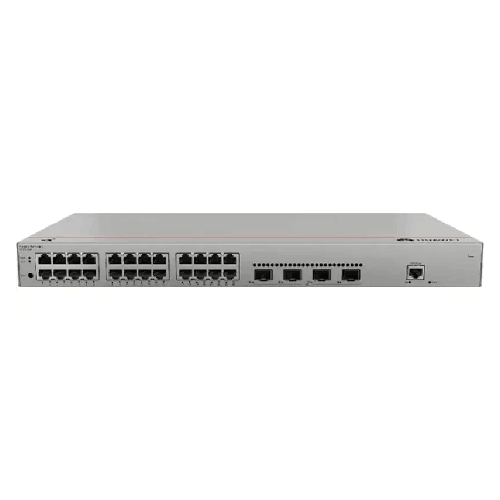
Huawei eKit S310-24T4S 24-Port & 4-Port GE SFP Managed Non-PoE Switch
Regular Price:৳0.00Availability: SKU: 6.54.130.9156
Quick Overview
-
Support
Saturday – Thursday: 09 AM - 06 PM. -
Payment
Cash on Delivery | Card | Online Payment -
Shipping Cost
Inside Dhaka 100tk | Outside Dhaka 150tk -
Warranty Policy
Read More
Description
Huawei eKit S310-24T4S 24-Port & 4-Port GE SFP Managed Non-PoE Switch Price in Bangladesh
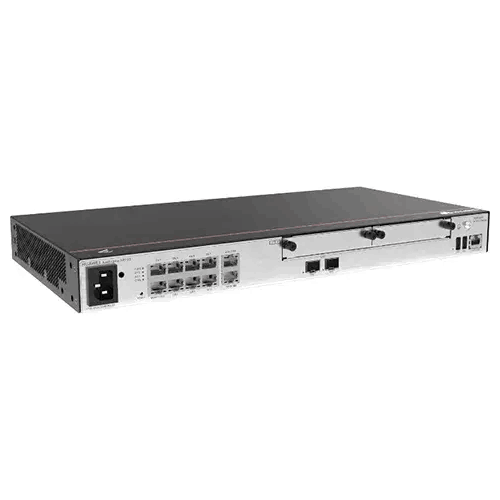
The Huawei eKit S310-24T4S 24-Port Gigabit Managed Non-PoE Switch is a business-focused networking solution designed for organizations that need reliable Gigabit Ethernet connectivity, flexible fiber uplinks, and centralized network management without integrated Power over Ethernet. The model combines 24 × 10/100/1000BASE-T Ethernet ports with 4 × GE SFP ports, providing a practical combination of copper access connectivity and fiber-based uplink capability. Huawei officially specifies a 56 Gbps switching capacity and 42 Mpps packet-forwarding performance for this model.
For offices, educational institutions, retail environments, professional service organizations, surveillance-network infrastructures, and other small and medium-sized business environments in Bangladesh, this port arrangement can simplify network design. The 24 copper ports can connect computers, printers, IP phones, access points, NAS devices, servers, and other Ethernet equipment, while the four GE SFP interfaces can be used with compatible optical modules for fiber connectivity between network segments or toward an aggregation layer.
The S310-24T4S is a managed non-PoE switch, which is an important distinction when selecting networking hardware. Unlike a PoE model, it does not provide Ethernet power to connected devices. This makes it suitable where connected endpoints already have their own power supplies or where PoE is intentionally not required.
24 Gigabit Ethernet Access Ports
At the access layer, the switch provides 24 × 10/100/1000BASE-T ports. These ports support Fast Ethernet and Gigabit Ethernet connectivity, allowing compatible network devices to operate according to their supported Ethernet speed.
For a typical office deployment, these ports can accommodate desktop computers, network printers, storage devices, IP-based equipment, wireless infrastructure, and other standard Ethernet endpoints. Having 24 copper interfaces in a single rack-mount chassis also helps consolidate multiple connections into a structured network cabinet.
The Gigabit Ethernet capability is particularly relevant for modern business environments where transferring files, accessing shared storage, using cloud applications, communicating with servers, and handling network-based services require more than basic Fast Ethernet performance.
Four GE SFP Ports for Fiber Connectivity
One of the key characteristics of the Huawei eKit S310-24T4S is its 4 × GE SFP port configuration. Huawei lists these ports as Gigabit Ethernet SFP interfaces.
SFP connectivity gives network administrators additional flexibility when designing uplinks. With compatible Gigabit optical transceivers and appropriate fiber infrastructure, these interfaces can connect the switch to another network switch or network segment over fiber.
This is useful when the distance, electrical environment, or physical layout makes fiber preferable to copper. For example, a business may place access switches on different floors and use fiber-based links to connect them back to a central network location.
The actual optical distance and fiber type depend on the SFP transceiver and optical infrastructure selected. Therefore, an SFP module should always be matched with the required fiber type, wavelength, connector, and transmission distance before deployment.
56 Gbps Switching Capacity
Huawei specifies a 56 Gbps switching capacity for the S310-24T4S.
Switching capacity represents the internal switching bandwidth available to the switch. In practical terms, this provides the internal bandwidth required to handle traffic across its Gigabit Ethernet and SFP interfaces within the device's supported architecture.
For a business network, this makes the switch appropriate for environments where numerous users and network devices communicate simultaneously. It can serve as an access switch in an office or as part of a larger structured LAN.
42 Mpps Packet Forwarding Performance
The S310-24T4S is specified with 42 Mpps packet-forwarding performance.
Packet-forwarding performance describes how quickly the switching system can process packets. Alongside the 56 Gbps switching capacity, this specification helps describe the hardware's network-processing capability.
Actual application performance, however, depends on many factors, including traffic patterns, packet sizes, network topology, connected devices, uplink configuration, and enabled features. Therefore, the 42 Mpps figure should be treated as a manufacturer-specified hardware performance specification rather than a guaranteed application throughput figure for every network environment.
Layer 2+ Managed Networking
Huawei identifies the S310 series as L2+ managed switches. Huawei's product documentation lists 16K MAC entries and 4K VLANs for the S310 platform, together with Layer 3 capabilities including IPv4 static routing, PBR, and IPv6. Huawei also lists support for iStack, ERPS, and SmartLink.
This management-oriented architecture provides considerably more network-control capability than an unmanaged switch. Network administrators can build structured LANs with segmentation and appropriate switching policies instead of simply connecting devices to a flat Ethernet network.
VLAN capability can be useful when separating departments, services, or classes of network traffic logically. For example, an organization could structure separate network segments for employees, guests, administration, and selected infrastructure services, subject to the network design and configuration requirements.
IPv4 Static Routing and IPv6 Support
The S310 platform documentation identifies IPv4 static routing and IPv6 among its Layer 3 capabilities.
Static routing can be useful in network architectures where predictable routes between defined network segments are required. It can reduce the need to depend entirely on a separate routing device for every simple inter-network routing requirement.
IPv6 support is also relevant for organizations planning or maintaining modern IP networks. However, the precise routing architecture should be designed according to the organization's addressing plan and the capabilities of the other network devices.
Network Resilience and Management Features
Huawei lists iStack, ERPS, and SmartLink among supported S310 platform capabilities.
These features are relevant when the switch forms part of a structured network requiring additional resiliency and network-management mechanisms. Their usefulness depends on the topology and configuration of the overall network rather than simply being enabled automatically.
The S310 series also supports both cloud management and on-premise management modes, according to Huawei's official datasheet. Huawei states that these management modes can be switched according to requirements.
For organizations with multiple network devices, management flexibility can make deployment and ongoing administration more practical.
Non-PoE Architecture
The Huawei S310-24T4S is a non-PoE model. This is important when comparing it with models such as the S310-24P4S.
Huawei lists the S310-24P4S separately with a 400 W PoE power capability, while the S310-24T4S is specified without PoE power.
A non-PoE switch is appropriate when connected devices are powered independently. This can be advantageous in installations where PoE is unnecessary and the network designer wants a straightforward Gigabit switching platform with fiber uplink options.
If your project requires power delivery to wireless access points, IP cameras, VoIP phones, or other PoE devices through Ethernet cables, a PoE-capable switch should be selected instead.
1U Rack-Mount Form Factor
Huawei specifies chassis dimensions of 43.6 mm × 442 mm × 220 mm (H × W × D) and a 1U chassis height for the S310-24T4S.
The 1U form factor is well suited to structured network cabinets and server racks. A rack-mounted switch can help keep Ethernet connections organized while leaving additional rack space for patch panels, UPS equipment, servers, storage, firewalls, and other infrastructure.
The full-configuration weight including packaging materials is specified by Huawei as 3.44 kg.
Built-In AC Power Module
The S310-24T4S uses a built-in AC power module. Huawei specifies a rated voltage range of 100 V AC to 240 V AC at 50/60 Hz. The datasheet also lists an AC input maximum voltage range of 90 V AC to 290 V AC at 45–65 Hz.
This broad rated input range is relevant to deployment planning because the switch is designed for standard AC-powered network infrastructure. As with all rack-mounted networking equipment, appropriate electrical protection, grounding, and installation practices should be followed.
Cooling and Operating Environment
Huawei specifies air cooling with intelligent fan-speed adjustment for the S310-24T4S.
The manufacturer's long-term operating temperature specification is −5°C to +50°C at altitudes from 0 to 1800 m. Huawei notes that for altitudes between 1800 m and 5000 m, the allowable operating temperature decreases by 1°C for every additional 220 m. Storage temperature is specified as −40°C to +70°C, with relative humidity of 5% to 95% non-condensing.
For a Bangladesh installation, proper rack ventilation remains important, particularly in server rooms where multiple active networking and computing devices generate heat.
Practical Networking for Bangladesh Businesses
In Bangladesh, the S310-24T4S can be considered for office LANs, educational facilities, retail networks, branch offices, corporate floors, professional service organizations, and other structured Ethernet deployments where Gigabit access and fiber uplinks are required.
For example, an office could use the 24 copper ports for employee workstations and network printers while reserving the SFP ports for fiber uplinks to another floor, a central aggregation switch, or another network segment.
A school or training center could similarly use the copper ports for computer labs and administrative devices while using fiber uplinks as part of a campus network architecture.
The switch can also be incorporated into a larger business network where access-layer connectivity, VLAN segmentation, Layer 3 static routing, and centralized management are part of the design.
A Flexible Choice for Structured Network Expansion
A major advantage of the S310-24T4S configuration is the balance between copper access ports and optical uplinks. The 24 Gigabit RJ45 interfaces provide broad endpoint connectivity, while the four GE SFP ports allow the network to extend beyond simple copper-only installations.
This becomes increasingly useful as organizations expand into multiple rooms, floors, buildings, or network zones. Instead of treating every connection as an isolated cable run, administrators can build a structured topology with dedicated uplinks between switching layers.
Because SFP interfaces depend on compatible transceivers, buyers should determine the required optical specifications before purchasing modules. The switch itself provides the SFP interfaces, but the complete optical link also depends on the selected transceiver and fiber infrastructure.
✅ Key Features
- 24 × 10/100/1000BASE-T Ports: Provides 24 Gigabit-capable copper Ethernet interfaces for computers, printers, servers, access points, and other compatible network devices.
- 4 × GE SFP Ports: Provides four Gigabit Ethernet SFP interfaces for compatible fiber-based network uplinks.
- 56 Gbps Switching Capacity: Provides substantial internal switching bandwidth for business LAN traffic.
- 42 Mpps Forwarding Performance: Manufacturer-specified packet-forwarding capability for the switch platform.
- L2+ Managed Architecture: Supports structured Layer 2 networking with additional Layer 3 capabilities.
- 16K MAC Entries: Provides a substantial MAC address table capacity for managed network environments.
- 4K VLANs: Supports extensive VLAN-based network segmentation.
- IPv4 Static Routing and IPv6: Adds Layer 3 functionality for suitable network designs.
- iStack, ERPS and SmartLink Support: Provides additional networking capabilities for suitable resilient network architectures.
- Cloud and On-Premise Management: The S310 series supports both management approaches, with the ability to switch between them as required.
- 1U Rack-Mount Chassis: Fits standard rack-oriented infrastructure with a 43.6 mm chassis height.
- Built-In AC Power: Uses an integrated AC power module with a rated input of 100–240 V AC, 50/60 Hz.
✅ Usage / Applications
- Corporate Office Networks: Connect employee computers, printers, network storage, and other Ethernet devices.
- SME Networks: Build a structured Gigabit LAN for small and medium-sized organizations.
- Branch Offices: Provide managed Ethernet connectivity with optical uplink options.
- Educational Institutions: Connect computer labs, administrative systems, and network infrastructure.
- Retail Networks: Support POS systems, computers, printers, and other Ethernet-enabled devices.
- Professional Service Offices: Provide centralized connectivity for workstations and shared network resources.
- Multi-Floor Buildings: Use the SFP interfaces for suitable fiber-based inter-floor uplinks.
- Server Room Access Networks: Provide Gigabit connectivity for selected network-connected equipment.
- Structured LAN Infrastructure: Use VLANs and managed switching features where network segmentation is required.
- Fiber-Linked Network Segments: Connect copper access networks to suitable optical infrastructure.
✅ Benefits of This Product?
- High Port Density: 24 Gigabit Ethernet ports allow many wired devices to be consolidated into one 1U switching platform.
- Fiber Uplink Flexibility: Four GE SFP ports provide options for compatible fiber-based uplinks.
- Managed Network Control: The L2+ architecture provides considerably more configuration capability than a basic unmanaged switch.
- VLAN-Based Segmentation: Support for up to 4K VLANs helps organizations design logically separated network environments.
- Layer 3 Capability: IPv4 static routing and IPv6 support can simplify selected network architectures.
- Rack-Friendly Design: The 1U chassis fits standard rack-based infrastructure.
- Non-PoE Simplicity: Suitable for networks where connected equipment has independent power.
- Management Flexibility: Huawei documents both cloud and on-premise management modes for the S310 series.
- Business-Oriented Design: The S310 platform is positioned by Huawei as an SME network switching solution.
✅ Ideal For
The Huawei eKit S310-24T4S is suitable for organizations that need a managed Gigabit Ethernet switch with both copper access connectivity and fiber uplink capability. It is particularly relevant for offices, SMEs, educational facilities, retail environments, branch networks, and structured business LANs where 24 Gigabit copper ports provide sufficient endpoint density.
It is also appropriate for network designs that require VLAN segmentation, IPv4 static routing, IPv6 capability, and additional network-management features.
Because this is a non-PoE model, it is better suited to deployments where network-connected devices receive power separately. Organizations planning to power IP cameras, wireless access points, VoIP phones, or other PoE endpoints directly through Ethernet should instead evaluate a PoE-equipped model.
The four GE SFP ports make the S310-24T4S particularly useful when a network needs compatible fiber uplinks alongside standard copper Ethernet connections. Before deployment, administrators should confirm the required SFP transceiver type, fiber infrastructure, rack space, power arrangement, and network topology.
✅ Why Choose the Huawei eKit S310-24T4S 24-Port & 4-Port GE SFP Managed Non-PoE Switch?
The Huawei eKit S310-24T4S combines a practical 24-port Gigabit Ethernet access configuration with four GE SFP interfaces in a 1U chassis. This combination allows organizations to build a copper-based access layer while retaining dedicated interfaces for compatible fiber connections. Huawei specifies 56 Gbps switching capacity and 42 Mpps forwarding performance for the model.
Its managed L2+ architecture also provides capabilities beyond simple Ethernet switching. Huawei documents 16K MAC entries, 4K VLANs, IPv4 static routing, IPv6, iStack, ERPS, and SmartLink across the S310 platform.
Another important consideration is the distinction between this model and its PoE counterpart. The S310-24T4S is designed as a non-PoE switch, while Huawei separately lists the S310-24P4S with 400 W PoE capability.
For buyers who do not require Ethernet-based power delivery, the non-PoE architecture can align more closely with the actual network requirement. Meanwhile, the four SFP ports provide additional flexibility for fiber-connected network segments.
The switch's 1U form factor, built-in AC power module, air cooling with intelligent fan-speed adjustment, and support for both cloud and on-premise management make it suitable for structured network infrastructure where centralized administration and physical rack organization matter.
✅ Why Buy This Product from BME?
When purchasing professional networking equipment in Bangladesh, selecting the correct model is only one part of the procurement process. Port type, PoE requirement, SFP compatibility, switching capacity, network architecture, rack dimensions, and deployment requirements should all be considered before finalizing an order.
BME can be used as a sourcing point for buyers looking for the Huawei eKit S310-24T4S managed switch in Bangladesh, particularly when the requirement calls for a business-oriented Gigabit switch with fiber uplink interfaces.
For organizations purchasing networking hardware for offices, branches, institutions, or larger projects, providing the exact model number during inquiry helps reduce confusion between visually similar Huawei switch variants. This is particularly important because the S310 family contains both PoE and non-PoE versions as well as models with different SFP and SFP+ configurations. Huawei's documentation confirms these model-level differences.
Before purchasing, buyers should confirm the required quantity, copper-port count, uplink type, PoE requirement, SFP module requirements, rack installation requirements, and intended network topology.
For B2B procurement, the exact product model should be included in quotations, purchase orders, and technical documentation so that the requested configuration remains clear throughout the purchasing process.
✅ Buying Guide
1. Confirm the Port Requirement:
Determine whether you need 24 copper Gigabit ports. The S310-24T4S provides 24 × 10/100/1000BASE-T interfaces.
2. Check Your Uplink Requirement:
This model has four GE SFP ports, not 10GE SFP+ ports. If your network requires 10 Gigabit optical uplinks, a different model should be evaluated.
3. Decide Whether PoE Is Required:
The S310-24T4S is non-PoE. If devices need to receive power through Ethernet, select an appropriate PoE switch instead.
4. Review Switching Performance:
The official specification lists 56 Gbps switching capacity and 42 Mpps packet forwarding.
5. Plan VLAN Requirements:
If your network requires segmentation, review the VLAN architecture and confirm how VLANs will be configured across the wider network.
6. Plan Fiber Connectivity:
Select compatible SFP transceivers according to fiber type, wavelength, connector, and required transmission distance. Do not select an SFP module solely by physical appearance.
7. Check Rack Space:
The switch has a 1U chassis with dimensions of 43.6 mm × 442 mm × 220 mm. Confirm available rack or cabinet space before installation.
8. Check Power Requirements:
Huawei specifies a built-in AC power module with a rated input of 100–240 V AC, 50/60 Hz.
9. Consider Cooling:
The switch uses air cooling with intelligent fan-speed adjustment. Maintain adequate airflow around the equipment when installing it in a rack.
10. Match the Switch to the Network Architecture:
For larger networks, consider how the S310-24T4S will interact with firewalls, routers, aggregation switches, wireless infrastructure, servers, and fiber uplinks.
✅ Customers Ask About / Frequently Asked Questions
Q1. Is the Huawei S310-24T4S a managed switch?
Yes. Huawei identifies the S310 platform as an L2+ managed switch.
Q2. How many Ethernet ports does the S310-24T4S have?
It has 24 × 10/100/1000BASE-T copper Ethernet ports.
Q3. How many SFP ports are included?
The switch has 4 × GE SFP ports.
Q4. Does the Huawei S310-24T4S support PoE?
No. The S310-24T4S is the non-PoE version. Huawei lists the S310-24P4S separately as a 400 W PoE model.
Q5. What is the switching capacity?
Huawei specifies a switching capacity of 56 Gbps.
Q6. What is the forwarding performance?
The official specification lists 42 Mpps packet-forwarding performance.
Q7. Does it support VLANs?
Yes. Huawei's S310 platform documentation specifies support for up to 4K VLANs.
Q8. Does it support Layer 3 functions?
Yes. Huawei documents IPv4 static routing and IPv6 capabilities for the S310 platform.
Q9. Is the S310-24T4S suitable for rack installation?
Yes. Huawei specifies a 1U chassis with dimensions of 43.6 mm × 442 mm × 220 mm.
Q10. What power input does it use?
It has a built-in AC power module and a rated input of 100–240 V AC, 50/60 Hz.
Q11. Can the SFP ports be used for fiber uplinks?
Yes. The four GE SFP interfaces are intended for compatible Gigabit Ethernet SFP connectivity. The exact optical capability depends on the selected compatible transceiver and fiber infrastructure.
Q12. Does Huawei provide cloud management for this series?
Huawei's official S310 datasheet states that the series supports both cloud management and on-premise management modes.
✅ Why Buy This Product
The Huawei eKit S310-24T4S brings together 24 Gigabit Ethernet access ports, four GE SFP interfaces, 56 Gbps switching capacity, and 42 Mpps forwarding performance in a 1U managed network switch.
Its L2+ capabilities, VLAN support, IPv4 static routing, IPv6 functionality, and additional network-management features make it suitable for structured business networks where an unmanaged switch would provide insufficient control.
For organizations that do not need PoE but do require both copper connectivity and fiber uplink flexibility, this model provides a clearly defined non-PoE configuration. It can be considered for office networks, SME infrastructure, educational facilities, branch deployments, retail environments, and other professional LAN applications.
For current availability and purchasing information in Bangladesh, use the exact model name Huawei eKit S310-24T4S when requesting a quotation or product confirmation.
What is the price of Huawei eKit S310-24T4S 24-Port & 4-Port GE SFP Managed Non-PoE Switch in Bangladesh?
Write a review
Question Answer
Have question about this product? Get specific details about this product from expert.