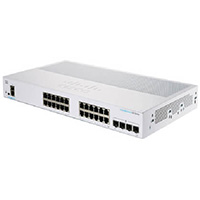
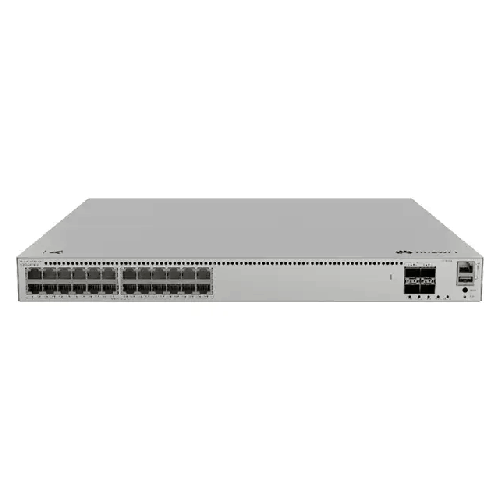
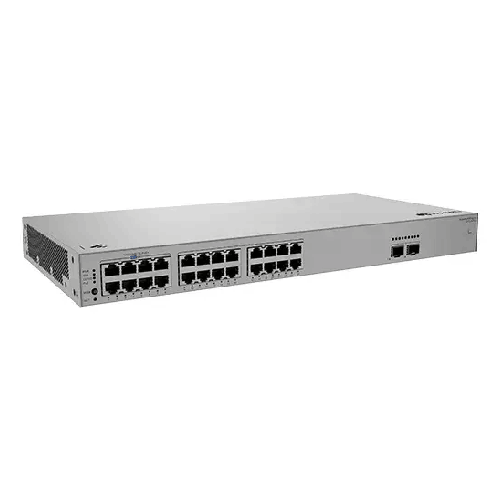
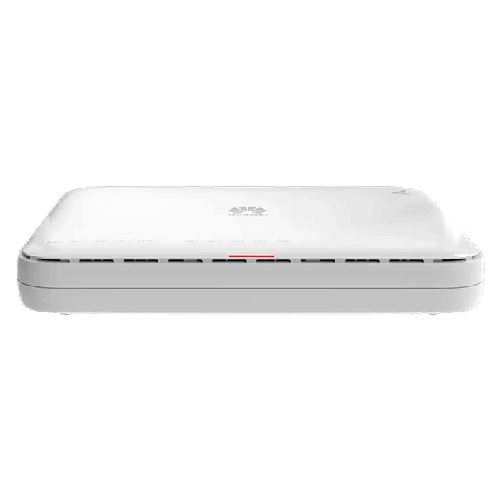
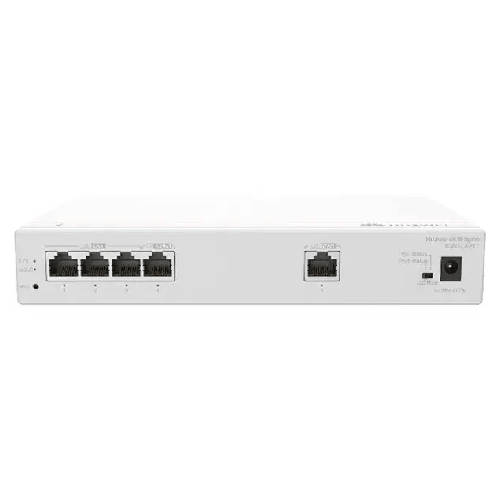
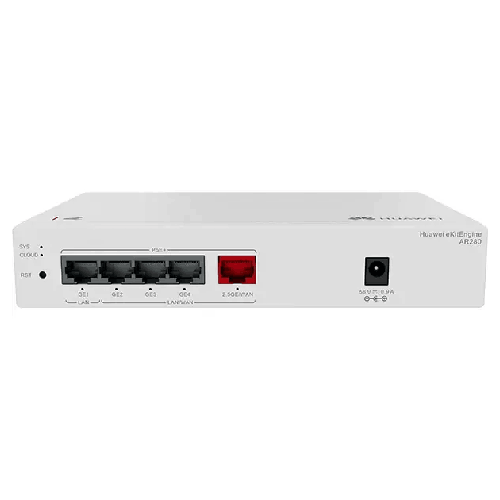
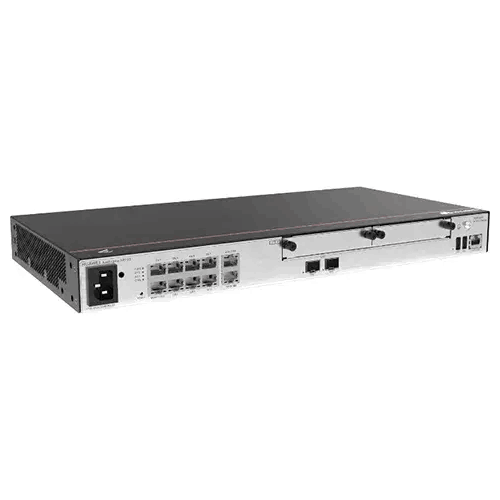
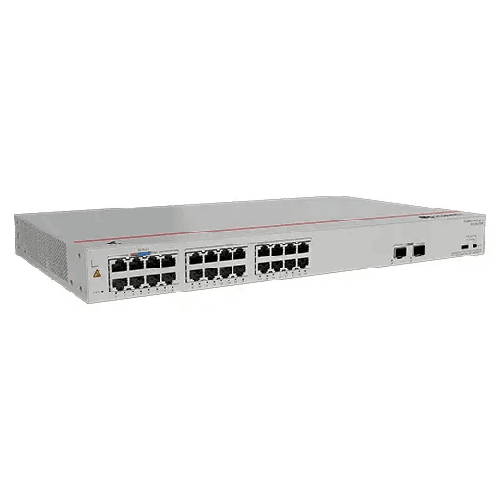
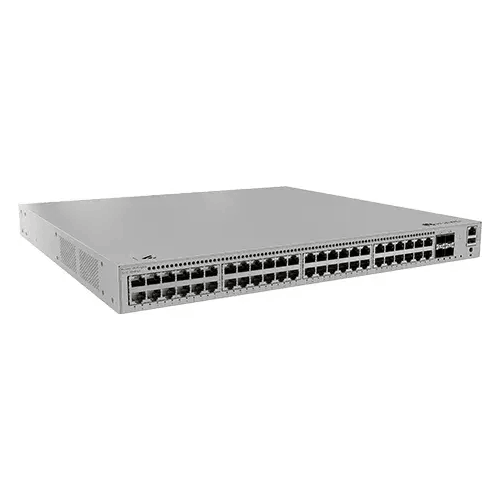
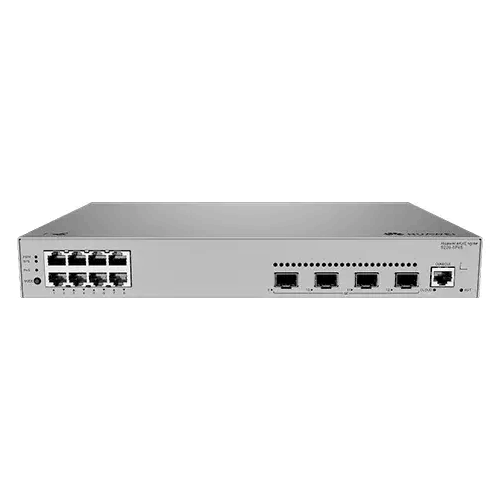
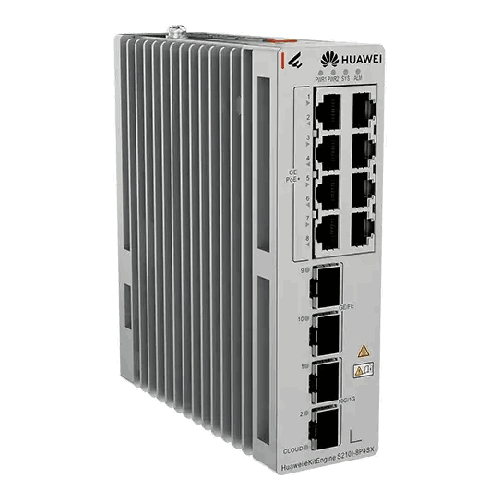
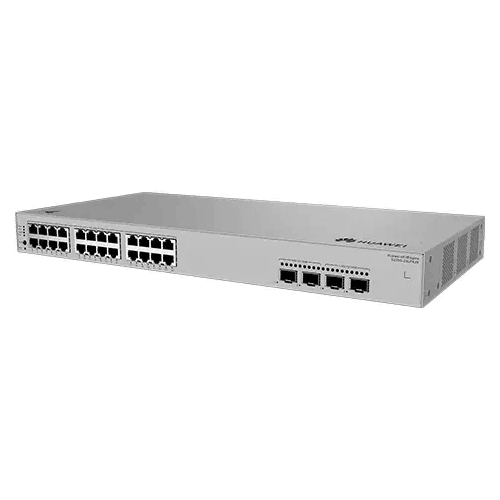
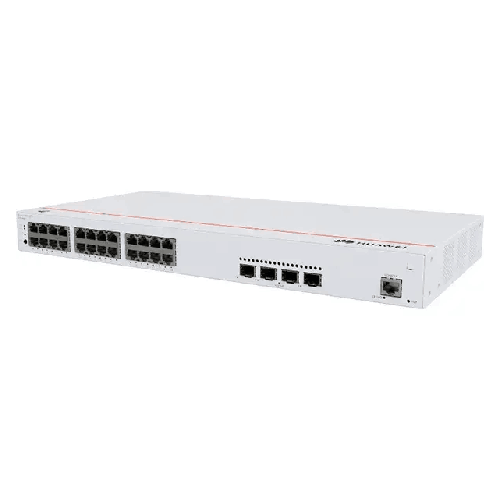
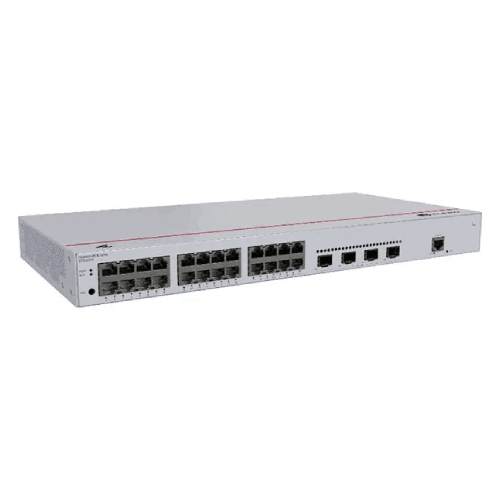
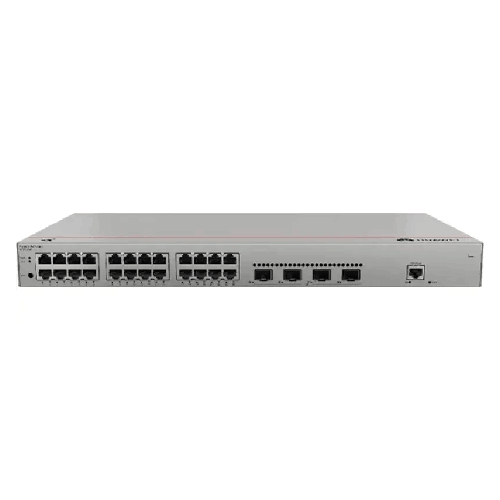
Huawei eKitEngine S210-24P2J Layer 2 Managed 24-Port PoE+ Access Switch
Regular Price:৳0.00Availability: SKU: 6.54.130.9162
Quick Overview
-
Support
Saturday – Thursday: 09 AM - 06 PM. -
Payment
Cash on Delivery | Card | Online Payment -
Shipping Cost
Inside Dhaka 100tk | Outside Dhaka 150tk -
Warranty Policy
Read More
Description
Huawei eKitEngine S210-24P2J Layer 2 Managed 24-Port PoE+ Access Switch Price in Bangladesh
The Huawei eKitEngine S210-24P2J Layer 2 Managed 24-Port PoE+ Access Switch is designed for organizations that need reliable Gigabit Ethernet connectivity together with centralized Power over Ethernet delivery. It combines 24 × 10/100/1000BASE-T PoE+ ports with 2 × 2.5GE SFP uplink ports, giving network administrators a practical access-layer platform for modern office, surveillance, wireless, hospitality, education, and smart-building deployments.
Huawei's current official product information identifies the S210-24P2J as a 24-port switch with 400W PoE+ capability, two 2.5GE SFP ports, built-in AC power, a metal chassis, and flexible rack, desktop, or wall installation.
For Bangladesh businesses, this combination is particularly useful when a network must connect a large number of powered endpoints without installing a separate power adapter for every compatible device. Wireless access points, IP cameras, VoIP phones, and other PoE-compatible network devices can receive power and network connectivity through Ethernet cabling, helping simplify physical deployment.
The S210-24P2J belongs to Huawei's eKitEngine S210 family and is positioned as a Layer 2 managed access switch. It is therefore intended for networks where administrators need more control than a basic unmanaged switch can provide. Instead of simply forwarding traffic between connected devices, a managed access switch can be integrated into a structured network design with segmentation, traffic management, access control, and other Layer 2 functions.
24 Gigabit PoE+ Access Ports
At the heart of the Huawei S210-24P2J are 24 × 10/100/1000BASE-T Ethernet ports with PoE+ support. Each port can operate at 10Mbps, 100Mbps, or 1000Mbps depending on the connected device and network requirements.
This makes the switch suitable for mixed endpoint environments where different devices may have different Ethernet capabilities. A Gigabit-capable workstation can use a higher-speed connection while a compatible IP phone, camera, or other endpoint can use the same physical infrastructure for both data and power.
Because all 24 access ports support PoE+, the switch can serve as a centralized connectivity and power platform for a considerable number of compatible devices. Huawei specifies a 400W maximum PoE power budget for the S210-24P2J.
Huawei's official product information also specifies that 24 ports can operate with a 15.4W 802.3af full-load allocation, while 13 ports can operate at a 30W 802.3at full-load allocation.
This distinction is important when planning a real installation. The number of powered devices should be calculated from their actual PoE requirements rather than simply counting the available Ethernet ports.
400W PoE+ Budget for Powered Network Devices
PoE is one of the major reasons to choose the S210-24P2J over a conventional non-PoE access switch. Instead of running separate electrical adapters to each supported endpoint, compatible devices can receive power through their Ethernet connection.
The 400W PoE budget provides substantial capacity for access-layer deployments involving multiple powered endpoints.
For example, a business can use the switch to connect PoE-capable wireless access points throughout an office, IP cameras around a facility, or network-enabled phones across different departments. The exact number of devices that can be powered simultaneously depends on the individual power consumption of those devices.
This makes proper PoE planning important. A network administrator should calculate the combined expected consumption of all powered endpoints and keep appropriate headroom rather than designing exactly at the theoretical maximum.
2.5GE SFP Uplink Connectivity
The Huawei S210-24P2J includes 2 × 2.5G/1G/100M SFP ports according to Huawei's current product specifications.
These uplink interfaces provide additional flexibility when connecting the access switch to an upstream aggregation, distribution, or core networking device. Compared with a standard Gigabit-only uplink, 2.5GE capability can provide additional bandwidth for suitable network architectures.
The SFP format also gives network designers more flexibility in choosing compatible optical or network connectivity according to the deployment environment. The exact transceiver, cable, and distance requirements should always be checked against the corresponding Huawei compatibility information and the requirements of the connected equipment.
For networks with multiple high-bandwidth endpoints, uplink planning is especially important. Even when individual access ports operate at Gigabit Ethernet speeds, the overall traffic pattern should be considered before selecting the upstream interface.
Layer 2 Managed Networking
The S210-24P2J is a Layer 2 managed switch, making it appropriate for structured business networks where administrators need greater visibility and control over Ethernet connectivity.
Huawei's S210-series documentation describes features including VLAN support, STP/RSTP, ERPS, port isolation, traffic controls, and security-related functions. Huawei also describes the S210 series as supporting full line-rate forwarding and port isolation for access environments.
For an organization, Layer 2 management can help separate different groups of network traffic. For example, a network administrator may design separate logical segments for office computers, surveillance equipment, voice devices, guest connectivity, or wireless access infrastructure, depending on the overall network architecture.
VLAN planning should always match the configuration of the upstream network equipment. The S210-24P2J should therefore be viewed as part of a complete network rather than as an isolated device.
Switching Performance
Huawei's official S210-series brochure lists the S210-24P2J with 396Gbps switching capacity and 92Mpps packet forwarding rate.
These figures describe the switching platform's ability to handle Ethernet traffic and are relevant when evaluating the switch for a multi-device access environment.
Huawei also describes the S210 series as supporting full line-rate forwarding, allowing its Ethernet ports to forward traffic without requiring the network to operate as a simple low-throughput access platform.
For purchasing decisions, however, switching capacity should not be considered in isolation. Uplink bandwidth, PoE demand, VLAN architecture, connected-device traffic patterns, and the capabilities of the upstream switch should all be evaluated together.
Flexible Installation for Business Environments
The Huawei S210-24P2J is designed as a 1U network switch with flexible installation options. Huawei specifies rack mounting, desk mounting, and wall mounting.
This is useful for Bangladesh businesses where network equipment may need to be installed in different types of environments. A rack installation can be appropriate for a structured server or network room, while wall or desktop mounting may be more convenient in smaller offices or distributed access locations.
The basic dimensions are approximately 43.6 × 442 × 220mm, with a maximum depth of approximately 227mm depending on protruding components. The device weighs approximately 2.88kg without packaging.
Before installation, sufficient ventilation clearance and cable access should be provided. The switch should also be mounted securely according to the selected installation method.
Built-In AC Power Supply
The S210-24P2J uses a built-in AC power supply, helping keep the installation compact compared with designs that rely on an external power adapter.
Huawei specifies a rated AC input of 100V to 240V at 50/60Hz, with a broader AC input range of 90V to 290V and high-voltage DC input support of 190V to 290V in its current product information.
For a Bangladesh installation, electrical infrastructure should still be checked by the installer before deployment. The switch should be connected to an appropriate electrical circuit and protected according to the requirements of the installation.
Intelligent Cooling and Thermal Management
The S210-24P2J uses built-in fans and air cooling. Huawei specifies two fan modules and an airflow arrangement that takes air from the left and front and exhausts it toward the right.
This airflow arrangement should be considered when positioning the switch in a rack, cabinet, or enclosed network area. Blocking the ventilation openings can affect thermal performance.
Huawei lists long-term operating temperatures of –5°C to +45°C at altitudes from 0 to 1800 meters, along with a long-term relative humidity range of 5% to 95% non-condensing.
For Bangladesh installations, keeping the network environment reasonably ventilated is particularly important in warm conditions and in rooms containing multiple active networking devices.
Metal Chassis and 1U Form Factor
The S210-24P2J features a metal chassis and a 1U-height design.
A compact 1U form factor helps organizations integrate the switch into standard network racks while maintaining a relatively short chassis depth compared with many larger enterprise switches.
Its physical design is well suited to access-layer deployment, where the switch may be positioned close to connected endpoints while still being integrated into a centralized rack-based network architecture.
Practical PoE Applications
One of the strongest practical applications of the Huawei S210-24P2J is network infrastructure that includes several powered Ethernet devices.
For an office, the switch can provide connectivity for computers and network peripherals while simultaneously supporting PoE-enabled phones or wireless access points.
For surveillance installations, compatible IP cameras can use the Ethernet cable for both data and power, reducing the need for separate power adapters at each camera location.
For wireless deployments, PoE-capable access points can be connected to the switch and positioned where wireless coverage is needed without requiring a separate local power adapter at every access point.
For hotels, Huawei itself lists the S210-24P2J as an access-switch model in an example intelligent hotel solution configuration.
Useful for Offices, Education, Hotels and Smart Buildings
The S210-24P2J can be considered for many structured access-layer environments.
In an office, it can connect employee devices, wireless infrastructure, IP phones, printers, and other Ethernet endpoints.
In educational facilities, it can support wired access and compatible PoE infrastructure across classrooms, administrative areas, and other network locations.
In hotels, PoE networking can simplify the deployment of wireless access points, IP surveillance, and other connected systems.
In smart-building deployments, centralized Ethernet connectivity can help connect different categories of network-enabled devices while allowing administrators to organize traffic according to the network design.
The appropriate model should always be selected after considering the required port count, uplink capacity, PoE budget, management features, and network architecture.
✅ Key Features
- 24 × Gigabit PoE+ Ports: Provides 24 × 10/100/1000BASE-T PoE+ access interfaces for compatible network endpoints.
- 400W PoE Budget: Provides up to 400W of total PoE power for supported connected devices.
- 2 × 2.5GE SFP Uplinks: Supports 2.5G/1G/100M SFP connectivity for flexible upstream networking.
- Layer 2 Managed Switching: Designed for managed access-layer network deployments with greater configuration and control than an unmanaged switch.
- 396Gbps Switching Capacity: Huawei's official S210-series brochure lists 396Gbps switching capacity for this model.
- 92Mpps Forwarding Rate: Huawei's official S210-series brochure lists a 92Mpps packet forwarding rate.
- Built-In AC Power: Integrates the AC power supply into the switch chassis for a practical installation.
- Flexible Installation: Supports rack, desktop, and wall mounting.
- Metal Chassis: Provides a durable physical enclosure suitable for structured network deployment.
- Intelligent Fan Cooling: Uses two built-in fan modules with controlled airflow for thermal management.
- PoE+ Device Support: Huawei specifies 802.3af/802.3at power allocation characteristics for the PoE ports.
- Network Protection Features: The S210 series supports functions such as port isolation and attack-related protection mechanisms.
✅ Usage / Applications
- Business Offices: Connect computers, IP phones, wireless access points, and other Ethernet devices.
- IP Surveillance: Provide network connectivity and PoE power to compatible IP cameras.
- Wi-Fi Infrastructure: Power compatible access points through Ethernet cabling.
- Hotels: Build access-layer networks for guest areas and connected hotel systems.
- Educational Institutions: Support classroom, administrative, and campus access networking.
- Smart Buildings: Connect network-enabled building infrastructure and access devices.
- Retail Stores: Support POS-related networking, surveillance, wireless access, and connected devices.
- SME Networks: Provide managed Gigabit connectivity with centralized PoE delivery.
- VoIP Deployments: Connect compatible PoE-powered IP telephones.
- Distributed Network Access: Use rack, wall, or desktop installation according to site requirements.
✅ Benefits of This Product?
- Centralized Network Connectivity: Connects up to 24 Gigabit Ethernet access devices through one managed switch.
- Centralized PoE Power: Reduces the need for individual power adapters for compatible PoE devices.
- High PoE Capacity: The 400W budget provides substantial power capacity for multi-device installations.
- Flexible Uplinks: Two 2.5GE SFP ports provide higher-speed uplink possibilities compared with basic Gigabit-only SFP interfaces.
- Managed Network Control: Provides a more structured platform for organizations requiring configurable Layer 2 networking.
- Flexible Physical Deployment: Rack, wall, and desktop installation options simplify deployment across different locations.
- Compact 1U Design: Fits standard rack environments while maintaining a relatively compact chassis.
- Broad Business Use: Suitable for office, hospitality, surveillance, education, wireless, and smart-building access networks.
- Professional Network Platform: Designed as part of Huawei's eKitEngine networking portfolio.
✅ Ideal For
The Huawei eKitEngine S210-24P2J is ideal for organizations that require a combination of Gigabit Ethernet access, PoE+ power delivery, and Layer 2 network management in one device. Its 24 PoE+ ports make it particularly relevant for environments with multiple powered network endpoints such as IP cameras, wireless access points, and compatible IP phones.
It is also a practical consideration for offices, hotels, educational facilities, retail locations, and other small-to-medium network deployments where centralized Ethernet connectivity can simplify infrastructure. The two 2.5GE SFP uplinks provide additional flexibility for connecting the access switch to a higher-level network.
Because the switch provides a 400W PoE budget, it can accommodate a meaningful number of PoE devices, although the actual quantity depends on the power requirements of the connected equipment.
Its rack, desktop, and wall installation options make it suitable for both centralized network rooms and distributed access locations.
✅ Why Choose the Huawei eKitEngine S210-24P2J?
The Huawei eKitEngine S210-24P2J brings together 24 Gigabit PoE+ access ports, a 400W PoE budget, and two 2.5GE SFP uplinks in a 1U Layer 2 managed switch. This combination makes it particularly useful when an organization wants to simplify both network connectivity and power delivery for compatible devices.
A major advantage is the density of PoE-capable access interfaces. Instead of deploying separate Ethernet switches and individual power arrangements for compatible endpoints, a properly planned S210-24P2J installation can centralize both functions at the access layer.
The 2.5GE SFP interfaces also give the network designer additional options when building the uplink side of the network. This can be useful when an access switch is connected to an aggregation or core layer that supports faster-than-Gigabit optical connectivity.
Huawei's official S210 documentation identifies the S210-24P2J with 396Gbps switching capacity and 92Mpps forwarding performance, while the current Huawei product page confirms its physical, PoE, power, and interface specifications.
The switch also supports flexible installation, built-in AC power, intelligent fan cooling, and a metal chassis.
For organizations planning an access network around PoE-enabled endpoints, these characteristics provide a practical combination of port density, power capacity, uplink flexibility, and managed network functionality.
✅ Why Buy This Product from BME?
Business Machine & Equipment (BME) is positioned as a Bangladesh-focused destination for business technology, networking equipment, IT infrastructure, and professional hardware. When selecting a managed PoE switch, purchasing decisions should be based not only on port count but also on the exact model, interface configuration, PoE capacity, installation requirements, and intended network architecture.
The Huawei eKitEngine S210-24P2J should be selected according to the actual requirements of your deployment. Before ordering, confirm the number and type of connected devices, their PoE power requirements, uplink requirements, rack or wall installation needs, and compatibility with the existing network infrastructure.
For business and institutional procurement, providing the exact Huawei model number—S210-24P2J—helps reduce confusion between similarly named S210-series models. This is especially important because different models in the S210 family can have different port configurations, uplink interfaces, power budgets, and physical characteristics.
BME can also be a practical starting point when comparing this switch with other Huawei eKitEngine models according to port density, PoE requirements, uplink speed, and deployment scale.
For larger projects, customers should evaluate the complete network design rather than selecting a switch solely by the number of ports. A professional network assessment can help determine whether 400W PoE capacity, two 2.5GE uplinks, and 24 Gigabit access interfaces meet the project's requirements.
✅ Buying Guide
1. Confirm the Required Port Count:
Determine how many wired endpoints need to connect to the switch. The S210-24P2J provides 24 × 10/100/1000BASE-T PoE+ ports.
2. Calculate the PoE Requirement:
Add the expected power consumption of all PoE devices. The total PoE budget is 400W.
3. Check the Powered Device Standard:
Confirm that connected equipment is compatible with the relevant PoE standards and power requirements. Huawei specifies both 802.3af and 802.3at allocation characteristics for this model.
4. Plan the Uplinks:
The switch provides two 2.5G/1G/100M SFP interfaces. Confirm that the upstream switch, transceiver, and network architecture support the intended uplink speed.
5. Plan VLAN and Network Segmentation:
If the organization needs separate networks for cameras, voice, Wi-Fi, staff devices, or guests, design the VLAN structure before installation.
6. Check Physical Installation:
The switch supports rack, desktop, and wall mounting. Ensure that the selected installation location provides sufficient physical support and ventilation.
7. Check Electrical Requirements:
Huawei specifies a 100–240V AC rated input at 50/60Hz. Verify the site's electrical installation before deployment.
8. Consider Uplink Traffic:
A switch can have many Gigabit access ports while sharing traffic toward a smaller number of uplinks. Review expected traffic patterns before finalizing the topology.
9. Allow PoE Headroom:
Do not design the PoE budget exactly at 400W if the connected devices may increase their consumption later. Maintaining reasonable headroom provides greater flexibility.
10. Match the Switch to the Network Layer:
The S210-24P2J is a Layer 2 managed access switch. Ensure that its role matches the requirements of the wider network architecture.
✅ Customers Ask About / Frequently Asked Questions
Q1. Is the Huawei S210-24P2J a managed switch?
Yes. The S210-24P2J is a Layer 2 managed access switch designed for controlled Ethernet networking.
Q2. How many Ethernet ports does the S210-24P2J have?
It has 24 × 10/100/1000BASE-T Ethernet ports, and all 24 access ports support PoE+.
Q3. What is the PoE budget of the Huawei S210-24P2J?
Huawei specifies a maximum PoE power budget of 400W.
Q4. Does the S210-24P2J support 2.5G uplinks?
Yes. It provides two SFP ports supporting 2.5G, 1G, and 100M connectivity.
Q5. Can it power IP cameras?
Yes, compatible PoE-enabled IP cameras can receive both network connectivity and power through the switch, subject to their PoE standard and power requirements.
Q6. Can it power wireless access points?
Yes, compatible PoE-powered access points can be connected to its PoE+ access ports. The total number depends on the power requirements of the access points and the 400W PoE budget.
Q7. What is the switching capacity of the S210-24P2J?
Huawei's official S210-series brochure lists 396Gbps switching capacity for this model.
Q8. What is its packet forwarding rate?
Huawei's official S210-series brochure lists a 92Mpps packet forwarding rate.
Q9. Can the switch be rack mounted?
Yes. Huawei specifies rack, desktop, and wall mounting options.
Q10. Does it have a built-in power supply?
Yes. The S210-24P2J uses a built-in AC power supply.
Q11. What is the operating temperature range?
Huawei specifies –5°C to +45°C for long-term operation at altitudes from 0 to 1800 meters.
Q12. Is the S210-24P2J suitable for a CCTV network?
It can be considered for compatible PoE IP-camera networks because it provides 24 PoE+ Gigabit access ports and a 400W PoE budget. The camera count should be calculated according to each camera's actual power and bandwidth requirements.
✅ Why Buy This Product
The Huawei eKitEngine S210-24P2J Layer 2 Managed 24-Port PoE+ Access Switch is a practical choice for organizations that need centralized Gigabit connectivity and PoE power in an access-layer network.
With 24 × 10/100/1000BASE-T PoE+ ports, a 400W PoE budget, and two 2.5GE SFP uplinks, it provides a strong combination of access connectivity and power-delivery capability.
Its managed Layer 2 architecture makes it more appropriate for structured business networks than a basic unmanaged Ethernet switch, while its flexible rack, wall, and desktop installation options simplify deployment across different environments.
For offices, hotels, schools, retail environments, surveillance networks, wireless deployments, and smart-building projects, the S210-24P2J can provide a centralized platform for compatible network endpoints.
If you are looking for a Huawei 24-port PoE+ managed switch in Bangladesh, the S210-24P2J is worth considering when its 400W PoE capacity, 2.5GE uplinks, Layer 2 feature set, and physical installation requirements match your network design.
What is the price of Huawei eKitEngine S210-24P2J Layer 2 Managed 24-Port PoE+ Access Switch in Bangladesh?
Write a review
Question Answer
Have question about this product? Get specific details about this product from expert.